Intel Raised $15 Billion for AI Chips. The Market Sold It Anyway.
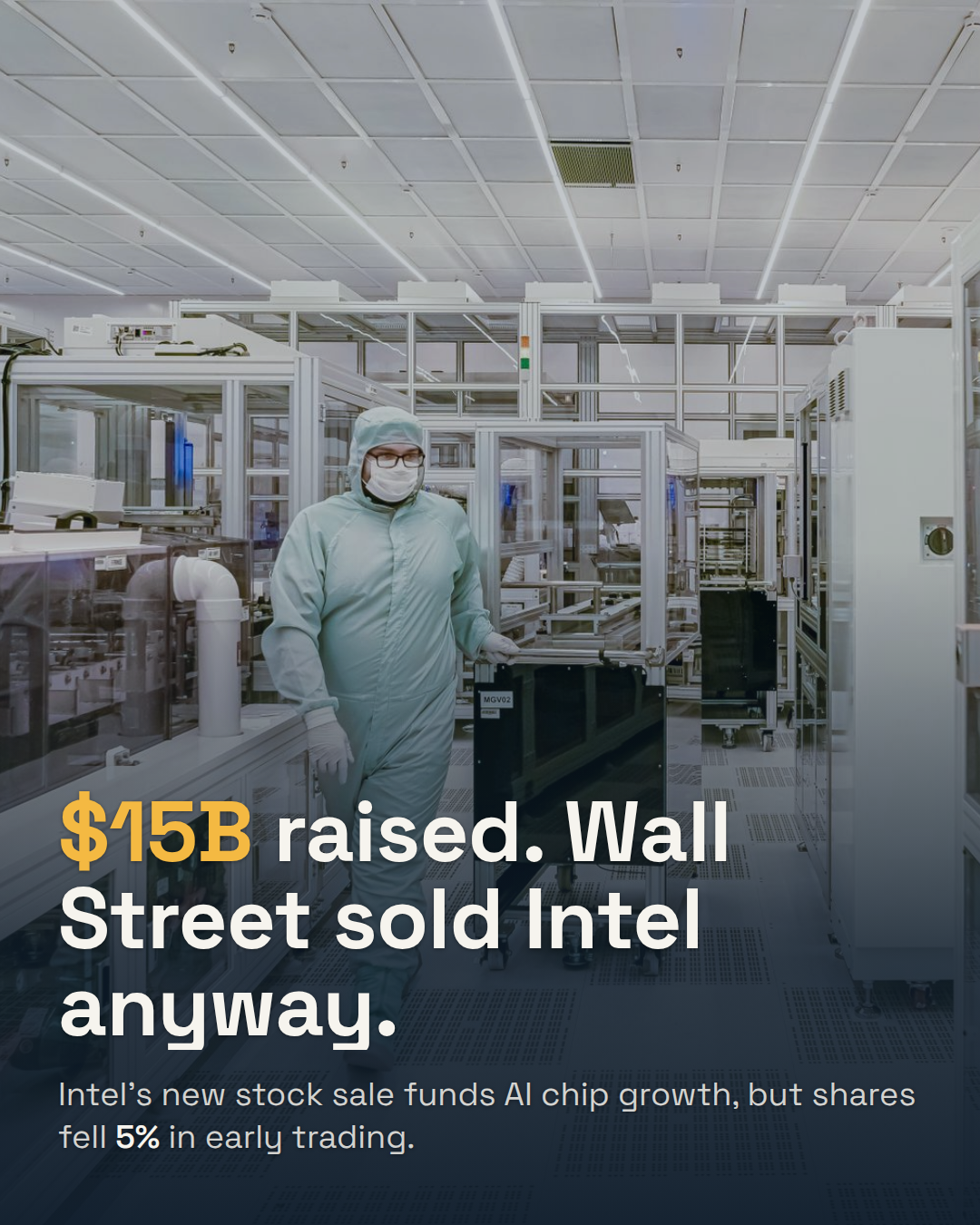
Intel launched a $15 billion share sale on August 10 to fund its AI chip and foundry buildout, and investors sent the stock down 5% despite a blockbuster 2026 rally.

Fiscedge Academy
Contributing Faculty & Practitioner
News Breakdown · FiscEdge Academy
Intel is raising $15 billion. The stock fell anyway.
On Monday, August 10, the chipmaker announced a proposed $15 billion underwritten public offering of common stock, with JPMorgan Securities, Goldman Sachs, Morgan Stanley and Citigroup Global Markets running the deal as joint book-running managers, plus a 30-day option for underwriters to buy up to $2.25 billion more. Shares dropped roughly 5%, sliding below $100 to about $97 in early trading, as investors priced in the dilution before the opening bell had even settled.
That reaction is the least interesting part of the story. Intel didn't need this money to survive. Its stock is up well over 100% in 2026 on a genuine turnaround under CEO Lip-Bu Tan. It's raising because the AI buildout has gotten so capital-intensive that even a company with two straight earnings beats, an Nvidia stake on its cap table and government backing still needs a fresh $15 billion to keep pace.
What actually happened
Intel says the proceeds go to "general corporate purposes, including capital expenditures and working capital" as it expands both its AI chip roadmap and its foundry business, the contract manufacturing arm it has spent two years rebuilding. The timing lines up with numbers Intel gave in July: 2026 capex guidance raised from $18 billion to about $20 billion, with spending expected to climb again in 2027. Server CPU demand tied to AI agents, Intel says, has already exceeded what its factories can produce.
The market's math
A 5% drop on a $15 billion raise is a straightforward dilution discount: new shares mean existing holders own a smaller slice of the company. But the sell-off has to be read against the run-up. Intel stock is up well over 100% year to date in 2026, fueled by the Nvidia investment, a preliminary Apple manufacturing agreement, government support and improving yields on its 18A chip process. Investors aren't questioning the turnaround. They're questioning the price of the next leg of it.
Why this matters if you don't own chip stocks
Every SaaS founder building on GPUs or AI APIs is a downstream customer of exactly this capex cycle. Intel raising $15 billion to build capacity is one more data point that compute supply, not compute demand, is the binding constraint in AI right now. It lands in the same pattern as Amazon's AI-linked bond sale earlier this year and a string of hyperscaler capex raises: the companies that make the picks and shovels are having to sell equity or debt at scale just to keep up with orders. That has two direct implications for anyone building on top of the stack. First, don't assume GPU and inference pricing gets materially cheaper soon, the supply side is still catching up to demand, not ahead of it. Second, capital markets are wide open for a credible AI infrastructure story: a company mid-turnaround just absorbed a $15 billion raise in a single trading session with four bulge-bracket banks lined up before the market even opened.
The signal under the headline
Two years ago, a raise this size from a chipmaker still finishing its turnaround would have read as a distress signal, not a growth move. In August 2026 it barely dents a stock still up well over 100% for the year. That is what a supercycle looks like from the inside: capital needs get bigger, not smaller, even as the underlying business gets healthier. If you're modeling out how much runway your own AI-dependent product needs, Intel's raise is a reminder that the infrastructure layer above you is still being built in real time, and it is not cheap for anyone, including the companies with the strongest balance sheets in the industry.
If you remember one thing
A capital raise is a signal about constraints, not weakness. When a company with genuinely strong numbers still needs to sell $15 billion in new stock, it's telling you where the real bottleneck in its market sits, and if your business sits downstream of that bottleneck, that's information about your own cost curve for the next 12 months, not just Intel's.
We break down capital raises like this one in FiscEdge's financial modeling course, including how to model dilution and read a cap table the way investors do. If you're building on top of the AI infrastructure stack, our startup strategy course covers how to plan around compute costs and supply constraints. For the underlying math, read what are unit economics. Browse the full blog for more daily breakdowns. Follow @fiscedge for daily Business & AI analysis.
Topics & Categorization:
How interesting did you find this article?