Intel Jumps 9% in a Day. Wall Street Just Bet on a Chip Shortage, Not a Turnaround.
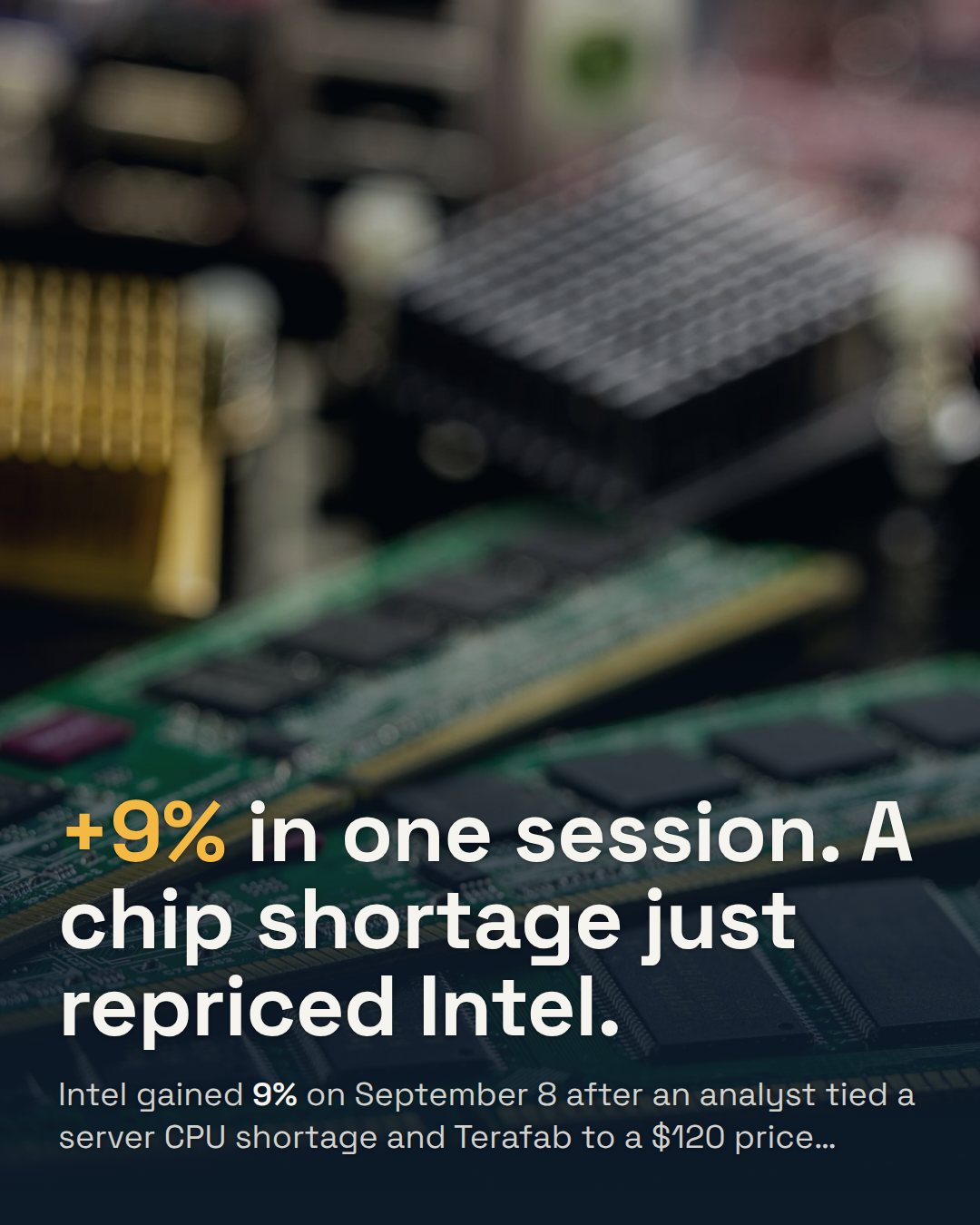
Intel shares jumped 9% on September 8 after an analyst upgrade cited a server CPU shortage and its role in Musk's Terafab chip complex, a signal compute costs are about to tighten.

Fiscedge Academy
Contributing Faculty & Practitioner
News Breakdown · FiscEdge Academy
Intel shares closed up 9% on September 8, near $104, after Northland Capital Markets analyst Gus Richard upgraded the stock from Market Perform to Outperform with a $120 price target. The move added roughly $9 to a stock that started the year under $30. The reason had nothing to do with Intel's usual turnaround narrative.
Richard's call rested on two things: a server CPU shortage that's now visibly showing up in delivery times, and Intel's role in Terafab, the Tesla and SpaceX chip complex under construction in Texas. The upgrade is the least interesting part of this story. The shortage underneath it is the part founders should actually read.
The chip shortage just widened past GPUs
For two years, "chip shortage" has meant one thing: Nvidia GPUs, rationed to the hyperscalers building frontier models. That story is now spreading sideways into ordinary server CPUs, the chips that run everything from a Stripe webhook handler to a Postgres instance. Intel and AMD are close to sold out of server processors for the rest of 2026. AMD's EPYC line is effectively booked through year-end, and Intel's own distributors are reportedly filling only about 40% of yearly backlog requests, with lead times stretching 8 to 22 weeks in the US and six to eight months in parts of Asia. That's the kind of shortage that shows up not as an outage, but as a quietly rising cloud bill six months from now, because AWS, Azure and GCP all buy the exact same processors you're renting by the hour.
Terafab is the other half of the trade
The second leg of the upgrade is Terafab, the Tesla and SpaceX-backed chip manufacturing complex going up in Grimes County, Texas, with Intel and xAI involved as partners. The project's initial phase carries a reported $16.8 billion price tag, with total build-out costs across all planned phases estimated as high as $119 billion, on a site described as more than five times the size of the world's current largest building. Musk's companies are effectively betting that owning fab capacity, not just renting Nvidia's, is the next lever in the AI compute race. For Intel, being named a manufacturing partner is a signal that its foundry business, which has burned billions in credibility over the past three years, might finally have a customer with both the balance sheet and the incentive to keep the lights on.
Whether or not Terafab ships on time, and megaprojects of this scale rarely ship on the first announced timeline, the market reaction tells you something simpler: investors are now pricing hardware supply as a business model, not a cost center. That's the same logic that has repriced Nvidia, Broadcom and CoreWeave over the past year, now showing up in a legacy chipmaker that spent the last three years being left out of the AI trade entirely.
What this actually changes if you're running a SaaS company
None of this is abstract for founders building on rented infrastructure. A server CPU shortage that's rationing supply to cloud providers eventually shows up as either slower instance availability at your preferred region, or a price increase you didn't budget for, the same pattern that hit GPU-dependent AI startups in 2024 and 2025 and is now arriving for plain compute. If your model assumes flat infrastructure costs for the next 12 to 18 months, this is the week to stress-test that assumption rather than discover it in an AWS invoice. It's also a reminder that "cloud costs" belong in your unit economics as a variable, not a rounding error, something we walk through in financial modeling: model a 15 to 25% compute cost increase into your runway the same way you'd model a hiring plan, because the underlying chip market, not your usage growth, is what's driving it.
It also changes how you should think about vendor lock-in and reserved pricing. When supply is tight, cloud providers reward customers who commit early with reserved-instance discounts precisely because they're trying to lock in their own scarce hardware allocation. Founders who've been avoiding multi-year reserved commitments to stay flexible should at least run the math now, before the discount disappears along with the supply. That's a build-vs-buy and infrastructure-planning conversation we cover in AI for entrepreneurs, and it pairs with the broader cost model in what does it cost to build a SaaS product.
If you remember one thing
A 9% pop in Intel stock is a market story. A server CPU backlog stretching past six months in parts of Asia is an operating story, and it's yours whether or not you've noticed it yet. Check your infrastructure assumptions before your cloud bill checks them for you.
We teach the infrastructure and unit-economics math behind decisions like these in FiscEdge's financial modeling and AI for entrepreneurs courses, and the full cost breakdown in what does it cost to build a SaaS product. Browse the full blog for more news breakdowns. Follow @fiscedge for daily Business & AI analysis.
Topics & Categorization:
How interesting did you find this article?