The US Lost 23,000 Jobs in July. Wall Street Rallied on the News.
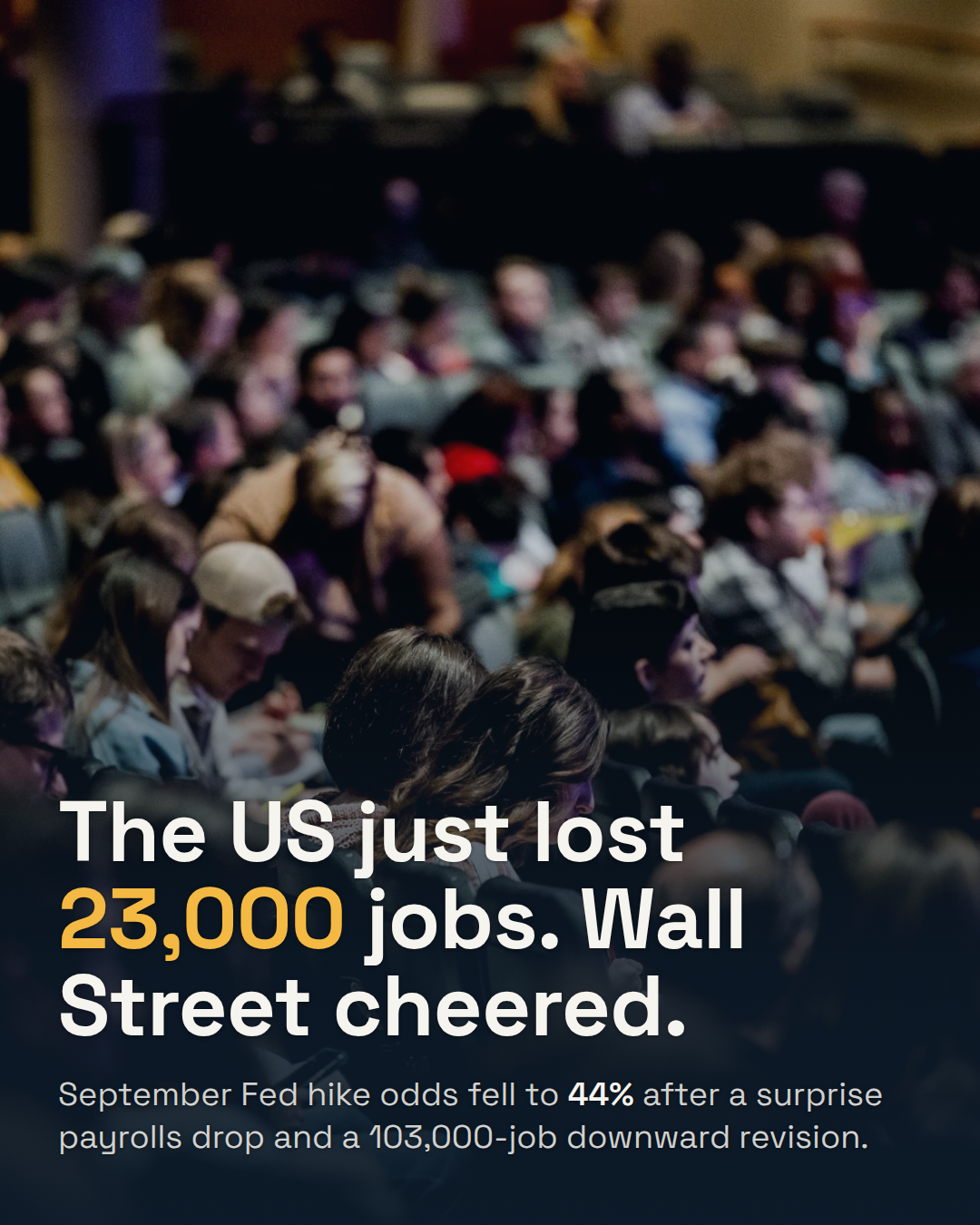
July payrolls fell 23,000 against a +83,000 forecast, and May and June were revised down a combined 103,000. Fed hike odds for September cratered to 44%, and that's the number that matters for founders raising this fall.

Fiscedge Academy
Contributing Faculty & Practitioner
News Breakdown · FiscEdge Academy
The US economy shed 23,000 jobs in July, the Bureau of Labor Statistics reported Friday, a stunning miss against the +83,000 Wall Street was expecting. The unemployment rate ticked down to 4.1%, but only because fewer people were working or looking for work, not because hiring picked up. Wage growth cooled too: average hourly earnings rose 3.2% year over year, the slowest pace since May 2021.
The report also came with a gut punch buried in the fine print. May's job gains were revised down by 66,000 (from +129,000 to +63,000), and June's were cut by 37,000 (from +57,000 to +20,000, the same June figure this desk flagged as fragile a month ago). That's 103,000 jobs that founders, recruiters and the Fed all thought existed a week ago and don't. Markets shrugged off the headline miss and rallied anyway: the Dow added 0.3%, the S&P 500 gained 0.5% and the Nasdaq jumped 1.1%, while the 10-year Treasury yield slid 5 basis points to 4.63%.
A weak jobs report making stocks go up looks backwards until you follow the signal under the headline: this was a report about the Fed, not about hiring.
The Fed's hawkish pivot just got vetoed
Going into Friday, futures markets had priced roughly a 58% chance the Federal Reserve would hike rates at its September meeting, on the back of stickier-than-expected inflation elsewhere in the economy. By Friday afternoon, CME FedWatch pricing for a September hike had collapsed to 44%, with the market instead pushing the higher-probability hike scenario out to October, where odds sat at 58.3%. In plain terms: the Fed was leaning toward tightening, and one weak print just talked it out of doing so on schedule.
That matters more than the headline jobs number for anyone raising capital. Discount rates on growth-stage financings track the risk-free rate, and every basis point the 10-year gives back makes a SaaS company's future cash flows worth more today, on paper. If you're modeling a raise for Q4, rebuild your discount-rate assumptions around a Fed that's now split, not tightening on autopilot.
Where the softness actually showed up
Government payrolls fell by 53,000, continuing a months-long contraction. Retail and leisure/hospitality both came in soft, and healthcare, usually the most reliable job-creating sector in any US downturn, grew at a slower-than-usual pace. None of that is AI-driven displacement; it's a broad, ordinary slowdown that happens to be landing in the sectors furthest from venture-backed tech. If your SaaS sells into retail operations, healthcare systems, or government agencies, budget cycles at your buyers are the thing to watch this quarter, not your own burn.
The revisions are the real story, not the headline number
A single soft month is noise. Two consecutive downward revisions totaling 103,000 jobs is a pattern, and it's the reason the Fed's rhetoric flipped in one session instead of drifting over months. For founders, the lesson isn't "the labor market is collapsing." It's that the data you're anchoring hiring and pricing decisions to today gets rewritten a month later, often in the same direction three months running. Treat any single BLS print as a hypothesis, not a fact, and build unit economics that survive being wrong about the macro backdrop for a quarter or two.
What this changes if you're building or raising right now
Two things move together here, and both work in a founder's favor for now. Hiring gets a little easier and a little cheaper: wage growth at 3.2% is the softest since 2021, which means fewer bidding wars for senior engineering and GTM hires. And if the Fed is genuinely less likely to hike in September, the cost of capital that feeds into every valuation model just got marginally cheaper, not more expensive. Neither effect is dramatic on its own, but stacked together they're a real, if narrow, window. Founders timing a raise around Fed meetings should treat September 17 (the next FOMC decision) as the date that resolves whether this window holds or closes.
If you remember one thing
A bad jobs number is not automatically bad news for your cap table. This one weakened the case for a Fed hike, pulled Treasury yields down, and made both capital and senior hires slightly cheaper in the same week, exactly the combination that makes Q4 fundraising conversations easier, not harder. Watch the revisions, not just the headline, and don't let one soft print talk you into freezing hiring or raise plans that otherwise make sense.
We teach founders how to model runway and valuation against a moving Fed in FiscEdge's financial modeling course and how to sequence a raise around macro catalysts in startup strategy. Browse the full blog for more breakdowns like this one. Follow @fiscedge for daily Business & AI analysis.
Topics & Categorization:
How interesting did you find this article?