A $3 Chinese Model Just Beat Claude and GPT at Coding. Founders Should Notice the Price, Not the Rank.
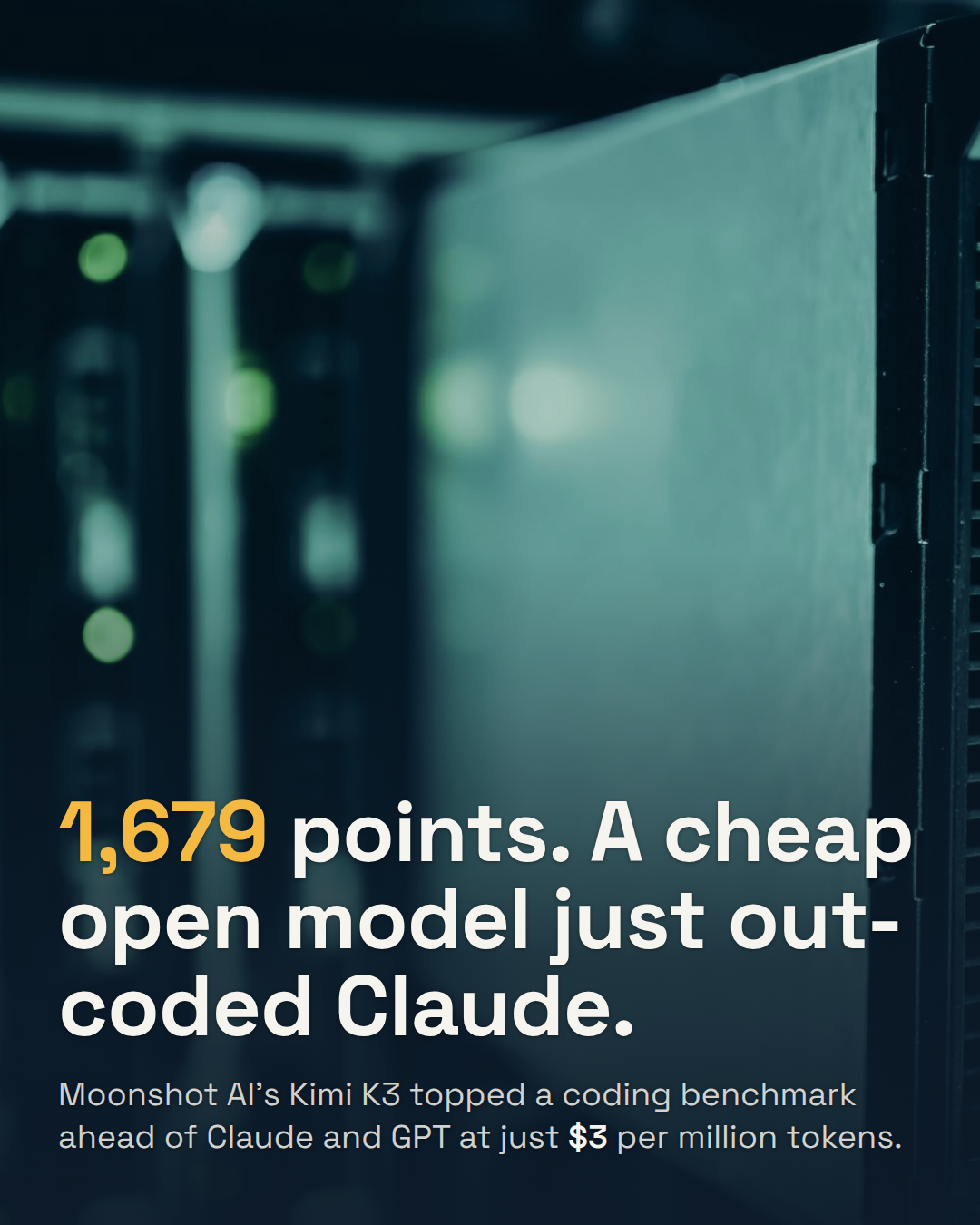
Moonshot AI's open-weight Kimi K3 topped the Frontend Code Arena benchmark on July 16, beating Claude Fable 5 and GPT-5.6 Sol, at a third of Claude's API price.
Fiscedge Academy
Contributing Faculty & Practitioner
News Breakdown · FiscEdge Academy
On July 16, Chinese lab Moonshot AI shipped Kimi K3, a 2.8 trillion-parameter open-weight model, and it immediately took the #1 spot on Arena.ai's Frontend Code Arena leaderboard with a score of 1,679, ahead of Anthropic's Claude Fable 5 (1,631) and OpenAI's GPT-5.6 Sol (1,618). That's a jump of 17 leaderboard positions from Kimi's own predecessor, K2.6, which scored 1,515 and sat 18th.
The score is the least interesting part. The signal under the headline is the price tag attached to it: Kimi K3 runs at $3 per million input tokens and $15 per million output tokens, against $10/$50 for Claude Fable 5 and $5/$30 for GPT-5.6 Sol. A model that just out-coded the two most expensive frontier systems on the market costs roughly a third as much to run, and its full weights will be publicly downloadable by July 27, meaning anyone will be able to self-host it and pay nobody per token at all.
The benchmark, in context
Kimi K3 didn't just win on the coding leaderboard, it swept 6 of 7 sub-domains inside it, including Brand & Marketing and Data & Analytics generation, where a lot of real SaaS frontend work actually lives. That's a meaningfully different result from previous Chinese open-weight releases, which tended to win on price and lose on capability. It's worth being precise about what this win covers, though: on broader general-knowledge and reasoning benchmarks, Kimi K3 lands behind the top Claude and OpenAI configurations, not ahead of them. This is a domain win in frontend and agentic coding, not a claim that Kimi K3 is the smartest model on earth. For a founder deciding what to build with, that distinction matters more than the headline rank.
The real disruption is the price, not the podium
Every few months a new model claims a leaderboard for a week and the news cycle moves on. What doesn't reset is the price floor. Kimi K3 shipping frontier-tier coding performance at $3/$15 per million tokens, with a $0.30 cache-hit rate on top of that, resets the cost baseline that every other lab now has to price against, closed labs included. If you're an AI-native SaaS founder running agents that write, review, or refactor frontend code in production, your per-task compute cost just had a credible floor cut by two-thirds, whether or not you ever touch Kimi K3 directly. Competitive pricing pressure from a viable open-weight alternative is what keeps Anthropic, OpenAI, and Google honest on rate cards, the same dynamic we cover in FiscEdge's AI for entrepreneurs course when we talk about not marrying a single model vendor before you've shipped a product.
What this changes if you're building on LLMs
Three things worth acting on this week, not filing away:
- Re-run your unit economics with a second model in the mix. If your SaaS margin model assumes a single frontier vendor's token price forever, you're underpricing your own resilience. A credible open-weight alternative at a third of the cost is exactly the kind of input that should show up in a cost-sensitivity table, the sort we build out in FiscEdge's building SaaS with AI course.
- Open weights mean optionality, not obligation. You don't need to migrate anything today. What changes is your negotiating position with every closed-model vendor you're paying, and your ability to self-host for compliance-sensitive workloads once the full weights land July 27.
- Coding-agent benchmarks are becoming a real product signal, not a marketing stat. If you're prototyping with AI coding agents rather than hiring a frontend team early, which stack in a specific domain like frontend generation now measurably matters. That's the exact skill we walk through hands-on in the vibe coding masterclass and in our explainer on what vibe coding actually is.
The geopolitical subtext
Kimi K3 lands a little over a week after Nvidia and SK Hynix both flagged the intensifying US-China race on AI compute, and it reinforces a pattern that's been building all year: US export controls have not stopped Chinese labs from shipping frontier-adjacent open-weight models, they've mostly just changed the shape of the competition to architecture efficiency over raw compute. Founders don't need to take a geopolitical position to notice the practical outcome: the number of credible, cheap, production-grade coding models available to a solo founder just went up again.
If you remember one thing
A model beating Claude and GPT on a single leaderboard is a headline. A model beating them on that leaderboard at a third of the price, with weights coming in eleven days, is a pricing floor the entire industry now has to answer to, and every dollar you're currently spending on LLM API calls is a negotiating chip you didn't have last week.
We teach founders how to build and price AI-native products without overpaying a single model vendor in building SaaS with AI and how to prototype fast with AI agents in our AI agents prototyping masterclass. Browse the full FiscEdge blog for more news breakdowns. Follow @fiscedge for daily Business & AI analysis.
Topics & Categorization:
How interesting did you find this article?