Google Can Buy 7% of Marvell for $12.2 Billion. The Catch: It Vests With Every $500M of Chip Orders.
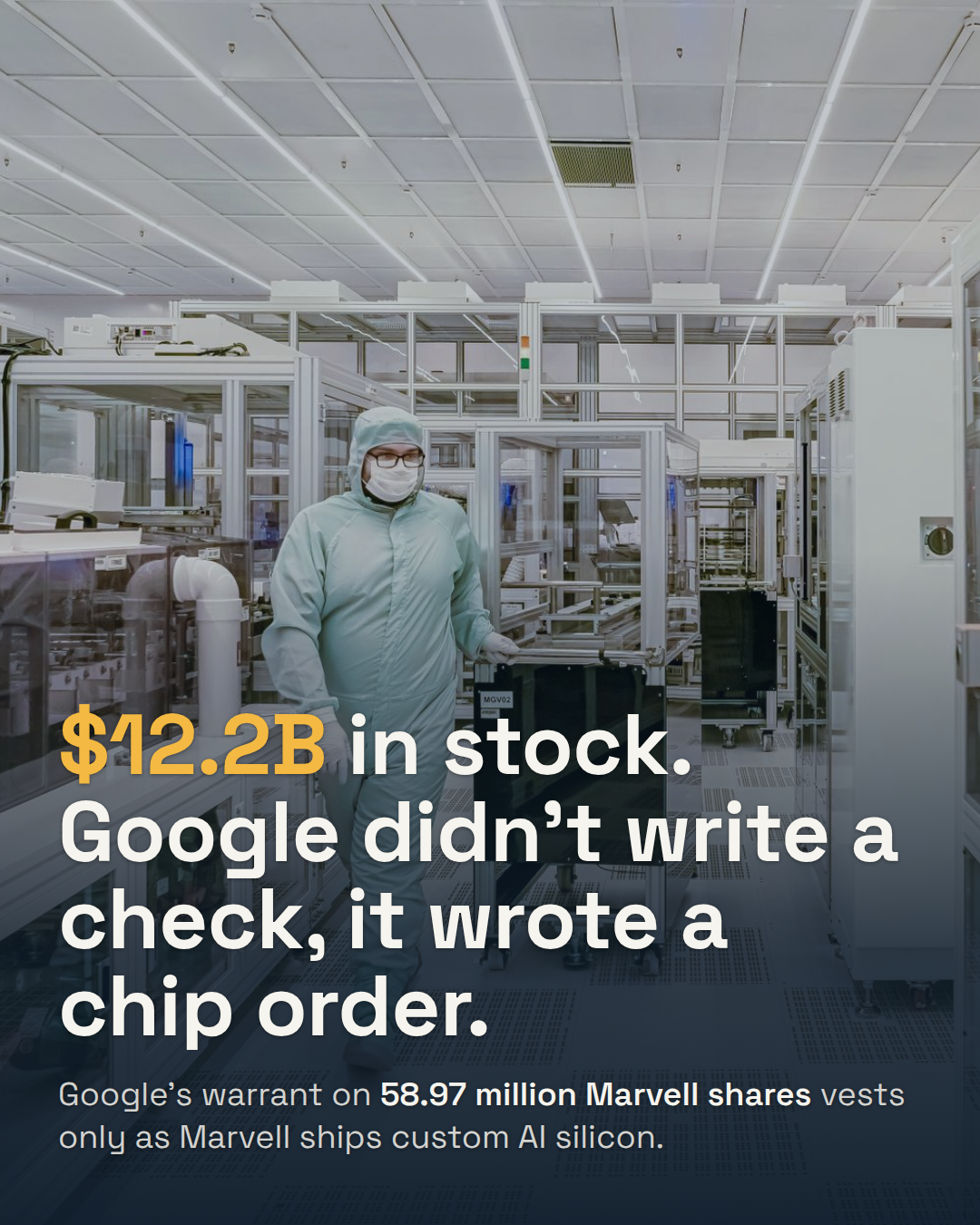
Google took a warrant on 58.97 million Marvell shares worth $12.2 billion, but nearly all of it vests only as Marvell ships custom AI chips, not upfront.

Fiscedge Academy
Contributing Faculty & Practitioner
News Breakdown · FiscEdge Academy
Google just handed Marvell Technology a warrant to buy 58.97 million shares, worth up to $12.2 billion at today's terms. Marvell stock jumped as much as 13% within hours of the news. Broadcom, Google's incumbent chip partner, fell as much as 5% the same morning.
The exercise price is set at $206.58 a share, and the warrant runs until August 18, 2033. If Google exercises the whole thing, it becomes Marvell's fifth-largest shareholder, owning roughly 7% of the company.
Here is the part that makes this more than a stock-market curiosity: Google doesn't get most of those shares for free, and it doesn't pay cash for them either. It earns them.
The number is the least interesting part
About 1.36 million of the warrant shares vest on a simple quarterly schedule over the first year, no strings attached. The remaining 57.6 million shares vest in 240 separate tranches, one tranche released for every $500 million of custom-chip revenue Marvell books from Google, running from Marvell's fiscal Q3 2027 through the end of fiscal 2033.
In plain terms: Google isn't investing in Marvell. It is pre-paying Marvell's future stock price with its own purchase orders. The more chips Google buys, the more of Marvell it gets to own, at a price locked in today. If Marvell's stock rises because the Google relationship succeeds, Google captures a slice of that upside, funded entirely by Marvell's own revenue from Google.
The underlying commercial deal, signed in late July and disclosed this week, covers silicon that attaches to Google's TPU ecosystem: AI inference accelerators, storage controllers, network interface controllers, memory interface controllers, and near-memory compute. This isn't Marvell replacing Broadcom as Google's primary TPU designer. It's Marvell becoming the supplier for everything that surrounds the TPU, the plumbing that turns a chip into a rack, and a rack into a cluster.
Why Broadcom investors flinched
Broadcom has been Google's main TPU design partner for years, and Wall Street's biggest fear about that relationship has always been the same: that Google's AI capital spending eventually gets spread across more vendors instead of concentrated in one. Marvell's warrant is exactly that fear, dated and priced.
JPMorgan pushed back the same day, reiterating an Overweight rating and $580 price target on Broadcom, and arguing that reports of delays to Google's next-generation TPU v9 2-nanometer program were overstated, with the ramp still on track for 2028. The more likely read: Google is building a deeper bench of suppliers for AI infrastructure, the same way it diversified cloud regions and power contracts, rather than swapping one vendor for another.
The bigger pattern: hyperscalers are financing their own supply chain
This is the third structure in as many months where a large buyer has used equity, not cash, to lock in AI infrastructure supply. It sits alongside deals where compute buyers take stakes in the chipmakers and data-center operators they depend on. The logic is consistent: when a customer's spending is large enough to move a supplier's stock price on its own, tying that spending to equity aligns both sides and removes the need for a separate financing round on the supplier's side.
For founders, the mechanism matters more than the ticker symbols. A revenue-vested warrant is a customer contract and a financing instrument stapled together. It lets a buyer say "we will pay you in stock, but only as you deliver," which is a far stronger commitment signal than a purchase order, and a far cheaper one than a cash investment. If you sell into large, concentrated customers, whether that's an enterprise logo or a hyperscaler, this is the term sheet you should expect to see more of: performance-based equity instead of upfront cash, structured around revenue milestones instead of time.
What this means if you are the smaller company in the deal
Three things are worth taking from Marvell's side of this table. First, the vesting structure protects Marvell too: it never gives up equity it hasn't earned in revenue, so the deal can't be used to pressure pricing later. Second, tying vesting to $500 million tranches, not to a single lump payment, gives both sides a shared, auditable metric to manage the relationship around, exactly the kind of milestone discipline worth building into your own model when a strategic customer proposes equity in place of cash. And third, the market reaction shows customers can now move a supplier's valuation simply by signing a contract with the right structure attached, which is a form of leverage every founder negotiating with a concentrated customer base should understand before the term sheet lands.
If you remember one thing
When a big customer offers you equity instead of cash, look at the vesting trigger before the headline number. A warrant that vests with revenue is a real commitment device; one that vests with time alone is closer to a gift with strings you haven't priced yet.
We teach how to read and structure deals like this in FiscEdge's financial modeling course, and how to negotiate with concentrated, high-leverage customers in startup strategy. For the AI infrastructure stack this deal sits inside, see our breakdown of unit economics and the AI for entrepreneurs track. Browse the full blog for more daily breakdowns. Follow @fiscedge for daily Business & AI analysis.
Topics & Categorization:
How interesting did you find this article?