Meta Just Agreed to Pay $18 Billion. The Real Cost Is a Court-Ordered Product Spec.
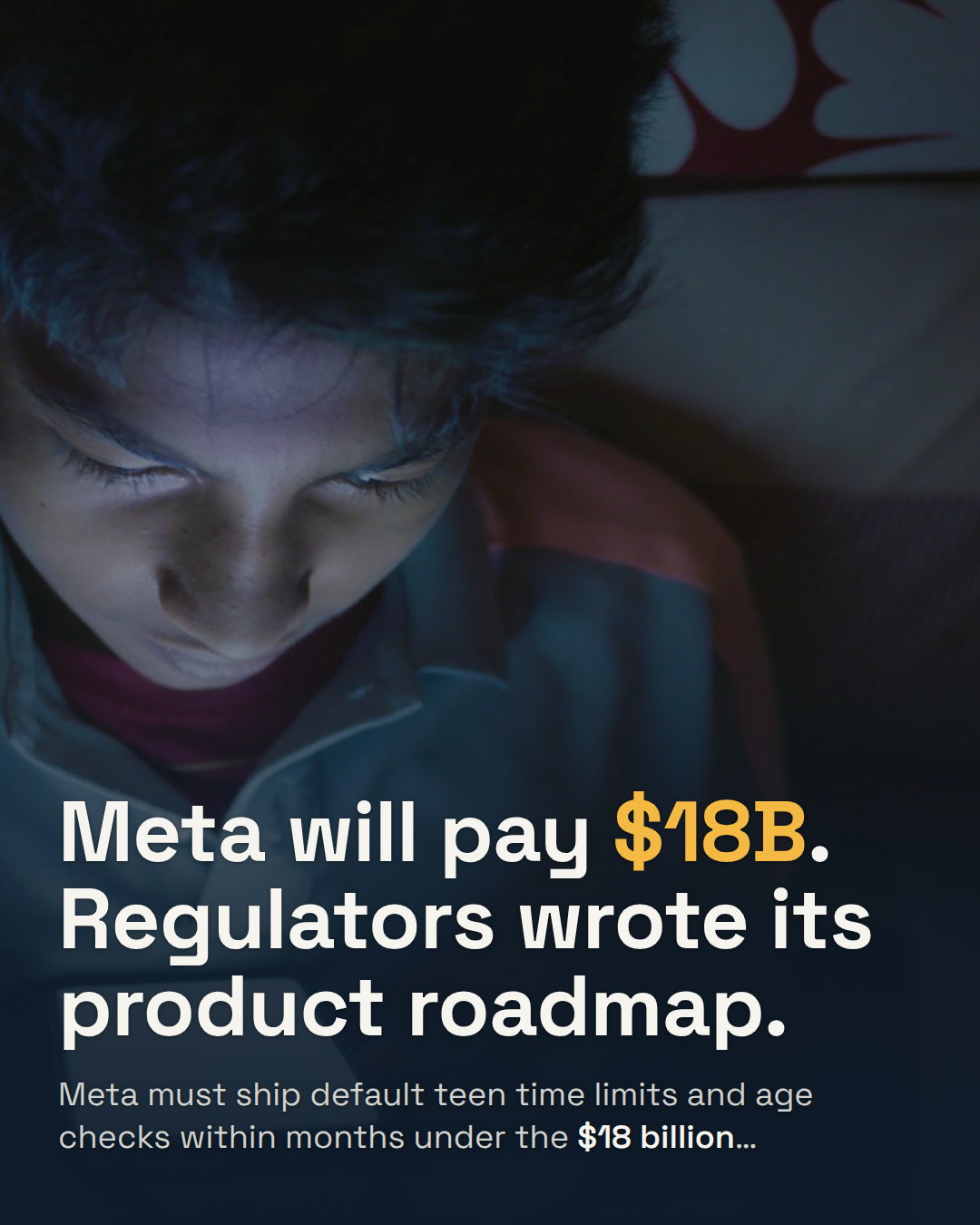
Meta will pay up to $18 billion to settle a 52-state lawsuit over addictive design for kids, and must ship default time limits and age checks within months.

Fiscedge Academy
Contributing Faculty & Practitioner
News Breakdown · FiscEdge Academy
Meta agreed to pay up to $18 billion over the next ten years to settle claims from a coalition of 52 state attorneys general that it engineered Facebook and Instagram to be addictive to kids. The trial had only started on August 18 in the Northern District of California; Meta settled before a jury could rule. California, which co-led the case, is due $1.5 billion to $2.1 billion; New York is in line for up to $1.13 billion. Meta's stock popped about 4% in premarket trading on the news, then gave the entire move back by the close.
That round trip is the tell. Wall Street's first read was "liability capped, move on." Its second read, once the terms were actually published, was that Meta just accepted the biggest constraint on product design any social platform has agreed to. The settlement amount is the least interesting number in this story. The real one is the list of features Meta now has to ship, on a deadline, because a court told it to.
What Meta actually has to build
Under the consent judgment, Meta must roll out, within months:
- A default two-hour daily time limit for users under 18, liftable only by a parent
- A default overnight block from midnight to 6 a.m. for minors, same parental-override rule
- A ban on showing like and reaction counts on posts by minors
- A ban on cosmetic-surgery-style image filters for minors
- A non-personalized feed option that isn't run by an engagement-ranking algorithm
- Stronger age verification to keep users under 13 off the platforms entirely
None of that is a settlement boilerplate promise to "review policies." It's a UX spec, with a court-ordered ship date, written by 52 attorneys general instead of a product team.
The clause built to spread
The sharper detail: Meta is holding back $5.3 billion of its own payment unless TikTok and YouTube adopt matching teen-safety limits. Meta, in other words, is using its own settlement to pressure its two biggest competitors into the same constraints, and it's doing so with the state AGs' blessing. TikTok and Snap have already settled parallel suits; YouTube's parent, Alphabet, is still exposed, along with more than 3,000 other youth-safety cases pending against these companies. If this contagion clause works, expect it templated into every consent decree that follows. A rule invented for one company is about to become the industry floor.
What this changes if you're building
Very few SaaS founders run a platform at Meta's scale, but the pattern here doesn't stay contained to Meta's scale. Regulators just demonstrated they will legislate specific default settings, not just fine companies after the fact, the moment a product has an engagement loop, a feed, or notifications, and a plausible teenage user base. That covers more of the founder audience than it sounds like: edtech, gaming, creator tools, consumer social features bolted onto B2B products, anything with a comment section or a streak mechanic.
The practical shift is that "we'll add parental controls once we have traction" is no longer a safe sequencing decision. Default-safe settings, age assurance, and an opt-out (not opt-in) posture toward minors are becoming table stakes before a product scales, not a retrofit after a lawsuit. Building that in at the architecture stage, rather than bolting it onto growth-optimized defaults later, is dramatically cheaper. It's also, structurally, the same discipline taught in FiscEdge's startup strategy course: decide what regulatory and reputational risk you're underwriting before you optimize a growth loop around it, not after. If your product roadmap includes anything AI-personalized in the feed or recommendation layer, the same logic applies to the AI-specific track in building SaaS with AI: personalization algorithms are now a named target in these settlements, not a neutral feature.
None of this requires a 29-state lawsuit to become expensive. It just requires an app store, a plaintiff's attorney, and a product that looks, from the outside, like it was optimized to keep a 15-year-old scrolling.
If you remember one thing
Default settings are no longer just a growth lever, they're now a court-ordered product spec for anyone with young users on the platform. Build the safe default in from day one; it's an architecture decision, not a policy PDF you write after the first cease-and-desist letter.
We teach this playbook in FiscEdge's startup strategy course and business fundamentals track. Browse the full blog. Follow @fiscedge for daily Business & AI analysis.
Topics & Categorization:
How interesting did you find this article?