Meta Beat Revenue Estimates. Its Free Cash Flow Fell 91% Anyway.
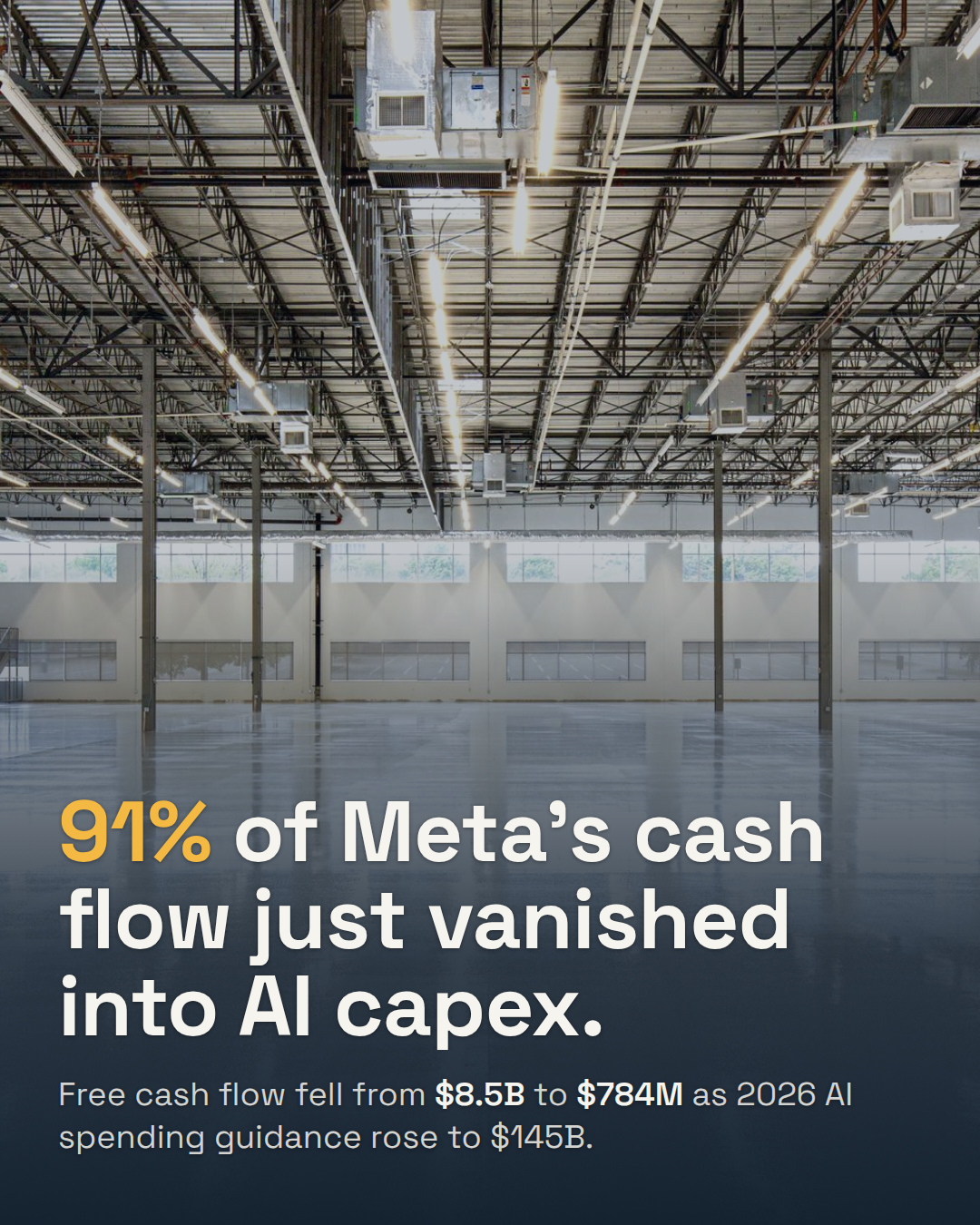
Meta's Q2 revenue rose 28% to $60.8B, beating estimates, but EPS missed by 14% and free cash flow collapsed from $8.5B to $784M as 2026 AI capex guidance hit $145B.

Fiscedge Academy
Contributing Faculty & Practitioner
News Breakdown · FiscEdge Academy
Meta Platforms reported second-quarter 2026 revenue of $60.8 billion, up 28% year over year and ahead of the $60.2 billion Wall Street expected. Advertising revenue came in at $59.3 billion, also a beat. By the numbers that usually move a stock, this was a good quarter. The stock fell as much as 9% the next trading day anyway, wiping out tens of billions in market value in hours.
The reason was buried two lines down in the same report: free cash flow collapsed from $8.5 billion a year ago to just $784 million this quarter, a drop of roughly 91%. Earnings per share landed at $6.18, missing the roughly $7.14 to $7.22 analyst range by about 14%. Management also raised the low end of its full-year AI capital spending guidance to $130 billion, keeping the top of the range at $145 billion.
The revenue beat is the least interesting number in this report. The interesting part is that Meta just showed, in one filing, exactly what it costs to keep pace in the AI infrastructure race, and investors decided the bill is bigger than the story they were being told.
Where the cash actually went
Total costs and expenses jumped 55% to roughly $42 billion for the quarter, including $2.4 billion in legal charges and $1.18 billion in severance tied to a May headcount reduction. Layer on quarterly capital expenditures of $31.1 billion, mostly data centers and AI chips, and a business that generated $8.5 billion in free cash flow a year ago produced less than a tenth of that this time.
None of this is a demand problem. Ad revenue beat estimates and grew nearly 30%. It's a spending problem, and management was upfront about why: on the earnings call, Mark Zuckerberg said Meta is fielding "a lot of offers for compute at a significant premium over what we paid for it," a comment widely read as Meta testing whether it should start renting out spare AI capacity like a cloud provider, rather than just consuming it internally. That's a company thinking out loud about how to make an enormous capex bill pay for itself, in real time, on an earnings call.
Why Wall Street punished the beat
Q3 revenue guidance of $62.5 billion came in slightly below consensus, and that, combined with a widening capex range and a cash flow number that fell off a cliff, was enough to trigger a wave of analyst price-target cuts even from firms that stayed bullish on the long-term AI thesis. The market's read: Meta is no longer being valued on ad growth alone. It's being valued on whether $130-145 billion a year in AI spending eventually shows up as cash, and this quarter it didn't.
That's a meaningfully different bar than "beat or miss revenue," and it's the same bar every other AI-spending hyperscaler is now being held to.
What this changes for founders
Meta has the balance sheet to absorb a quarter like this. Most companies don't, and that's exactly why this report is worth studying rather than skimming.
- Free cash flow is the tell, not revenue. A company (or a startup) can beat every top-line number and still get punished if cash generation doesn't follow. Track your own cash conversion the same way the market just tracked Meta's, not as an afterthought below the revenue slide.
- Capex guidance is a forward liability, not just a growth signal. Meta raising its spending floor to $130 billion is a bet that returns arrive later. If you're planning AI infrastructure spend into your own model, make sure your projections separate "we're investing ahead of revenue" from "we don't know when this pays back."
- Renting out your own excess capacity is a real lever. Zuckerberg's comment about reselling compute at a premium is a reminder that infrastructure spend doesn't have to be a pure cost center if you build in optionality from the start, a principle that applies whether you're buying GPU clusters or just over-provisioning cloud spend "to be safe."
If you're modeling a fundraise or a budget around AI tooling costs, this is a good week to stress-test your own cash flow assumptions the way public-market analysts just stress-tested Meta's, a skill covered in depth in FiscEdge's financial modeling course.
If you remember one thing
Meta beat revenue estimates and still lost roughly a tenth of its market value in a day, because free cash flow fell 91% while AI capex guidance rose to $145 billion. Growth without cash conversion is not a footnote anymore, it's the headline, and any founder scaling AI spend should be tracking that ratio before an investor makes them.
We teach the frameworks behind reading a filing like this one in FiscEdge's financial modeling course, and how to plan AI infrastructure costs without hyperscaler-sized bills in AI for entrepreneurs. For the fundamentals behind cash flow versus revenue, see our explainer on unit economics. Browse the full blog for more breakdowns. Follow @fiscedge for daily Business & AI analysis.
Topics & Categorization:
How interesting did you find this article?