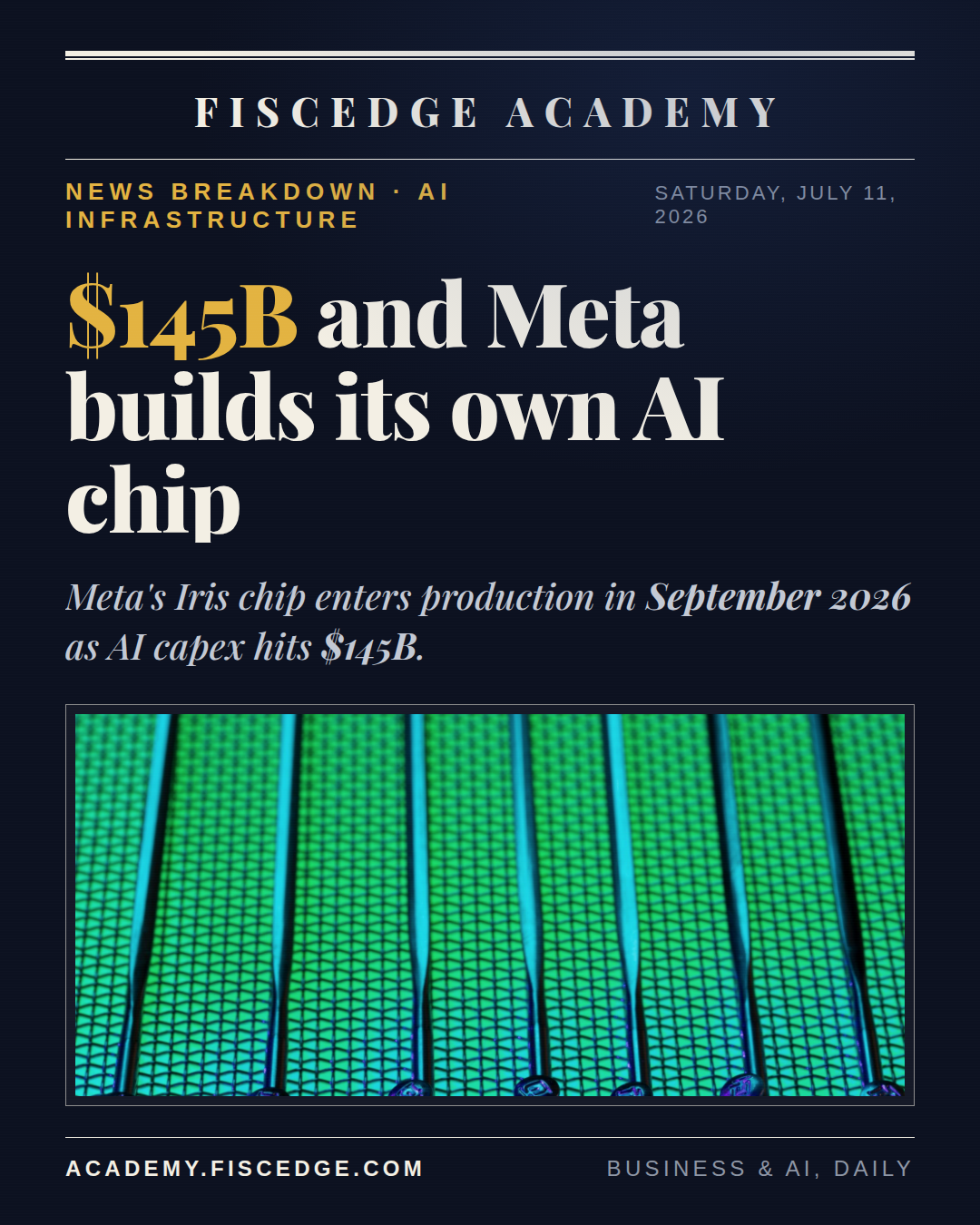
Meta's Iris AI Chip Enters Production in September as 2026 AI Capex Hits $145B.
Meta's in-house Iris chip begins production in September 2026 to help double compute capacity to 14GW, as 2026 AI capex hits $145B, a signal of where AI's real cost advantage is heading.

Fiscedge Academy
Contributing Faculty & Practitioner
News Breakdown · FiscEdge Academy
Meta will move its next-generation, in-house AI chip, codenamed Iris, into production in September 2026, according to an internal memo reported by Reuters and confirmed by multiple outlets. Iris is the fourth generation of Meta's custom silicon program and cleared its testing phase in about six weeks, well ahead of the multi-month validation cycle typical for chips at this scale. Meta says the ramp supports a plan to roughly double the company's total data center compute capacity, to 14 gigawatts, by 2027.
The announcement lands days after Meta confirmed it had raised its full-year 2026 capital expenditure guidance to $125 billion to $145 billion, up from an already enormous $115 billion to $135 billion range set earlier this year, and nearly double the $72.2 billion it spent on capex in all of 2025.
The dollar figure is the headline. The decision to build a chip business inside a company that primarily sells ads is the story.
What Meta is actually building
Iris is designed with Broadcom, the same partner behind Google's newest TPU and OpenAI's first custom chip, and will be manufactured by TSMC. It's the second entry in a four-chip roadmap: MTIA 300 is already in production, Iris (MTIA 400) enters production this fall, a chip codenamed Arke is slated for later this year, and a fourth, Astrid, is planned for 2027.
None of this replaces Nvidia in the near term. Meta is still buying enormous volumes of Nvidia GPUs, and most analysts read the MTIA line as a way to absorb growth and trim the margin Meta pays on inference workloads, not to swap out its training stack. But the direction is unambiguous: every hyperscaler with the balance sheet to do it is now designing its own silicon rather than paying someone else's markup indefinitely.
The signal under the headline
Two numbers matter more than "Meta built a chip." First, Mark Zuckerberg has confirmed Meta is cutting roughly 8,000 corporate jobs, by his own account partly to free up capital for compute. Second, 2026 capex guidance alone now exceeds Meta's combined AI infrastructure spending for 2024 and 2025. When a company with Meta's cash generation chooses to fund silicon and data centers by shrinking headcount, that's a clear statement about where it believes the durable cost advantage in AI actually sits: in owning the compute layer, not just in owning a frontier model.
That's worth taking seriously if your business runs on top of rented AI infrastructure. The companies with the capital to vertically integrate are doing it. Everyone else is still paying retail.
Why this matters if you're building on AI
You don't compete with Meta for chip supply, but you inherit the second-order effects of this arms race in two ways.
First, on cost. As Meta, Google, Amazon and OpenAI each bring more custom silicon online, total AI compute supply grows faster than it would on Nvidia allocation alone, which is a long-run tailwind on inference pricing for anyone building products on top of rented models. That's good news for gross margins on AI features, but it plays out over years, not quarters, so don't bake aggressive near-term cost declines into this year's model.
Second, on capital discipline. Meta just demonstrated, at extreme scale, that "AI infrastructure spend" and "headcount" are now treated as a shared budget line inside a major tech company. If the best-capitalized AI spenders in the world are trading people for compute, expect that trade-off to show up in how investors evaluate your own burn rate too, especially if inference is a growing share of your costs relative to payroll.
The founder takeaway
Three things worth acting on:
- Model your inference costs as a declining but volatile input, not a fixed line item. Hyperscaler silicon investments like Iris are a multi-year deflationary force on compute pricing, but the timeline is uncertain, so stress-test your unit economics at today's prices, not tomorrow's optimistic ones. FiscEdge's financial modeling course walks through how to build that stress-test into a real forecast.
- Watch where the capital is actually going, not just how much of it there is. A capex number tells you a company is spending. A memo about job cuts to fund that capex tells you what it's willing to sacrifice for it, and that's the more honest signal of strategic priority.
- Don't assume compute stays cheap by default. It's getting cheaper because a handful of companies are pouring unprecedented capital into owning the supply chain, not because AI infrastructure is naturally trending toward commodity pricing on its own. That's the core idea behind our unit economics breakdown, and it's worth revisiting before you price your next AI feature.
If you remember one thing
Meta didn't just ship a chip. It told you, in a single memo, that compute has become important enough to trade jobs for, and that's a bigger tell about where AI economics are heading than any spec sheet.
We teach how to architect AI products without over-committing to a single vendor's cost curve in FiscEdge's building SaaS with AI course, and how model compute and infrastructure costs into your margins in the financial modeling course. Browse the full blog. Follow @fiscedge for daily Business & AI analysis.
Topics & Categorization:
How interesting did you find this article?