Meta Open Sourced a 30-Billion-Parameter AI Agent. It Runs on One Gaming GPU.
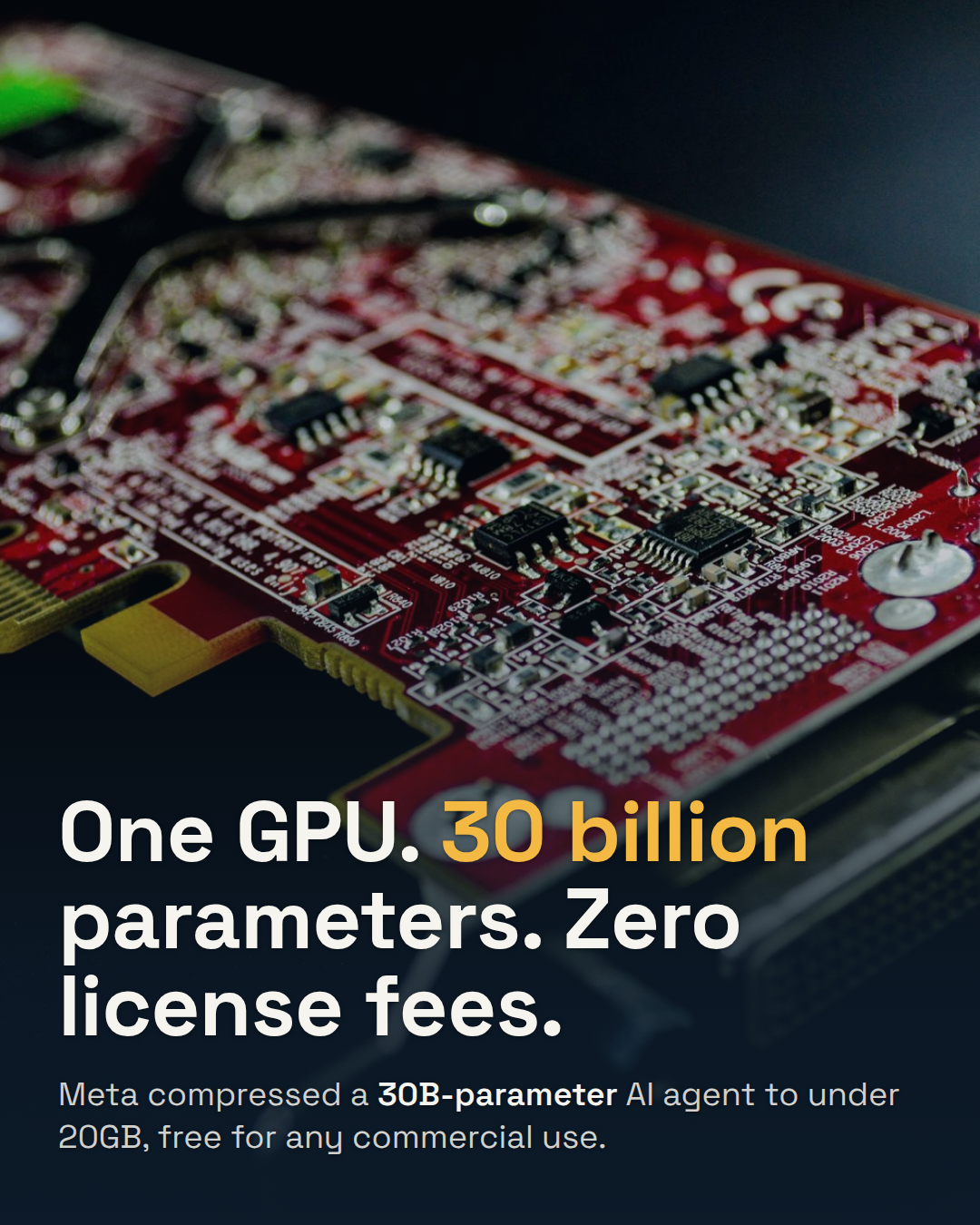
Meta released Muse Glimmer, a 30B-parameter agent model, under a fully unrestricted Apache 2.0 license on August 10, compressed to under 20GB so it runs locally on a single consumer GPU.
Fiscedge Academy
Contributing Faculty & Practitioner
News Breakdown · FiscEdge Academy
Meta gave away a 30-billion-parameter AI agent for free on August 10, and buried the more interesting news in the license field.
Meta Superintelligence Labs released Muse Glimmer, a 30B-parameter model purpose-built for local, always-on AI agents, under Apache 2.0, the most permissive license Meta has ever attached to a flagship model. Compressed to roughly 4-bit precision, the weights fit under 20GB, small enough to run on a single consumer GPU in a gaming PC or a Mac Studio, no cluster required. It ships with a 128K-plus token context window (some independent benchmarking sites clock it past 260K), covers more than 100 languages, and scores 21 points above Llama 4 Maverick, Meta's last open-weight flagship, on agentic benchmarks. It's live now on Hugging Face and through inference platforms like Together AI.
Those numbers are the least interesting part of this story.
What Meta actually shipped
Muse Glimmer is distilled from Muse Spark, the larger model Meta previewed in April, and it isn't built for chat. It's built for agents: long chains of sequential tool calls, recovering when a step in the middle of a task fails, and reading a screenshot, a chart or a PDF directly through a built-in perception encoder rather than a bolted-on vision add-on. That's the workflow most SaaS founders are actually trying to automate right now, an agent that can look at a dashboard, decide what to click, and keep going after it hits an error.
The license is the real headline
Meta's Llama models have carried a commercial license since 2023, with usage conditions large companies had to clear with Meta's legal team before shipping a Llama-powered product at scale. Muse Glimmer drops that entirely. Apache 2.0 permits unrestricted commercial use, modification and redistribution: no revenue thresholds, no request-a-license step, no clause your counsel needs to review before you ship. For a solo founder or a five-person team, that's the difference between running this in production today and waiting weeks for legal sign-off.
Why this changes your build-vs-buy math
If you're paying per token for GPT-5.6 or Claude to power an agentic feature inside your product, Muse Glimmer just moved your break-even point. A model that scores meaningfully above Meta's previous open flagship, runs on a single consumer GPU, and costs nothing beyond hardware and electricity is a real substitute for API calls on a large class of workflows: internal tooling, high-volume low-stakes agents, anything where you're currently absorbing token costs to keep a feature's unit economics from embarrassing you on a board slide. It won't replace a frontier model for your hardest reasoning tasks. It's a serious option for everything else, and everything else is most of what a typical AI feature actually does.
The signal under the headline
This is Meta running the Llama playbook again, faster and with fewer restrictions than last time. Give away a capable model, commoditize the layer your biggest competitors charge for, and win on distribution and infrastructure instead. Every time that happens, the model gets one step closer to being a utility rather than a product, and the margin in AI keeps moving up the stack, toward whoever owns the data, the workflow and the customer relationship, not whoever owns the weights. If your current pitch to investors leans on "we built a fine-tuned model," this is a reminder that the ground under that pitch keeps shifting.
If you remember one thing
The moat was never going to be the model. Muse Glimmer is one more data point that the model layer is heading toward free, capable and permissively licensed, which means the defensible part of your AI product has to be something a model release can't replicate: your data, your workflow, your distribution, or your relationship with the customer. If your roadmap still assumes model access is the hard part, it's time to rewrite that roadmap.
We cover exactly this kind of build-vs-buy decision in FiscEdge's AI for entrepreneurs course, including when to self-host a model versus pay for an API. If you're shipping AI features inside a product, building SaaS with AI walks through the unit economics in detail, and what it actually costs to build a SaaS product breaks down where compute spend really goes. Browse the full blog for more daily breakdowns. Follow @fiscedge for daily Business & AI analysis.
Topics & Categorization:
How interesting did you find this article?