Microsoft's Anthropic Stake Just Made $3.2 Billion. Its OpenAI Stake Lost $600 Million.
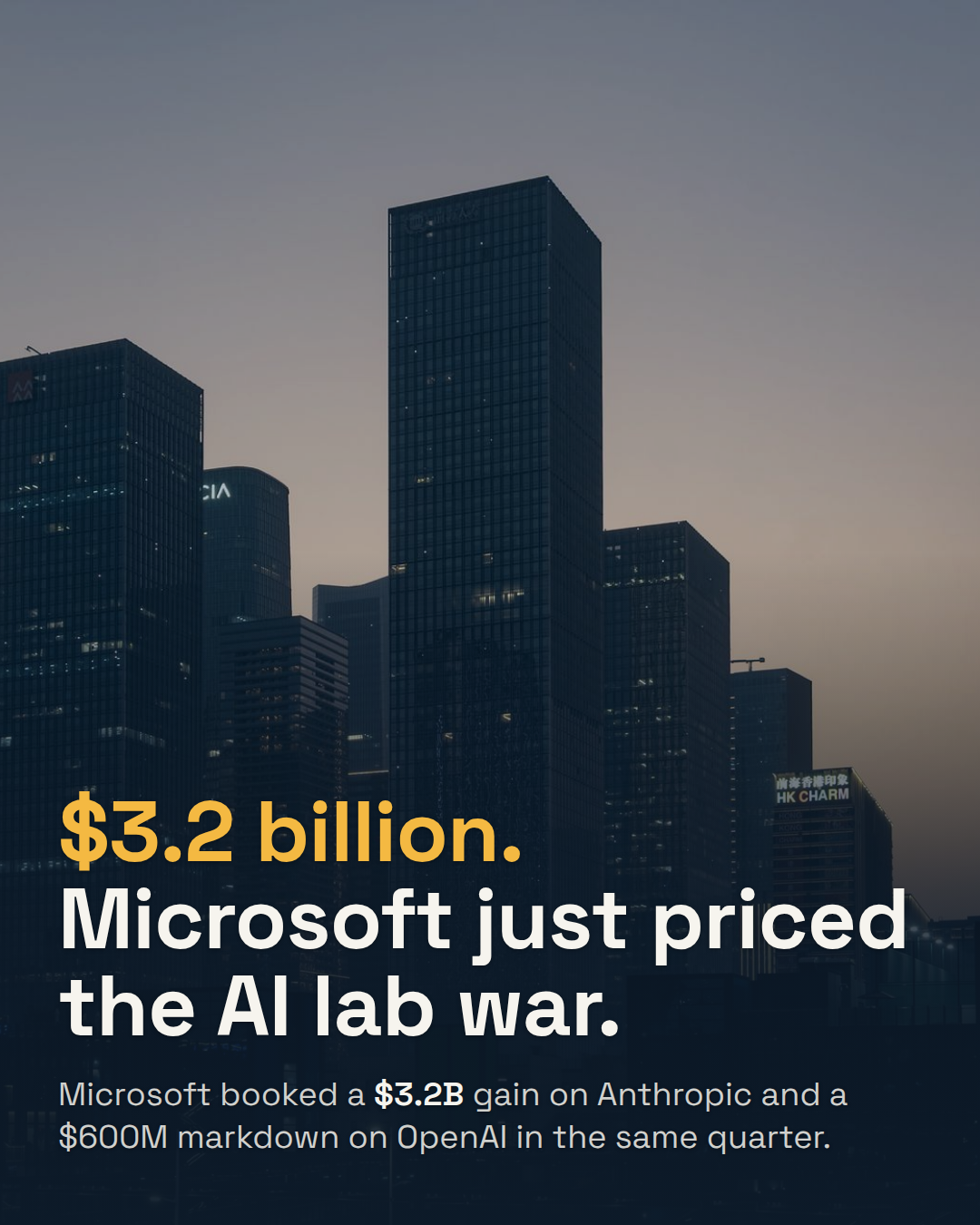
Microsoft's Q4 earnings show a $3.2 billion gain on its Anthropic stake and a $600 million markdown on OpenAI, the clearest real-time read yet on how markets price the two AI labs.

Fiscedge Academy
Contributing Faculty & Practitioner
News Breakdown · FiscEdge Academy
Microsoft's fiscal Q4 2026 earnings, reported Wednesday, delivered the usual blowout numbers: $90.01 billion in quarterly revenue (up 18% year over year, versus $87.62 billion expected), adjusted EPS of $4.74 against a $4.24 estimate, and full-year revenue of $331.8 billion with $133.7 billion in net income. Azure grew 43% in the quarter, its fastest pace in years, and full-year Azure revenue crossed $100 billion, up 41%.
Buried in the same filing was a smaller, stranger number. Microsoft's minority stake in Anthropic generated a $3.2 billion gain in the quarter, adding 33 cents to earnings per share. Its stake in OpenAI was marked down about $600 million, cutting EPS by roughly 7 cents. Two rival AI labs, one filing, opposite directions, same three months.
The revenue beat is the least interesting part of this report. The interesting part is that Microsoft's balance sheet just became the closest thing the market has to a real-time stock ticker for two companies that don't have one.
Why this number even exists
Neither OpenAI nor Anthropic is public. Their valuations come from private funding rounds that happen once or twice a year and get locked in for months. But accounting rules require Microsoft to mark its equity stakes to fair value every quarter, using secondary transactions, comparable multiples and internal models. That means every 90 days, Microsoft's 10-Q effectively hands the market an appraisal of both labs, whether either company wants one or not.
For the full fiscal year, the OpenAI stake still produced a $5 billion gain, adding 67 cents to annual EPS, so the Q4 markdown is a wobble inside a bigger up year, not a reversal. But the fact that a wobble of that size can happen in a single quarter, at two labs Microsoft has a front-row seat into, tells you these valuations are far more liquid and far more volatile than the "last round was $X billion" headlines suggest.
The capex number that matters more than the marks
Microsoft's quarterly capital spending hit $41 billion, up 69%, and management is now guiding to roughly $175 billion for fiscal 2027. That capex funds the Azure GPU clusters both OpenAI and, increasingly, Anthropic depend on. Microsoft is simultaneously an investor in these labs, their landlord for compute, and, more openly than ever, their competitor. CEO-level messaging this earnings season has leaned hard into a "swap any model at any time" pitch, and internally, executives have reportedly told sales teams to position Microsoft's own models against OpenAI's and Anthropic's on cost and integration rather than raw capability.
That's not a contradiction. It's the actual shape of the AI stack right now: infrastructure, capital and model layers are stacked inside the same handful of companies, and the incentives at each layer don't always point the same way.
What this changes for founders
If your product is built on top of a single foundation model, this quarter is a reminder that the lab behind it is being repriced by outsiders every three months, even if you never see the number. A few practical implications:
- Don't hard-wire a single vendor. Microsoft's own "any model, any time" positioning is the same advice founders should already be following: abstract your model layer so a pricing change, a markdown, or a lab-level shake-up doesn't become an outage for your product.
- Watch hyperscaler earnings, not just funding announcements. Quarterly filings from Microsoft, Google and Amazon are now a better leading indicator of AI-lab health than the next splashy round, because they're audited, dated and public.
- Capex guidance is a demand signal. A $175 billion capex plan for next year says compute supply keeps expanding, which should keep pressure on inference pricing in your favor, at least until the bill for that spending comes due.
Founders raising on AI-native models should expect investors to start asking about model-layer concentration risk the same way they ask about customer concentration. This quarter gave them the data to justify it.
If you remember one thing
A single earnings report just put a $3.2 billion gain and a $600 million loss on two AI labs in the same three months, proof that "AI valuation" is a moving number, not a fixed one, and that building your business on a single model provider is a bet on a mark that can swing by billions before your next board meeting.
We break down how to model scenarios like this in FiscEdge's financial modeling course, and how to build vendor-agnostic AI products in AI for entrepreneurs. For the fundamentals behind reading a filing like this one, see our explainer on unit economics. Browse the full blog for more breakdowns. Follow @fiscedge for daily Business & AI analysis.
Topics & Categorization:
How interesting did you find this article?