Mistral Raises €3 Billion at a €21 Billion Valuation. Its Chip Suppliers Are Now Its Owners.
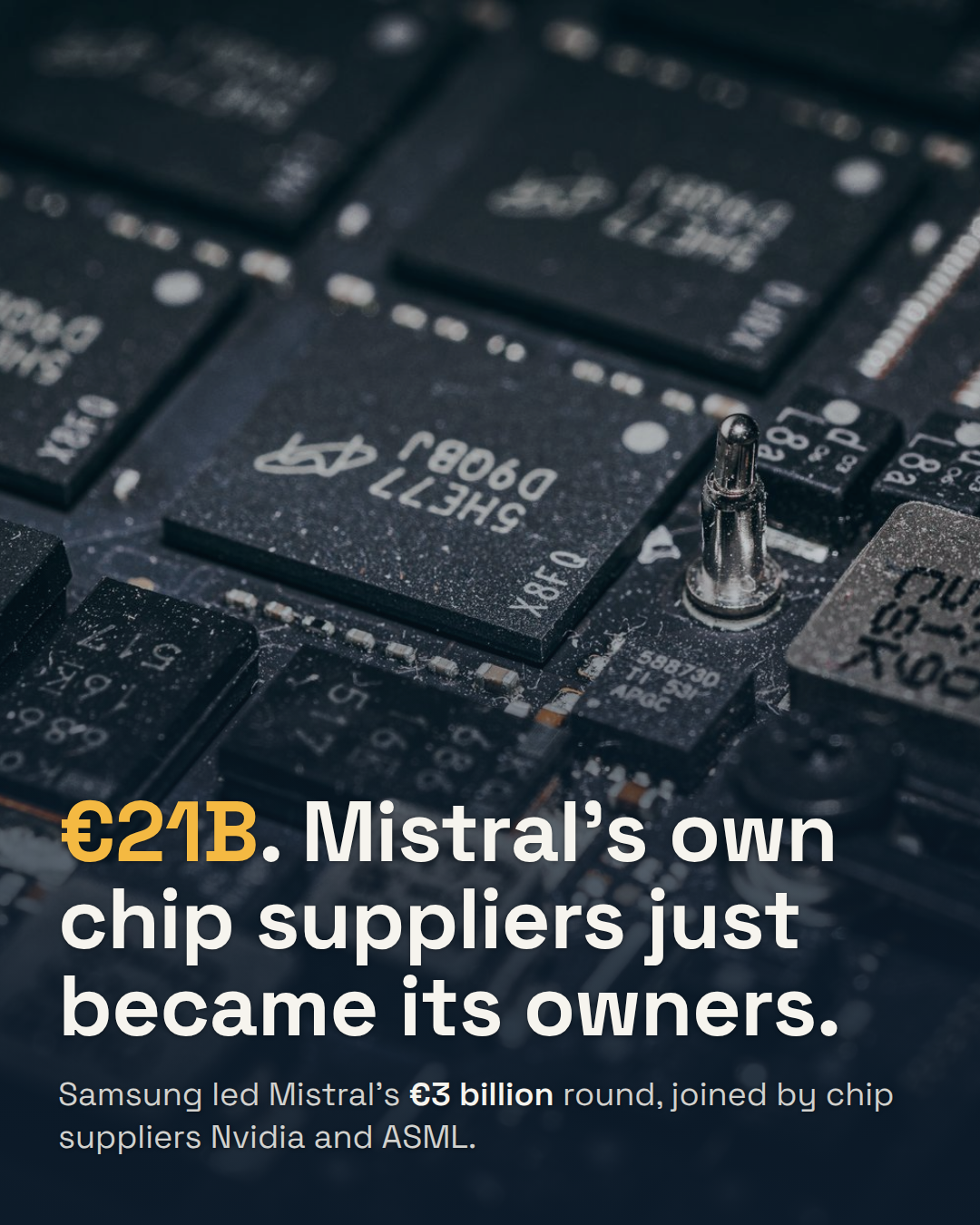
Mistral closed a €3 billion round led by Samsung, valuing it at €21 billion, with chipmakers Nvidia and ASML also on the cap table. For founders, that blurs supplier and investor.

Fiscedge Academy
Contributing Faculty & Practitioner
News Breakdown · FiscEdge Academy
Mistral AI, the Paris-based frontier-model lab, closed a €3 billion (~$3.5 billion) Series D on Tuesday, pushing its post-money valuation past €21 billion (~$24 billion). Samsung Electronics led the round with a stake of up to €1 billion, its largest disclosed bet on a European AI company to date, jointly with the EU-backed Scaleup Europe Fund and existing investor PSG Equity.
A year ago, Mistral raised €1.7 billion at an €11.7 billion valuation in a Series C led by the Dutch chipmaker ASML. The price tag has nearly doubled since then, and the company says this is now the largest equity round ever completed by a European technology company, full stop, not just in AI.
The investor list is the real story
Samsung, Nvidia, ASML, BlackRock-managed funds, BNP Paribas CIB, Salesforce Ventures and the sovereign fund of the Grand Duchy of Luxembourg all show up on the cap table. Two of those names, Nvidia and ASML, are not passive money. They are Mistral's own supply chain: ASML makes the lithography machines that print the chips Mistral trains on, and Nvidia makes the chips themselves.
That is the pattern to watch, and it is not unique to Europe. US labs have run the same playbook, most visibly Anthropic, whose two largest outside shareholders are Amazon and Alphabet, the same companies that sell it cloud compute. When your suppliers become your equity holders, the financing round and the customer contract start to blur into the same negotiation. Mistral CEO Arthur Mensch has framed the raise as buying "compute autonomy," the ability to build out data centers Mistral can rent to others while still controlling its own training capacity rather than depending entirely on a hyperscaler's queue.
Still a rounding error next to the US majors, and that is the point
Put €21 billion next to the numbers dominating the same news cycle: OpenAI's roughly $500 billion valuation, Anthropic's reported push toward a $2 trillion IPO valuation, xAI raising at nine figures a month. Mistral's round is enormous by European standards and still an order of magnitude smaller than what the two US frontier labs are commanding.
For founders benchmarking against "AI company" valuations in a pitch deck, that gap is the useful data point, not the headline number. Capital intensity in frontier AI scales with how much compute you can credibly promise to buy, and right now US labs can promise more of it, faster, because their investor base includes the hyperscalers directly. A European challenger closing its "largest ever" round and still landing at one-twentieth of OpenAI's valuation tells you how steep the compute arms race has actually gotten, and how much of a moat pure geographic or regulatory positioning is not.
What this changes if you build on top of any of these labs
If your product calls Mistral's API, or any frontier model API, alongside OpenAI's or Anthropic's, this round is a reason to keep that multi-provider setup rather than consolidate. A well-capitalized European alternative backed by chipmakers and a sovereign fund is a genuine hedge against US-only model dependency, both for pricing leverage and for customers in regulated industries who care where their inference runs and under whose jurisdiction.
It is also a reminder to model vendor concentration the way we teach in FiscEdge's financial modeling course: a supplier who is also an investor has less incentive to walk away from a bad contract with you, but also less incentive to compete hard on price. If AI inference or training is a real line item in your unit economics, the unit economics breakdown on our blog is the right starting discipline before you lock into any single lab, European or American. And if you are weighing whether to build your own AI features versus buying access to someone else's frontier model, that build-versus-buy tradeoff is exactly what we walk through in FiscEdge's AI for entrepreneurs track.
If you remember one thing
When a chip supplier shows up as a lead investor in an AI company's funding round, the round is really a long-term supply agreement wearing a valuation number. Read the cap table before you read the headline, on any AI vendor you plan to build on.
We cover vendor concentration, cap tables and AI build-versus-buy decisions in FiscEdge's financial modeling course and AI for entrepreneurs track. Browse the full blog for more news breakdowns. Follow @fiscedge for daily Business & AI analysis.
Topics & Categorization:
How interesting did you find this article?