Moonshot AI's Servers Buckled Under Demand. Investors Are Betting $30 Billion Anyway.
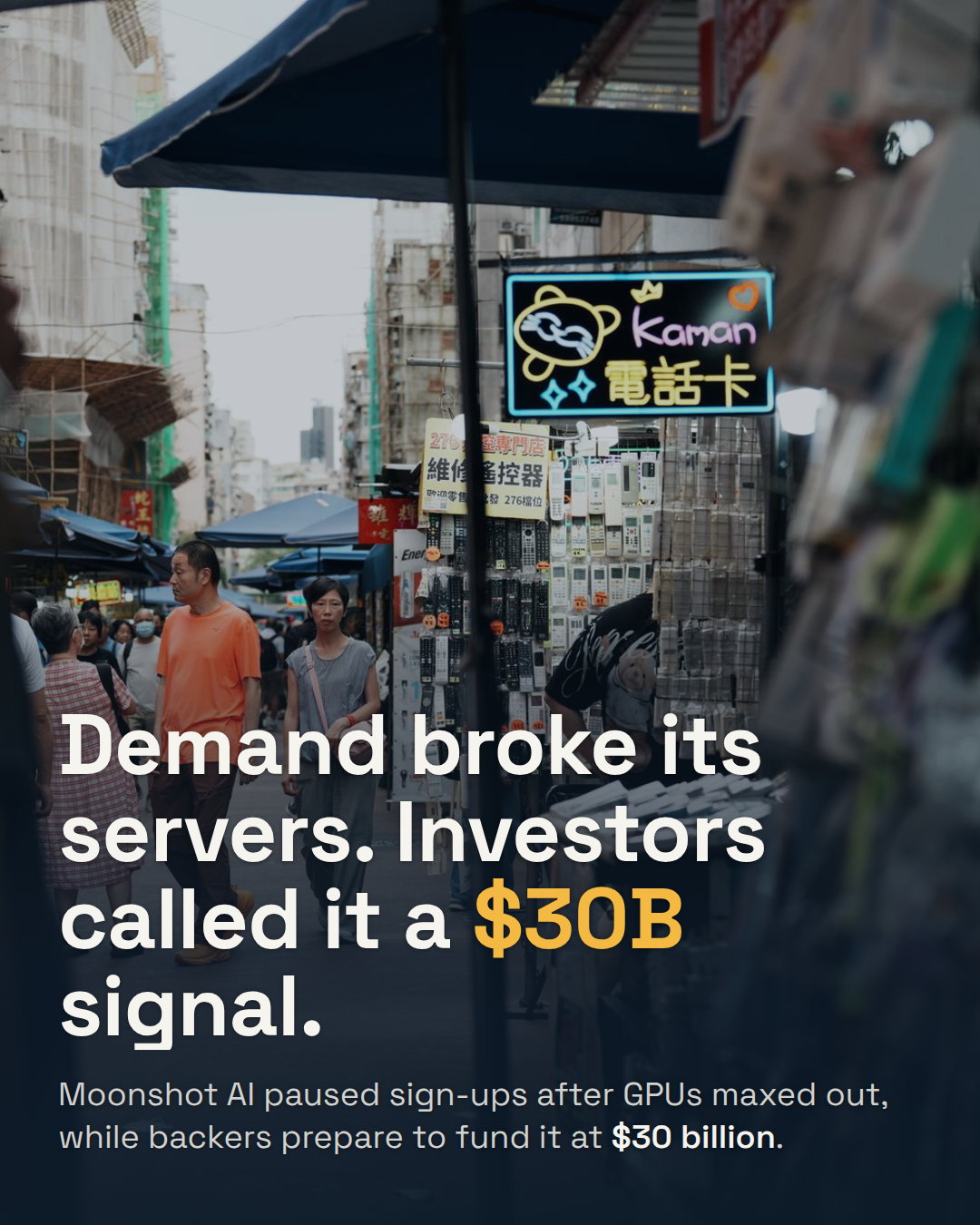
Moonshot AI paused new Kimi K3 subscriptions after demand maxed out GPU capacity, even as investors prepare to fund a Hong Kong IPO at a $30 billion valuation.

Fiscedge Academy
Contributing Faculty & Practitioner
News Breakdown · FiscEdge Academy
On July 19, Chinese AI lab Moonshot AI paused new subscriptions for its Kimi K3 model, just three days after launch, because user demand maxed out its GPU capacity within 48 hours. The company told existing subscribers they were unaffected, but new signups were frozen, with spots to reopen "in batches" as compute frees up.
The same week, Moonshot sent shareholders a proposal to list on the Hong Kong Stock Exchange within six months, alongside a funding round that could push its valuation above $30 billion, a roughly 50% jump from the $20 billion it was valued at in May. The company is reportedly looking to raise more than $2 billion, with CICC and Goldman Sachs in talks to underwrite the offering.
The number that matters most isn't the valuation. It's the timeline behind it: Moonshot's annual recurring revenue went from $100 million in March to $200 million in April to $300 million in June, then grew fast enough in July that the company had to stop selling its own product. That's the signal under the headline, growth that outran infrastructure, arriving in the exact week the company is trying to convince public-market investors it can execute at scale.
The demand problem money doesn't fix in 48 hours
Kimi K3 is a 2.8 trillion-parameter open-weight model with a 1-million-token context window, and it landed on July 16 to strong reviews and a genuine price advantage over Western frontier models. What happened next is the part founders should study: request volume exceeded Moonshot's projections so fast that GPU capacity hit its ceiling before the weekend was over. Existing GPU fleets, the ones sized for last month's traffic, simply could not absorb this month's demand curve. Full open-source weights are expected by July 27, which may relieve some pressure by letting large users self-host, but for now Moonshot is rationing access to its own hit product.
The IPO math, and why the timing isn't a coincidence
A 50% valuation jump in two months is not typical for a company that isn't also showing revenue to match. Moonshot's ARR tripled between March and June, and the GPU crunch is, awkwardly, proof that the demand behind that revenue is real rather than manufactured. Investors underwriting a $2 billion round don't need to take management's word for product-market fit when the company is turning away paying customers because it can't serve them fast enough. That's a strange kind of good problem to have heading into IPO roadshows, capacity constraints as a credibility signal.
What this changes if you're scaling a SaaS product
Three things worth taking from this, whether you're pre-seed or fundraising for a Series A:
- Model your infrastructure cost curve against your best-case growth scenario, not your average one. Most founders build capacity plans off historical usage. Moonshot's 48-hour ceiling is a reminder that a single viral launch, a press hit, a good benchmark result, can move demand faster than any procurement cycle. This is exactly the kind of scenario planning we walk through in FiscEdge's financial modeling course.
- A capacity crisis during a raise is not automatically a red flag. If you can show investors the shortfall is demand-driven rather than execution-driven, and you have a credible plan to fund the fix, it can read as validation instead of dysfunction. Knowing which story you're telling, and having the numbers to back it, is core to raising on the right terms.
- Revenue trajectory, not a single ARR snapshot, is what actually moves valuation. Moonshot's three-month tripling did more for its $30 billion number than any model benchmark. Founders obsessing over a single metric at a single point in time are missing what actually gets priced in a raise, a point we build out with real cohort math in building SaaS with AI and in our explainer on how unit economics actually work.
The part that's easy to miss
Moonshot didn't get here by having the cheapest model or the biggest lab. It got here by shipping something people wanted faster than it could staff the servers to give it to them. For a founder, that is simultaneously the best problem in the world and the one most likely to blow up a fundraise if the ops story doesn't hold up under investor questioning. The lesson isn't "grow fast." It's "grow fast and be able to explain, with numbers, exactly why your infrastructure is one step behind your demand and not two."
If you remember one thing
A funding round that closes while you're turning away customers is not a contradiction, it's the strongest signal you can hand an investor, but only if you can prove the bottleneck is capacity and not a broken product. Know which one you're actually looking at before you walk into the room.
We teach founders how to model growth, capacity, and fundraising timing together in FiscEdge's financial modeling course and how to plan a raise around real traction in startup strategy. Browse the full FiscEdge blog for more news breakdowns. Follow @fiscedge for daily Business & AI analysis.
Topics & Categorization:
How interesting did you find this article?