National Grid Just Paid $1.75B to Skip the Grid Entirely for AI Power.
National Grid invested $1.75B for 35% of Joulent, funding a 2.67GW gas plant built to power a Microsoft data center directly. AI's real bottleneck moved to electrons.

Fiscedge Academy
Contributing Faculty & Practitioner
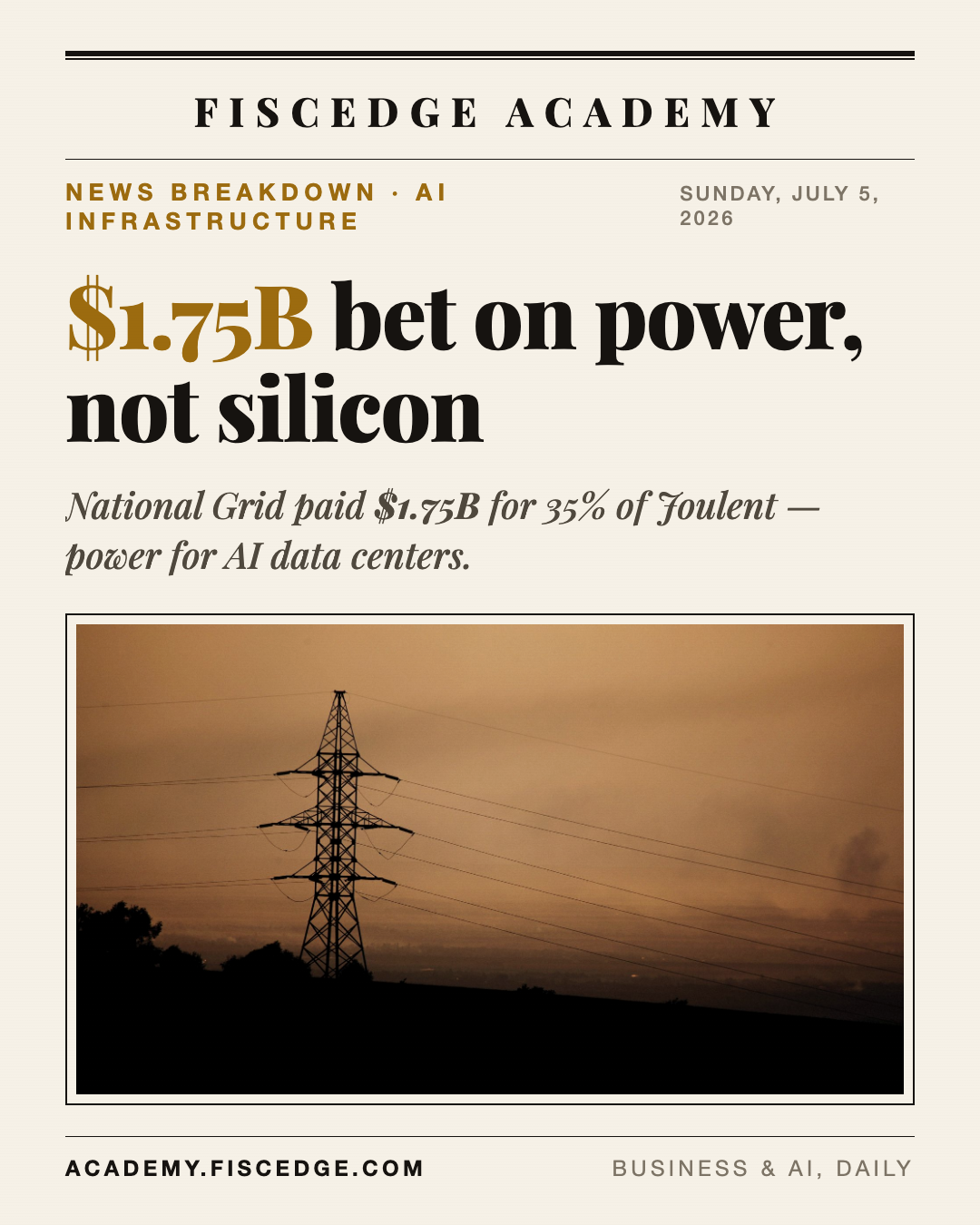
News Breakdown · FiscEdge Academy
National Grid Ventures, the commercial investment arm of UK utility National Grid plc, is investing $1.75 billion for a 35% stake in Joulent, a Houston-based energy infrastructure company — a deal announced July 1, 2026 and confirmed by National Grid's own release, a Businesswire statement from Joulent, and an SEC filing. The investment values Joulent at roughly $5 billion.
The money funds Joulent's first project, "Project Kilby": a 2.67-gigawatt gas-fired power facility in West Texas, built in a 50/50 partnership with Chevron. It will supply electricity directly to a Microsoft-operated data center campus under a 20-year power purchase agreement, with first power targeted for 2028.
The headline is a utility buying into a power plant. The real story is what that power plant is built to avoid.
The point of Project Kilby is to skip the grid
Joulent calls its model "Across the Meter" — generating power on-site, right next to the customer's load, instead of routing it through the public transmission grid. For a data center operator like Microsoft, that means bypassing years of interconnection queues, permitting delays, and grid capacity constraints that have become the single biggest bottleneck in scaling AI infrastructure.
Chevron is in the deal as a co-developer, not a customer, supplying the natural gas and operating expertise. Meanwhile National Grid — a company that normally makes its money running the public grid — is instead funding a project explicitly built to bypass it.
The signal under the headline
For the last two years, the AI capacity conversation was mostly about chips: who has the GPUs, who's queued up at Nvidia, who locked in the best supply deal. This deal is a clean signal that the bottleneck has moved. Power, not silicon, is now the constraint serious AI infrastructure players are racing to solve — and they're solving it by building private power plants rather than waiting for utilities to expand the public grid.
That a grid operator is co-funding a project designed to route around its own network is the tell. National Grid isn't fighting this shift; it's positioning itself to profit from both sides of it — the public grid and the private, co-located alternative.
Why this matters even if you're not building data centers
Most SaaS founders will never negotiate a power purchase agreement. But the underlying pattern — a resource constraint moving up the stack from "buy more compute" to "guarantee the physical inputs compute depends on" — is worth tracking for anyone whose product economics ride on AI inference pricing.
If power is now the gating factor on how fast new AI data center capacity comes online, that has second-order effects on GPU cloud pricing and availability — the same inputs that show up in your own AI feature's gross margin. Capacity constraints upstream tend to show up as price volatility downstream, months later.
A few things worth doing with this:
- Track power and interconnection news the way you'd track chip supply news. It's becoming a leading indicator for compute cost and availability, not a background utility story.
- Don't assume today's inference pricing is stable if you're modeling a multi-year AI cost curve. Physical capacity constraints on the supply side can move prices independently of anything the model labs do.
- If you're raising or evaluating AI infrastructure plays, "how do you solve for power" is now a legitimate diligence question — the investors behind this deal clearly think it is.
If you remember one thing
When a company whose entire business is running the grid starts funding private power plants to bypass it, that's your signal that the real constraint on AI's growth has moved from chips to electrons.
We break down how physical and capital constraints flow into your cost model in FiscEdge's financial modeling course, and how to think about infrastructure dependencies when building an AI-native product in building SaaS with AI. If you're weighing what it actually costs to stand up AI-heavy infrastructure, start with our breakdown on the real cost of building a SaaS. Browse the full blog. Follow @fiscedge for daily Business & AI analysis.
Topics & Categorization:
How interesting did you find this article?