Neko Health Raises $700M at a $7B Valuation. Zuckerberg and Sharapova Just Wrote Checks.
Daniel Ek's Neko Health raised $700 million at a $7 billion valuation, quadrupling in 18 months. For founders, the cap table itself is now a distribution strategy.
Fiscedge Academy
Contributing Faculty & Practitioner
News Breakdown · FiscEdge Academy
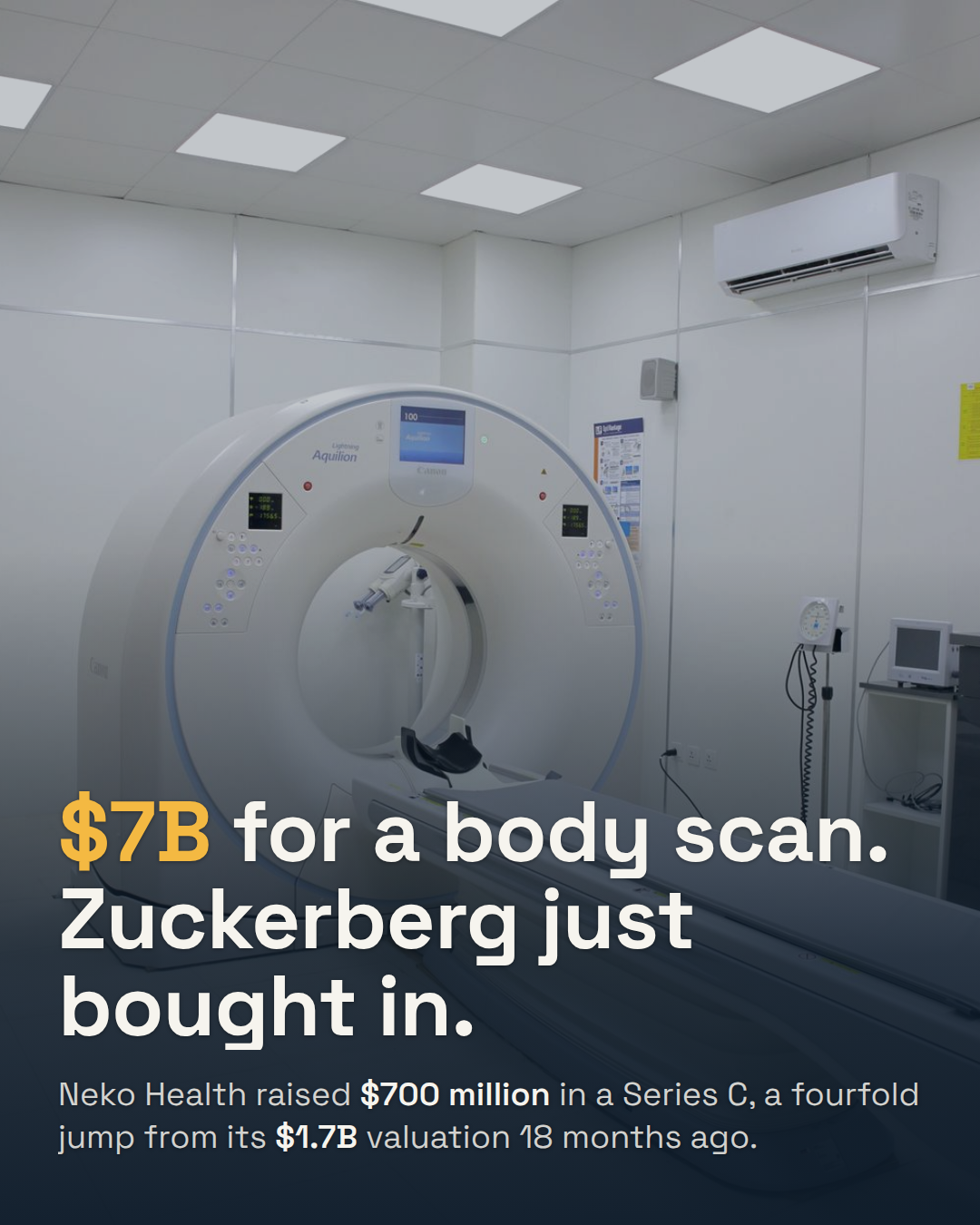
On July 15, Stockholm-based Neko Health closed a $700 million Series C at a valuation of roughly $7 billion, a fourfold jump from the $1.7 billion it was worth after its $260 million Series B just eighteen months earlier, in January 2025. The round was led by Lightspeed Venture Partners and co-led by O.G. Venture Partners, with existing backers Atomico, General Catalyst and Lakestar returning alongside new institutional money from Liberty City Ventures, Positive Sum and BDT & MSD. It's also stacked with individual checks from Mark Zuckerberg and Priscilla Chan, Tim Ferriss, Maria Sharapova, Thierry Henry, Jimmy Iovine, will.i.am and Claudia Schiffer.
Neko, co-founded by Spotify's Daniel Ek and Hjalmar Nilsonne, sells a 60-minute, non-invasive full-body scan that captures millions of data points on heart, skin, blood and metabolic health, priced at £299 in the UK. The company will use the new capital to open its first US clinic, in Manhattan, later this year, its first move into the world's largest healthcare market.
The valuation multiple is not the interesting part. What matters is what kind of company just got priced like a hypergrowth SaaS business.
A consumer-hardware company is pricing like a software company
Neko is, functionally, a subscription-adjacent diagnostics business bolted onto proprietary hardware: a scanning pod, a clinic lease, a clinician review, and a recurring reason to come back every year. A fourfold valuation increase in eighteen months, with only a handful of clinics actually operating before this raise, tells you investors are underwriting the same thing they underwrite in enterprise SaaS: a repeatable unit, a defensible loop of proprietary data, and a founder with a track record of building a platform (Ek scaled Spotify to hundreds of millions of subscribers). The scan itself is the product; the annual habit is the business model.
The cap table is doing marketing, not just financing
Zuckerberg, Ferriss, Sharapova, Henry, Iovine and will.i.am on a term sheet is not incidental. Each of those names carries an audience Neko will need to convert into its first cohort of paying US customers, and a validation signal for the affluent, health-optimizing demographic Neko is targeting first. This is the same tactic FiscEdge asks founders to plan for deliberately in our startup strategy course: treat your investor list as a distribution channel, not just a source of runway. Who signs the check can matter as much as how large the check is, especially in a consumer category where trust and word-of-mouth set the ceiling on growth.
Read the valuation jump as a forecast, not a fact
Going from $1.7 billion to roughly $7 billion in a year and a half, without yet operating at scale in the US, is a bet on a growth curve that hasn't happened yet, not a reflection of current revenue. Founders raising in this environment should study exactly how Neko's narrative was built: a defined expansion market (the US), a name-brand founder repeating a playbook that already worked once, and investors willing to pay a premium for the option on that repeat. If your own model can't yet show why a growth curve is inevitable rather than hoped for, that's the gap between your pitch and Neko's, and it's precisely the muscle we train in FiscEdge's financial modeling course: building assumptions an investor can stress-test, not just admire.
The category to watch
Preventive-health scanning sits at the intersection of two categories investors are currently paying a premium for: data-driven diagnostics and celebrity-anchored consumer brands. Neko is not an AI company in the way this newsletter usually covers, but its data-capture model, millions of biometric points per scan, reviewed and structured for a same-day clinical read, is the same infrastructure play drawing capital into AI-driven health records, wearables and longevity startups more broadly. Expect more consumer health startups to chase this same structure: hardware for data capture, software for the recurring loop, and a founder-led narrative that skips past "the market doesn't exist yet."
If you remember one thing
When a company's valuation quadruples faster than its physical footprint expands, investors are pricing the founder's next chapter, not the current one. Before you raise on that basis yourself, make sure the unit economics behind the recurring loop, not just the story, can survive a term sheet's due diligence.
We teach how to build defensible unit economics and pitch a growth narrative investors can underwrite in FiscEdge's financial modeling course and startup strategy course. New to recurring-revenue math? Start with what are unit economics. Browse the full blog. Follow @fiscedge for daily Business & AI analysis.
Topics & Categorization:
How interesting did you find this article?