Nscale Filed for an IPO at a $35 Billion Valuation. It Lost $1 Billion in Six Months.
Nscale, the Nvidia-backed AI data center company that houses Anthropic's compute, filed to go public at up to a $35 billion valuation despite a $1 billion first-half loss.

Fiscedge Academy
Contributing Faculty & Practitioner
News Breakdown · FiscEdge Academy
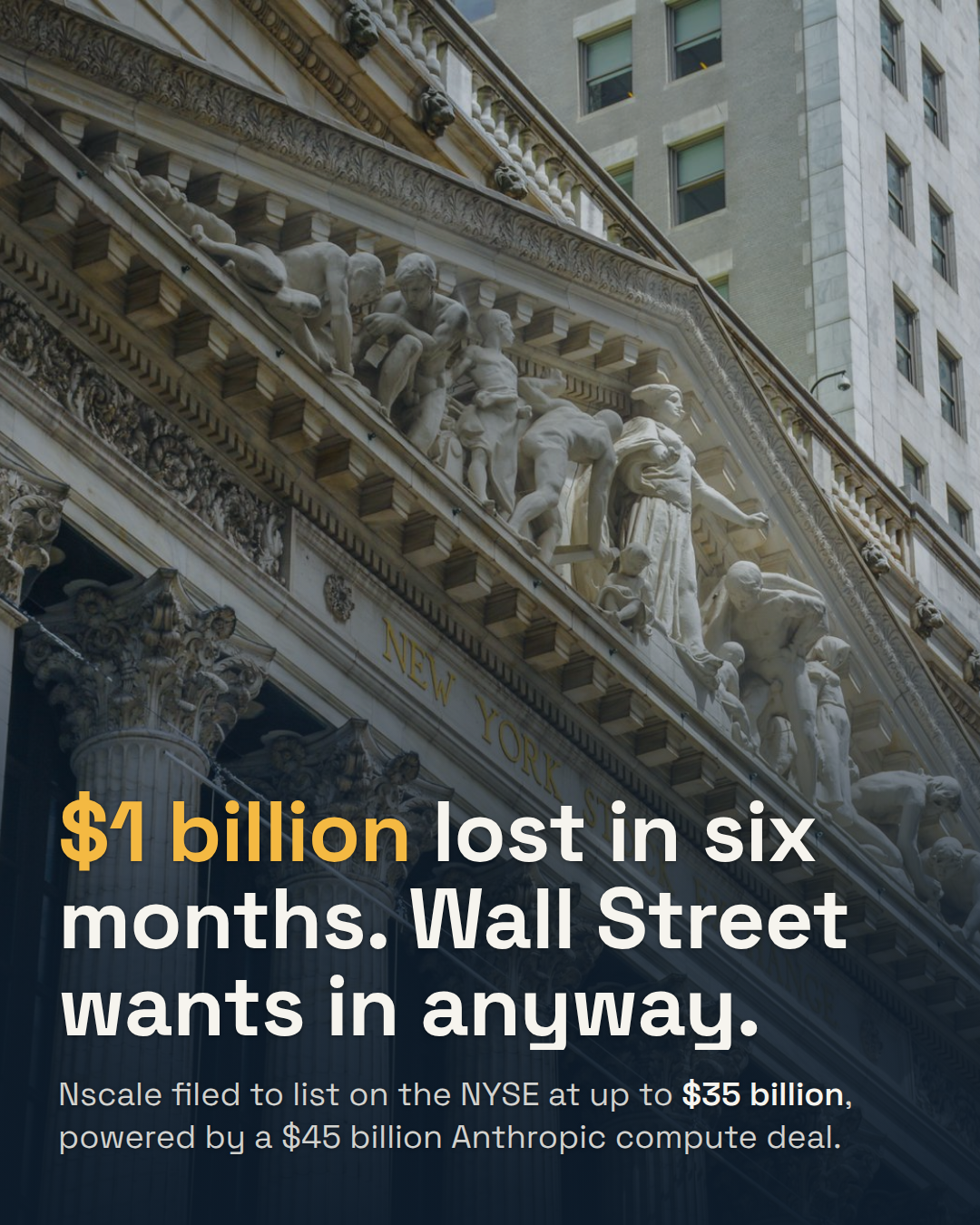
Nscale, the two-year-old, London-based company that rents Nvidia GPUs to Anthropic, filed to go public on the New York Stock Exchange on September 18, targeting a valuation as high as $35 billion. In the same filing, it disclosed a net loss of $1.02 billion on revenue of $140.6 million for the six months ended June 30, up from a $368.9 million loss on just $10.4 million in revenue a year earlier.
Read those two numbers together and the story writes itself: revenue grew 13.5x year over year, and the loss grew 2.8x right alongside it. Nscale will trade as NSCL, led by Goldman Sachs, J.P. Morgan and Morgan Stanley, and it wants Wall Street to price it not on what it earned, but on what it says it's contracted to earn: a $103 billion total backlog, scaled up from $100 million just two and a half years ago.
But the backlog number isn't the interesting part either. The interesting part is who is funding it, and it turns out one of Nscale's most important customers is also about to become one of its largest shareholders.
The loop: Nvidia funds the company that houses Anthropic's compute
On September 15, three days before the S-1 became public, Nscale signed a subscription agreement for at least $3.1 billion in convertible loan notes. Of that, $1 billion is earmarked specifically for Nvidia, convertible into Nscale equity the moment the IPO prices. Nvidia already backed Nscale's $1.1 billion Series B in 2025.
Meanwhile, the reason Nscale exists at this scale at all is a $44.6 billion compute deal it signed with Anthropic to run AI workloads out of its Monarch Compute Campus in West Virginia, built largely on Nvidia chips. So: Nvidia sells the chips, invests in the company that houses the chips, and that company rents the chips to Anthropic, which Nvidia has also invested billions in directly. Every dollar in this loop touches Nvidia at least twice before it becomes revenue for anyone else.
This isn't fraud and it isn't new (SoftBank's loan to fund its OpenAI bet, Oracle selling its own stock to cover its cloud backlog, and Anthropic's separate $35 billion deal with Nvidia-backed Lambda all rhyme with it), but it's a pattern every founder building near AI infrastructure should be able to name on sight, because it changes how you read any "backlog" or "commitment" headline in this sector.
Backlog is a promise, not a receipt
$103 billion sounds like Nscale already earned it. It didn't. A contracted backlog is future revenue an AI lab has committed to pay for compute over years, contingent on that lab actually having the cash to pay when the bill comes due, and on Nscale actually delivering the capacity on schedule. Nscale went from $100 million to $103 billion in about 30 months, largely on the strength of two or three counterparties. That's not diversified revenue, it's concentrated conviction, and the entire IPO pitch rests on Anthropic, and whoever signs the next mega-deal, staying solvent and still wanting the capacity years from now.
If you're building anything that sells to, or depends on, a small number of very large customers, this is your own risk profile in miniature. A signed contract is not cash. Model your runway off what's actually been paid, not what's been promised.
From crypto mining to a $35 billion NYSE filing in two years
Nscale didn't start as an AI company. It spun out of Arkon Energy, an Australian crypto-mining infrastructure operator, when founders Josh Payne and Nathan Townsend re-pointed the same data center know-how at GPUs instead of mining rigs in 2024. A $155 million Series A in December 2024 became a $1.1 billion Series B in 2025, then a $2 billion Series C at a $14.6 billion valuation, and now an IPO filing targeting more than double that. The infrastructure didn't change nearly as much as the story attached to it did.
The lesson isn't "pivot into AI." It's that the fastest-growing capital raises right now are going to companies that can point at a single, enormous, named counterparty and a backlog number, not at a diversified customer base. That's a very different fundraising motion than the one most SaaS founders are trained to run, and conflating the two will get your deck the wrong questions in a room currently obsessed with AI infrastructure math.
If you remember one thing
A backlog is not revenue, and a strategic investor is not a customer. When Nvidia funds the company that houses the chips it sells to a lab it also owns a piece of, every number in that chain is a bet on the other two holding, not three independent proof points. Build your own model, and your own diligence on anyone else's, the same way: what's paid, what's promised, and who's actually exposed if the promise breaks.
We break down deal structures like this one in FiscEdge's financial modeling course, and how to build a fundraising narrative that survives scrutiny in the startup strategy track. For the mechanics of building on top of foundation-model infrastructure, see AI for entrepreneurs. If backlog versus revenue still feels fuzzy, start with what are unit economics. Browse the full blog for more breakdowns. Follow @fiscedge for daily Business & AI analysis.
Topics & Categorization:
How interesting did you find this article?