Nvidia May Guarantee $250 Billion in Debt for OpenAI's Ohio Data Center. It's Also Financing the Chips Inside It.
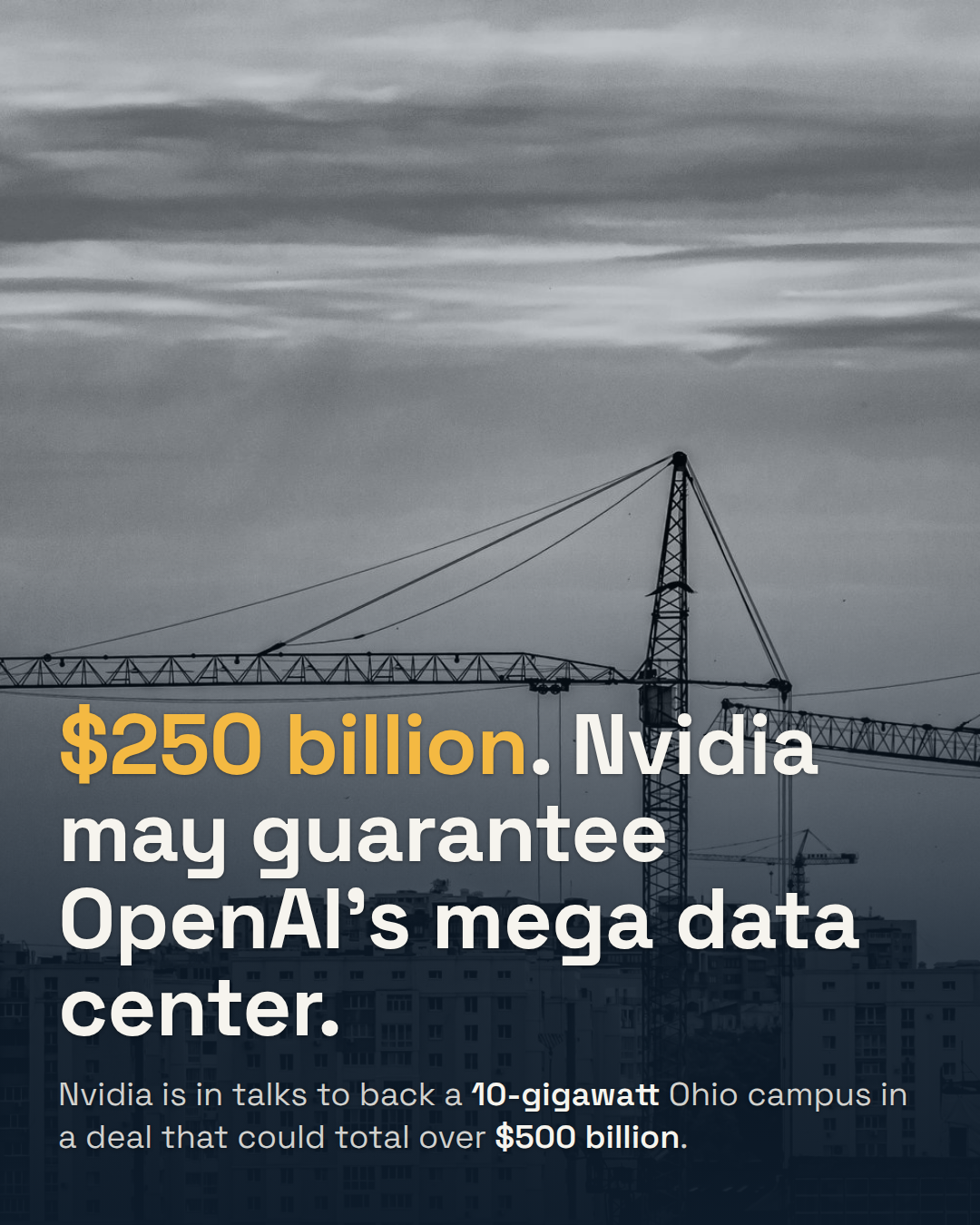
Nvidia is reportedly negotiating a $250 billion guarantee for OpenAI's 10-gigawatt Ohio data center campus, a deal that would rank among the largest financing packages ever struck in tech.

Fiscedge Academy
Contributing Faculty & Practitioner
News Breakdown · FiscEdge Academy
Nvidia is in talks to guarantee roughly $250 billion in financing so OpenAI can lease a 10-gigawatt data center campus that SoftBank's SB Energy is building on a former uranium-enrichment site in Piketon, Ohio, according to a Wall Street Journal report corroborated by multiple outlets. The guarantee alone would rank among the largest financing arrangements in tech history, and it doesn't even cover the hardware: Nvidia is separately discussing a further $350 billion package to finance the chips that will actually fill the buildings. Add it up and the Piketon campus alone could cost more than $500 billion once chips, power and construction are counted, with a first phase of roughly 800 megawatts targeted for 2028. Nothing is signed yet; both sides describe the terms as still under negotiation.
The dollar figures are the least interesting part of this story. The signal under the headline is who is writing the guarantee, and why.
The lender is also the supplier
Strip away the acronyms and the deal is straightforward: Nvidia, the company selling OpenAI the chips, is also proposing to backstop the debt OpenAI needs to build the building those chips go into. That is not a normal customer-vendor relationship, it's vendor financing at a scale the industry hasn't tried before. Nvidia already has billions committed across OpenAI, Anthropic, CoreWeave and xAI in various compute and equity arrangements; this new guarantee would tie its own balance sheet even more directly to whether OpenAI can eventually generate enough revenue to service the debt on a campus built to run Nvidia's chips. If OpenAI's growth slows, Nvidia isn't just losing a customer, it's exposed as a guarantor. Markets noticed: the same week this reporting landed, a broader tech selloff hit semiconductor names on rising unease about exactly this kind of circular AI financing, even as the Dow and S&P held up on unrelated strength elsewhere in the market.
Why OpenAI wants to own the building, not rent it
Right now OpenAI's compute runs mostly on infrastructure it doesn't control: Microsoft's Azure, plus deals with Oracle and Amazon. A guarantee that lets it lease and eventually control a dedicated 10-gigawatt campus is a bet that owning the physical layer, power contracts and all, is worth the balance-sheet risk of a $250 billion guarantee. For Nvidia, the logic is symmetric: locking in a customer's infrastructure for a decade locks in chip demand for a decade. Both companies get something. What's less clear is who absorbs the loss if the underlying business, selling AI subscriptions and API calls, doesn't grow fast enough to cover a financing structure this size.
What this means if you build on top of any of this
You don't need a data center to be affected by how it gets financed.
1. Vendor financing this concentrated is a fragility signal, not just a growth signal. When your compute or API provider's suppliers are also its lenders, an interruption anywhere in that chain, a slower OpenAI quarter, a stalled Ohio build, can ripple into pricing or availability for everyone downstream, including you. If AI infrastructure costs sit anywhere in your model, stress-test them the way we walk through in the financial modeling course, assuming a disruption scenario, not just a stable-pricing one.
2. Capital intensity at this scale should recalibrate your own build-vs-buy decisions. If OpenAI, with tens of billions in revenue, still needs a quarter-trillion-dollar guarantee to build infrastructure, that's a strong signal that founders have no business trying to own compute infrastructure themselves. Rent it, and put the savings into the parts of the business only you can build, a tradeoff we cover in AI for Entrepreneurs.
3. "Cheap" AI compute pricing today is subsidized by deals like this one. Guarantees and vendor financing exist because AI infrastructure doesn't yet pay for itself on usage revenue alone. That gap has to close eventually, through higher prices, tighter API limits, or both. Bake a pricing-increase scenario into any SaaS product built on a frontier model API, the same discipline we teach in our breakdown of what it actually costs to build a SaaS product.
If you remember one thing
When the company selling you the chips is also guaranteeing the debt to build the building for those chips, the AI infrastructure boom is being financed as much by promises as by revenue. Plan your own AI costs for the world where that gap gets priced in, not the one where it doesn't.
We cover infrastructure and vendor-risk planning like this in FiscEdge's financial modeling course and AI for Entrepreneurs. For the fundamentals of pricing an AI-dependent product, see our guide on what it costs to build a SaaS product. Browse the full blog for more. Follow @fiscedge for daily Business & AI analysis.
Topics & Categorization:
How interesting did you find this article?