Nvidia Lined Up $500 Billion in Financing. Wall Street Erased $130 Billion From Its Stock Anyway.
Nvidia partnered with six Wall Street giants to mobilize over $500 billion for AI data centers, using its own chips as collateral, and investors read it as a warning sign, not a win.

Fiscedge Academy
Contributing Faculty & Practitioner
News Breakdown · FiscEdge Academy
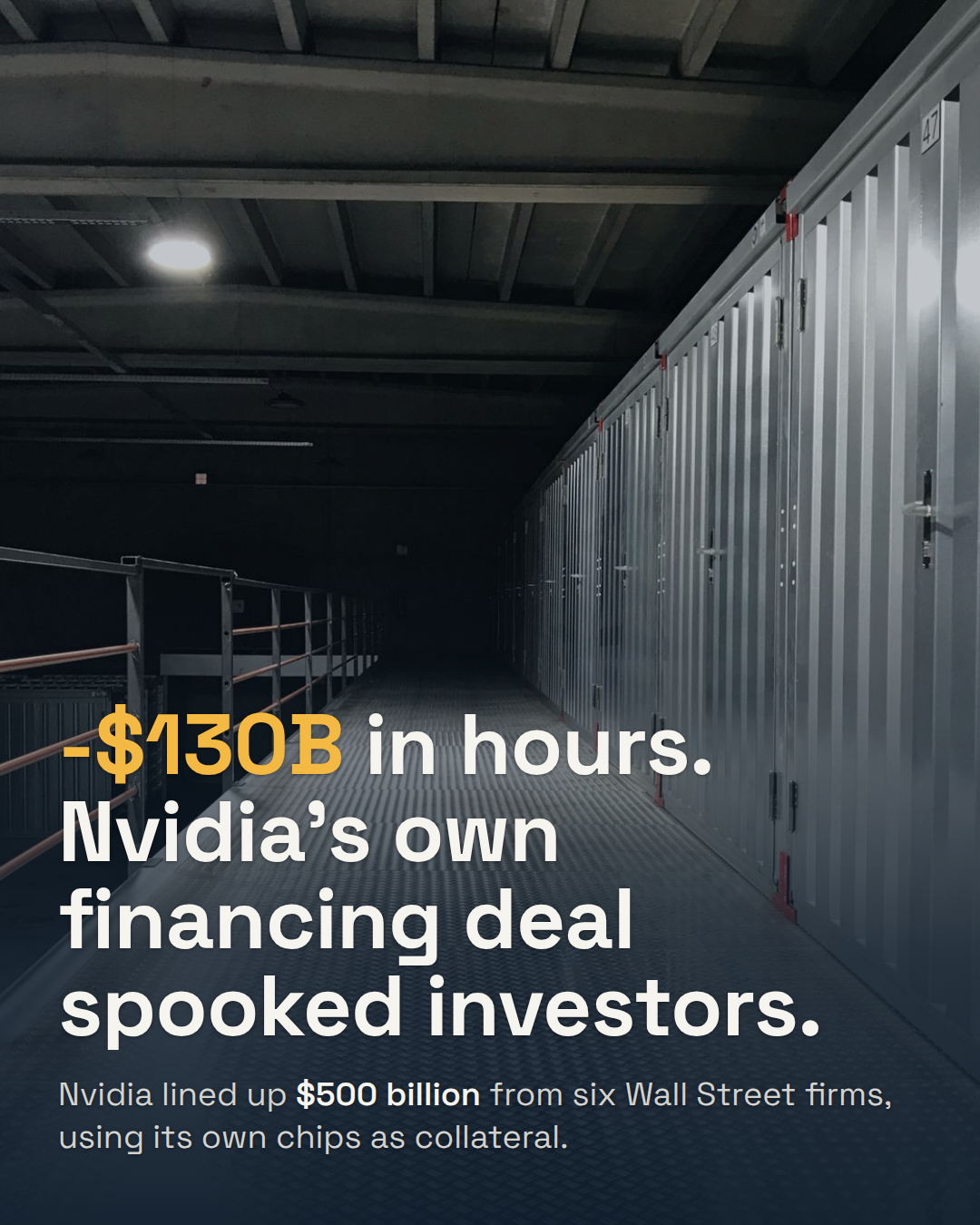
Nvidia spent Monday lining up six of the biggest names on Wall Street, Apollo, BlackRock, Blackstone, Brookfield, Goldman Sachs and KKR, to build financing platforms capable of mobilizing more than $500 billion in third-party capital for AI data center construction. The structure is unusual: Nvidia's own chips become the collateral, packaged into private offerings and bonds issued by special-purpose entities, which then lease the compute back to Nvidia's customers so they can build without draining their own cash.
Investors did not cheer. Nvidia shares fell as much as 3.2% the same day, erasing roughly $130 billion in market value, on fears that the company most exposed to an AI capex slowdown had just engineered a way to keep the spending going regardless. The dollar figure is the least interesting part of this story. The signal is that the company selling the chips is now also the company financing the buildings that hold them, and the market's first reaction was to price that as a risk, not a win.
How the collateral actually works
The mechanics matter more than the headline number. Special-purpose vehicles, backed by Apollo, BlackRock, Blackstone, Brookfield, Goldman Sachs and KKR, will issue debt (tens of billions of dollars at a time, according to reporting on the deal) using Nvidia GPUs and the data centers housing them as collateral. That debt funds construction; the resulting compute capacity gets leased to Nvidia's own customers at what the company is calling "attractive rates." CEO Jensen Huang told CNBC he approached only these six firms and that none of them turned him down, and described Nvidia chips as an "investable asset" in their own right, comparable to real estate or infrastructure debt rather than a depreciating piece of hardware.
That framing is the point. Nvidia needs its customers, OpenAI, hyperscalers, sovereign AI projects, to keep building at a pace their own balance sheets increasingly can't fund with equity alone. This follows Nvidia's reported talks earlier this summer to backstop financing for a roughly $250 billion OpenAI data center project in Ohio. Whether that specific commitment sits inside this new $500 billion platform is not yet public, but the direction is the same: Nvidia is turning into a lender to its own demand base.
Why Wall Street sold the news instead of buying it
"Circular financing" is the phrase analysts kept reaching for. When the chipmaker helps arrange the debt that buys its own chips, and its GPUs are the collateral backing that debt, the value of the collateral depends on the same AI demand cycle the financing is meant to extend. If AI infrastructure spending slows for any reason, cheaper Chinese chips undercutting GPU pricing, weaker-than-expected enterprise AI adoption, a pullback from any single hyperscaler, the collateral backing hundreds of billions in new debt loses value at the same moment the debt needs repaying. Investors have seen this pattern before, in telecom vendor financing in the early 2000s, and the muscle memory is why a $500 billion capital mobilization announcement knocked $130 billion off Nvidia's own valuation in a single session.
What this means if you build anywhere near AI
Most SaaS founders don't touch GPU financing directly, but the ripple effects reach further than the datacenter layer. First, this is a strong signal that compute supply is not going to get materially cheaper on any near-term timeline, since the entire structure exists to keep capex flowing rather than let it correct; anyone underwriting an AI-native product on an assumption of falling inference costs should stress-test that number the way you'd stress-test any other input cost in a model, which is exactly the exercise covered in FiscEdge's financial modeling course. Second, vendor concentration risk just went up a level: if Nvidia is now financing the infrastructure its biggest customers run on, an AI lab's cost structure and its chip supplier's balance sheet are more entangled than they look on a pricing page, worth factoring into any build-versus-buy decision covered in the AI for entrepreneurs track.
If you remember one thing
Nvidia didn't just sell $500 billion worth of future demand, it agreed to help finance it, using its own chips as the collateral. Wall Street's first read was that this looks less like confidence and more like a company propping up the cycle it depends on, and founders pricing AI into their own roadmaps should treat today's compute costs as a floor, not a ceiling.
We teach this playbook in FiscEdge's startup strategy course. Browse the full blog for more news breakdowns. Follow @fiscedge for daily Business & AI analysis.
Topics & Categorization:
How interesting did you find this article?