Nvidia Posted a $96 Billion Quarter, Up 106%. Its Guidance Says Demand Is Still Accelerating.
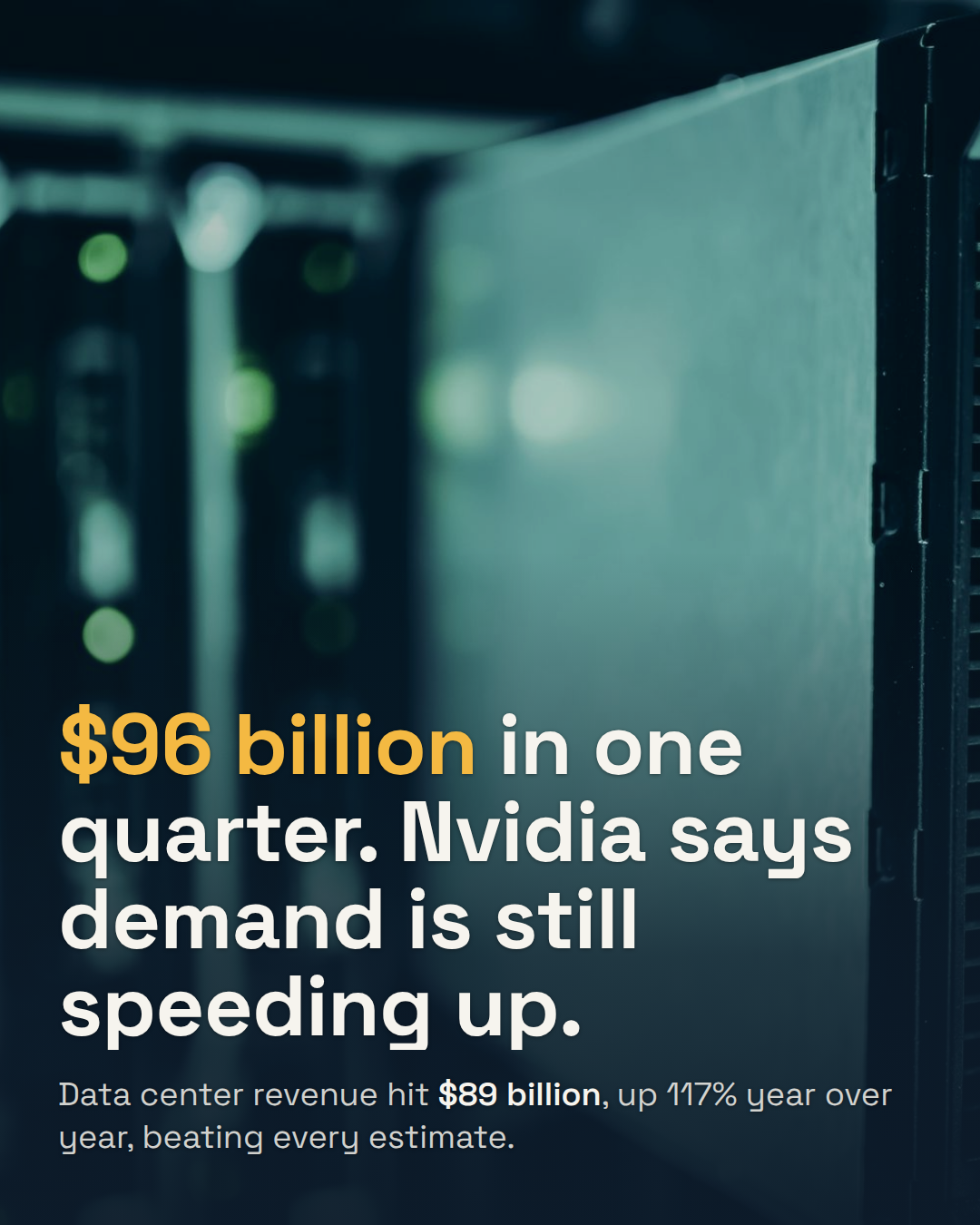
Nvidia's data center revenue hit $89 billion, up 117%, and its next-quarter guidance excludes China entirely and still points to 85%+ growth.

Fiscedge Academy
Contributing Faculty & Practitioner
News Breakdown · FiscEdge Academy
Nvidia reported $96.2 billion in revenue for its fiscal second quarter, up 106% from $46.7 billion a year ago, according to the company's official filing confirmed by Fortune and Benzinga. Data center revenue, the AI chip business that now drives nearly the entire company, hit $89.0 billion, up 117% year over year and beating analyst estimates of $85.7 billion. Non-GAAP earnings per share came in at $2.22, above the $2.09 Wall Street expected, and shares rose roughly 4.7% in after-hours trading.
Those are the headline numbers. They are also, according to CEO Jensen Huang on the earnings call, not the point. "AI has reached its inflection point," Huang said. "It's doing useful work. Its tokens are productive and profitable. Now, compute is revenue."
The number is the least interesting part
A 106% revenue jump at a company this size would be remarkable in any quarter. What makes this one different is the guidance. Nvidia told investors to expect $108 billion in third-quarter revenue, plus or minus 2%, and it built that number excluding any data center compute revenue from China entirely. Strip out one of the largest AI markets on earth and the company is still guiding to 85-93% year-over-year growth.
That is the signal under the headline. Two years into the AI infrastructure buildout, skeptics have argued that hyperscaler capex is a promise, not a proof, of demand: that Microsoft, Google, Amazon and Meta are spending on faith that customers will eventually show up and pay for the compute. Nvidia's numbers say the customers already showed up. This isn't a forecast of future AI adoption, it's revenue booked today, at a 75% gross margin, from chips that shipped and were paid for.
Why the guidance matters more than the beat
Beating a quarter is not hard to explain away as one-time tailwinds. Guiding to near-90% growth for the next quarter, with an entire national market carved out of the base case, is much harder to wave off as noise. It tells you the order book for Nvidia's next-generation Vera Rubin platform is filling faster than the company can build it, not slower.
That has a direct, unglamorous consequence for anyone renting compute rather than buying racks: scarcity pricing doesn't ease when the scarce good's maker reports record demand. FiscEdge covered Nvidia's own decision to raise AI server prices over 15% two weeks ago, blaming memory chip costs. This quarter's numbers explain why that increase stuck: demand for the underlying hardware is still accelerating, which means there is no near-term pressure on Nvidia, or on the cloud providers who buy from it, to compete that price back down.
What this means if you're building or raising right now
For founders whose products run on rented AI infrastructure, three things follow directly from this report:
- Treat compute cost as a rising line, not a flat one. A supplier posting 106% growth and guiding higher has zero incentive to cut prices. Build your financial model assuming inference and GPU-hour costs trend up through 2027, not sideways.
- Capital is still chasing this category, and that changes your fundraising comps. Investors who read a $96 billion quarter with an 85%+ growth guide will benchmark your AI-adjacent pitch against a market that is demonstrably still expanding, not cooling. If your deck assumes AI infrastructure spend plateaus soon, be ready to defend that against this print.
- Your unit economics need a stress case, not just a base case. Run your model at today's compute pricing and again at 15-20% higher. If the business only works in the first scenario, that's a real risk to flag to yourself before an investor flags it to you.
- Efficiency is now a durable moat, not a nice-to-have. Teams that architect for smaller models, aggressive caching and lower token counts per task are structurally insulated from a cost curve that just got a fresh data point confirming it keeps climbing. This is core to what we teach in building SaaS with AI and AI for entrepreneurs: the architecture decisions you make now determine how exposed you are to a supply chain you don't control.
If you remember one thing
Nvidia didn't just beat a quarter, it guided to accelerating growth while deliberately excluding China from the math, which is the clearest signal yet that AI compute demand is real revenue, not just capex promises. If you're building on top of that infrastructure, model your costs as if the party continues, because right now the company selling the shovels says it does.
We teach how to build cost-resilient, fundable AI products in FiscEdge's financial modeling and building SaaS with AI courses. Browse the full blog for more breakdowns like this one. Follow @fiscedge for daily Business & AI analysis.
Topics & Categorization:
How interesting did you find this article?