Nvidia Buys Hugging Face for $12.93 Billion. AI's Open Model Hub Now Has One Owner.
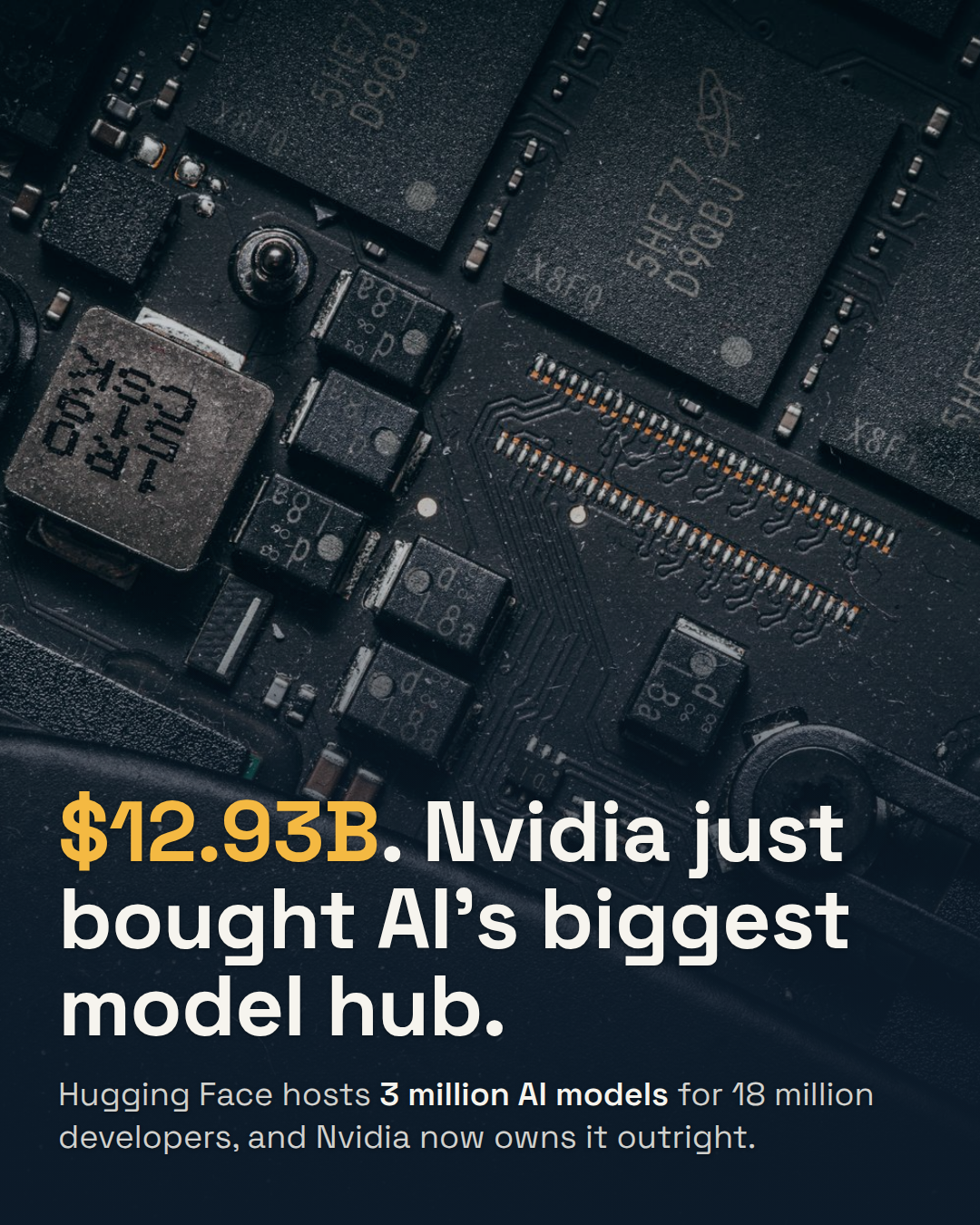
Nvidia is paying $12.93 billion for Hugging Face, the hub hosting 3 million AI models. For founders building on open source, the neutral middleman just picked a side.
Fiscedge Academy
Contributing Faculty & Practitioner
News Breakdown · FiscEdge Academy
Nvidia confirmed Thursday it will buy Hugging Face for $12.93 billion, a figure Hugging Face co-founder Clem Delangue posted down to the dollar: $12,930,300,000. The breakdown is roughly $11.9 billion paid out to shareholders plus up to $1 billion in retention equity for employees joining Nvidia. The deal is expected to close in the first half of 2027, pending regulatory clearance.
It is Nvidia's second-largest acquisition ever, behind only the roughly $20 billion it paid for Groq's assets in December. This one is not for chips or engineers. It is for a website.
Hugging Face is the platform where 18 million developers and researchers store, share and download AI models: more than 3 million models, 500,000 datasets, 1 million applications, used inside 200,000 companies. It has no meaningful revenue relative to its price tag. What it has is the default distribution layer for open-weight AI, the place a founder goes when they want a model that is not OpenAI's or Google's.
The number that matters is not $12.93 billion
The dollar figure is the headline. The real story is what Nvidia is buying with it: control, or at least influence, over the front door to open-source AI.
Nvidia has spent three years selling the picks and shovels of the AI boom, the GPUs everyone from OpenAI to a two-person startup rents by the hour. Hugging Face is a different layer entirely, the software and community layer where developers actually decide which model to use. Owning it puts Nvidia inside the decision, not just underneath it. Jensen Huang has been explicit that this is a full-stack bet: Nvidia wants to sit at every point where an AI product gets built, not just the point where it gets trained.
That is also why this deal moved so fast. CNBC first reported Nvidia was close to a deal in late August, weeks after Hugging Face had been reported to be exploring outside investment at a similar valuation. A month of "exploring" turned into a signed agreement, a pace worth remembering the next time your own strategic conversations feel like they are dragging.
The promise Nvidia has to keep
The obvious objection: if the company that makes the GPUs also owns the platform where you pick your model, does it start steering you toward Nvidia hardware? Delangue's answer, posted alongside the deal, was that an open model hub is "structurally, by definition, a de-concentration platform," and that Nvidia has committed to keeping Hugging Face "open, independent and compute agnostic." Concretely, that means AMD's ROCm builds, Intel back-ends and Apple silicon quantizations are supposed to keep working exactly as they do today.
That commitment is the load-bearing claim in the whole deal, and it is worth treating as a promise to watch rather than a fact already delivered. Regulators reviewing the deal through mid-2027 will be watching the same thing. So should anyone whose product depends on it.
What this changes if you build on open models
If your stack pulls a model, dataset or Space from Hugging Face, you now depend on infrastructure owned by the largest GPU company on earth, not a neutral nonprofit-adjacent startup. That is not automatically bad. Nvidia has every incentive to keep the hub thriving, since a shrinking open-source ecosystem is a shrinking market for its chips. But "every incentive to be neutral" and "structurally neutral" are not the same guarantee, and the gap between them is exactly what a smart founder builds contingency around rather than assumes away.
Two practical moves. First, if a specific model or dataset is load-bearing for your product, know where else you could get it before you need to, the same vendor-dependency mapping we walk through in FiscEdge's AI for entrepreneurs track. Second, this deal is a live example of a company buying distribution instead of building it, a pattern worth studying if you are thinking about your own moat, covered in more depth in FiscEdge's startup strategy course. Owning the shelf, not just the product on it, is a strategy available to founders at much smaller scale than Nvidia's.
If you remember one thing
Nvidia did not just buy a website with 18 million users, it bought the place where the AI industry decides which models to trust, and it is now asking that same industry to trust its promise to leave the shelf neutral. Any founder building on someone else's open platform should assume the same question applies to their own stack: who owns the layer you depend on, and what happens the day their incentives stop lining up with yours.
We cover platform risk and moat-building in FiscEdge's startup strategy course and AI for entrepreneurs track. Browse the full blog for more news breakdowns. Follow @fiscedge for daily Business & AI analysis.
Topics & Categorization:
How interesting did you find this article?