Nvidia Just Signed a $500 Billion Deal With SK Group. The Target Isn't Chips, It's Memory.
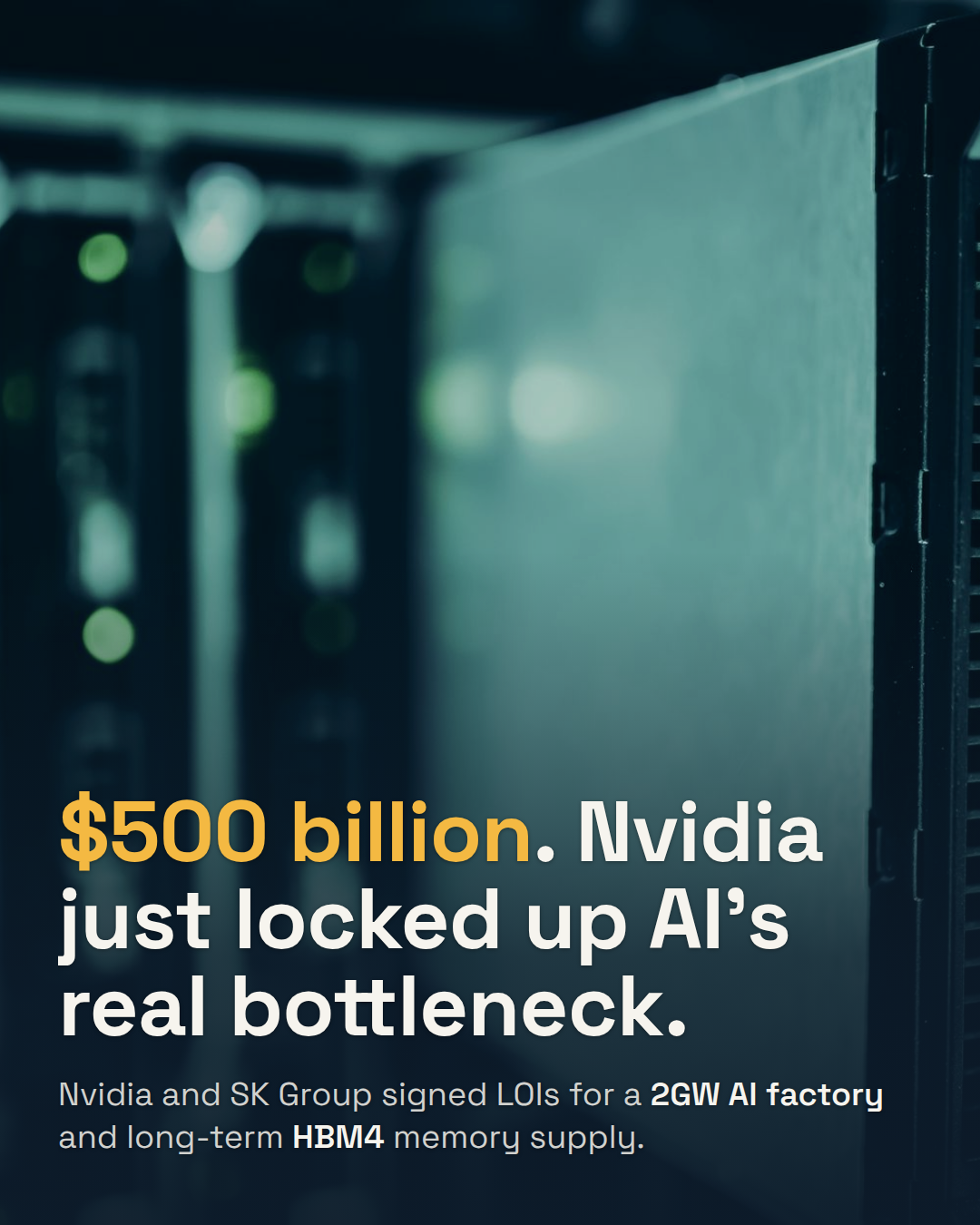
Nvidia and SK Group signed letters of intent worth over $500 billion for AI factories and next-gen HBM4 memory, locking up the resource actually constraining AI infrastructure growth.

Fiscedge Academy
Contributing Faculty & Practitioner
News Breakdown · FiscEdge Academy
Nvidia and South Korea's SK Group signed Letters of Intent on July 25 for a partnership worth more than $500 billion. SK Telecom will build a 2-gigawatt Nvidia Vera Rubin DSX AI Factory, with the first phase coming online in 2027. In a parallel agreement, Nvidia locked in SK Hynix as a preferential, multi-year supplier of HBM3E and next-generation HBM4 memory, the specialized chips that sit next to GPUs and feed them data. Nvidia is also putting $1 billion into Naver, Korea's largest cloud company, to expand its data centers.
$500 billion is the number every headline led with. It's also the least interesting part of this story. The signal under the headline is what Nvidia actually spent that money locking down: not more GPU capacity, but the memory that GPUs can't run without.
The bottleneck moved from chips to memory
For two years, the AI infrastructure story was about who could get their hands on enough GPUs. That story is changing. HBM4 pricing is running around $500 per stack, and Morgan Stanley analyst Joseph Moore is on record arguing memory shortages could actually intensify through 2027 and 2028, not ease. Nvidia's response was to go around the open market entirely and secure first call on SK Hynix's leading-edge output ahead of hyperscalers and rival chipmakers competing for the same supply. When the world's most valuable AI company spends $500 billion to guarantee a memory allocation instead of just buying more compute, that's a clearer read on where the real constraint sits than any earnings call.
The stock drop that proves the point
Here's the detail most coverage buried: on the same day SK Hynix and Nvidia announced what SK executives called one of the industry's most significant partnerships, SK Hynix shares fell 7.7%, their worst single session in months. That wasn't a verdict on the deal. It landed inside a broader KOSPI rout of over 8% triggered by unexpectedly strong U.S. jobs data, and at least one Wall Street analyst raised, not cut, Nvidia's price target on the news. The mismatch between a landmark supply lock-up and a red stock chart is itself informative: markets are still digesting AI infrastructure deals through a macro lens first, deal fundamentals second. If you're watching public comps to gauge sentiment toward AI-adjacent businesses, a single down day tells you less than it looks like it does.
Why founders should care about a memory deal
You don't need to touch a data center for this to matter to your P&L.
1. Your inference costs are downstream of a supply chain you don't control. Every dollar you pay for GPU-backed features, managed AI infrastructure, or API calls to a frontier model is gated in part by HBM availability. Nvidia just needed a $500 billion deal to guarantee its own supply; that is not a market where prices are about to soften. Budget accordingly, and revisit the AI cost assumptions in your model the way we teach in the financial modeling course, not as a fixed line item but as one that can move against you.
2. Vertical lock-up deals are becoming the norm, not the exception. Nvidia didn't wait for the spot market; it pre-bought years of supply and took an equity-adjacent stake in a cloud provider (Naver) to secure downstream capacity too. If your product depends on any single upstream vendor, whether that's a model API, a cloud region, or a specialized chip, this is the playbook incumbents now use to protect themselves, and the one you should study before you're the company left competing for leftover capacity.
3. AI infrastructure economics belong in your unit economics from day one. Founders building AI features often price them like software, then discover compute is their largest variable cost. That's exactly the trap we walk through in AI for Entrepreneurs, and it's worth revisiting alongside our breakdown of what it actually costs to build a SaaS product before you lock in pricing you can't sustain if memory and compute costs stay elevated through 2028.
If you remember one thing
The AI industry's next scarcity fight isn't over chips, it's over the memory that feeds them, and Nvidia just paid $500 billion to make sure it doesn't lose that fight. If your business has any AI-driven cost line, assume elevated infrastructure pricing persists for years, not quarters, and price your product accordingly.
We break down infrastructure cost planning like this in FiscEdge's financial modeling course and AI for Entrepreneurs. For the fundamentals of pricing an AI-dependent product, see our guide on what it costs to build a SaaS product. Browse the full blog for more. Follow @fiscedge for daily Business & AI analysis.
Topics & Categorization:
How interesting did you find this article?