OLIX Raises $312M at a $3.3B Valuation. It's Now Europe's Largest Semiconductor Funding Round Ever.
A 25-year-old founder's photonic chip startup tripled its valuation in six months, backed by Arm and Reed Hastings, by promising to route AI compute around the global HBM memory shortage.

Fiscedge Academy
Contributing Faculty & Practitioner
News Breakdown · FiscEdge Academy
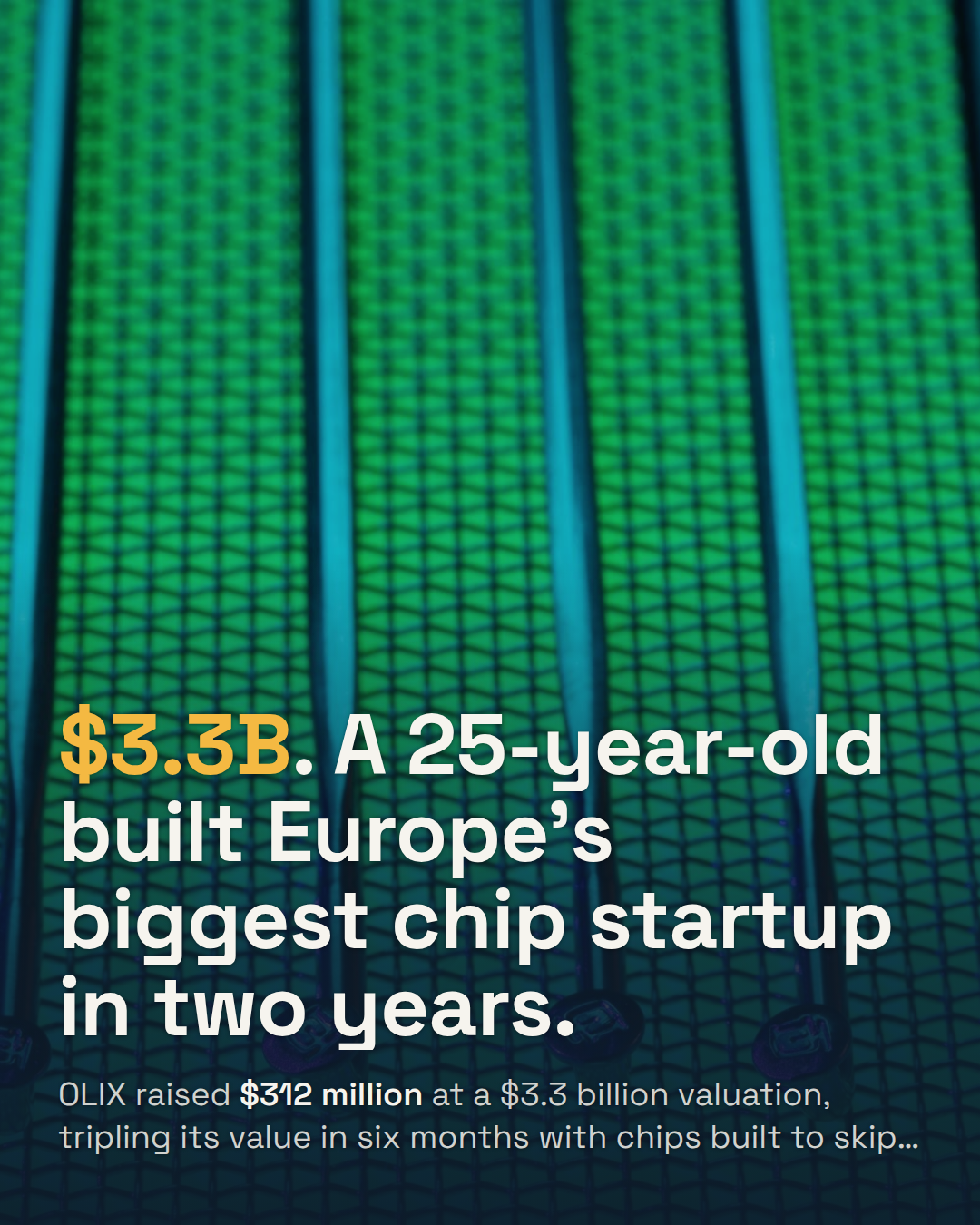
London chip startup OLIX has closed a $312 million Series B at a $3.3 billion valuation, the largest venture round ever raised by a European semiconductor company. The round nearly triples what OLIX was worth six months ago, when it raised $220 million at a $1 billion valuation in February. New money came from Arm, market maker Hudson River Trading, Netflix co-founder Reed Hastings and the UK government's own Sovereign AI venture fund, while earlier backers Hummingbird Ventures, Creandum, Plural, Crane, Phoenix Court and Transition all increased their positions. Stanford's Nick McKeown, the professor who co-invented software-defined networking, OpenFlow and P4, joined the board the same day.
The founder is 25. The company is two years old. The number is the least interesting part.
A chip that skips the memory bill entirely
OLIX builds what it calls Optical Tensor Processing Units, or OTPUs: chips that move AI inference math through light instead of electricity. The pitch isn't "faster," it's "cheaper to run at scale." Every Nvidia GPU cluster burns a growing share of its budget on high-bandwidth memory (HBM), a component now in chronic global shortage and a major reason AI infrastructure costs keep climbing. OLIX's architecture replaces HBM with SRAM-based memory and optical die-to-die interconnects, which it says cuts cost and power per token while scaling to racks of more than 100,000 interconnected chips. That is a direct shot at the single biggest line item in anyone's AI infrastructure spend.
The company itself is barely two years old. It was registered in March 2024 as Flux Corp by James Dacombe, a Thiel Fellow who simultaneously runs CoMind, a brain-monitoring startup he founded as a teenager that has separately raised $100 million. Flux rebranded to OLIX in January 2026, right before its first big round.
Why investors are paying a memory-shortage premium
The HBM shortage isn't a rumor founders can ignore, it is already showing up in earnings. Chipmakers have flagged tightening HBM supply as a constraint on how fast they can ship AI accelerators, and every hyperscaler building a data center this year is negotiating for memory capacity as hard as for compute. OLIX's bet is that a photonic architecture sidesteps that bottleneck rather than competing for the same scarce component, and the UK government putting its Sovereign AI fund behind that bet signals this isn't read as a science project anymore, it's read as infrastructure policy.
That framing matters for how fast the money moved. A 3x markup in six months usually means either a hype cycle or a real supply constraint investors are racing to get ahead of. Here, the backers are unusually hard-nosed: Arm and Hudson River Trading aren't momentum funds, and a Stanford networking pioneer doesn't join a board to chase a headline. The signal is that serious infrastructure money believes the memory bottleneck is structural, not temporary, and is paying up for anyone credibly positioned to route around it.
What this changes for founders and operators
- Your AI compute cost curve is not fixed, it's a supply story. If your unit economics assume GPU and memory pricing stay flat, this round is a reminder that the underlying hardware market is moving fast enough to change your margins in a single fiscal year. Model a range, not a point estimate, when you're forecasting infrastructure spend.
- Infrastructure bottlenecks are where the biggest rounds are forming right now. Between this and Valar Atomics' nuclear-powered compute round earlier this year, the largest checks in AI aren't going to model layer startups anymore, they're going to whoever removes a physical constraint on compute. If you're raising and your story is "smarter model," it's worth asking whether "cheaper, more available compute" is the pitch investors actually want to fund this year.
- A young founder running two companies at once still closed the largest round in his category. Dacombe's dual-CEO setup would be a red flag in most decks. It wasn't disqualifying here because the metrics, a 3x markup backed by named enterprise-grade investors, did the talking. Investors underwrite proof over biography.
- Government-backed strategic capital is now a real category to track. The UK's Sovereign AI fund investing alongside private VCs is part of a broader pattern of state capital chasing AI infrastructure independence. If you're building anything adjacent to compute, energy or chips, sovereign funds are worth researching as a funding source.
If you remember one thing
OLIX didn't raise Europe's biggest semiconductor round because photonic chips are a novel idea, it raised it because the HBM shortage turned "an alternative to scarce memory" into one of the most fundable pitches in hardware. If you're building anything that depends on AI compute costs coming down, the lesson isn't to bet on any one chip company, it's to underwrite your own model on the assumption that infrastructure pricing keeps moving, and to build the muscle to re-forecast fast when it does.
We teach how to model infrastructure and unit-economics risk into a real forecast in FiscEdge's financial modeling track, and how to size up hardware and infrastructure opportunities in AI for entrepreneurs. If you're weighing where the next fundable bottleneck is before you build, startup strategy covers how to read a market like this one. Browse the full blog for more breakdowns like this. Follow @fiscedge for daily Business & AI analysis.
Topics & Categorization:
How interesting did you find this article?