OpenAI's Valuation Could Hit $1.5 Trillion. It Was $852 Billion in March.
Investors have offered OpenAI a $1.2 trillion valuation for a new round, but the company reportedly wants $1.5 trillion. Here's what that markup means for your own fundraise.

Fiscedge Academy
Contributing Faculty & Practitioner
News Breakdown · FiscEdge Academy
Investors have approached OpenAI about a new funding round that would value the company at roughly $1.2 trillion, the Financial Times reported on September 15, with Reuters, CNBC and Forbes confirming the talks the following day. OpenAI, according to the same reporting, thinks that number is too low: the company is reportedly holding out for at least $1.5 trillion, pointing to accelerating adoption of its Codex coding tool and its newest models, GPT-6 Astra and GPT-5.6 Sol, as justification.
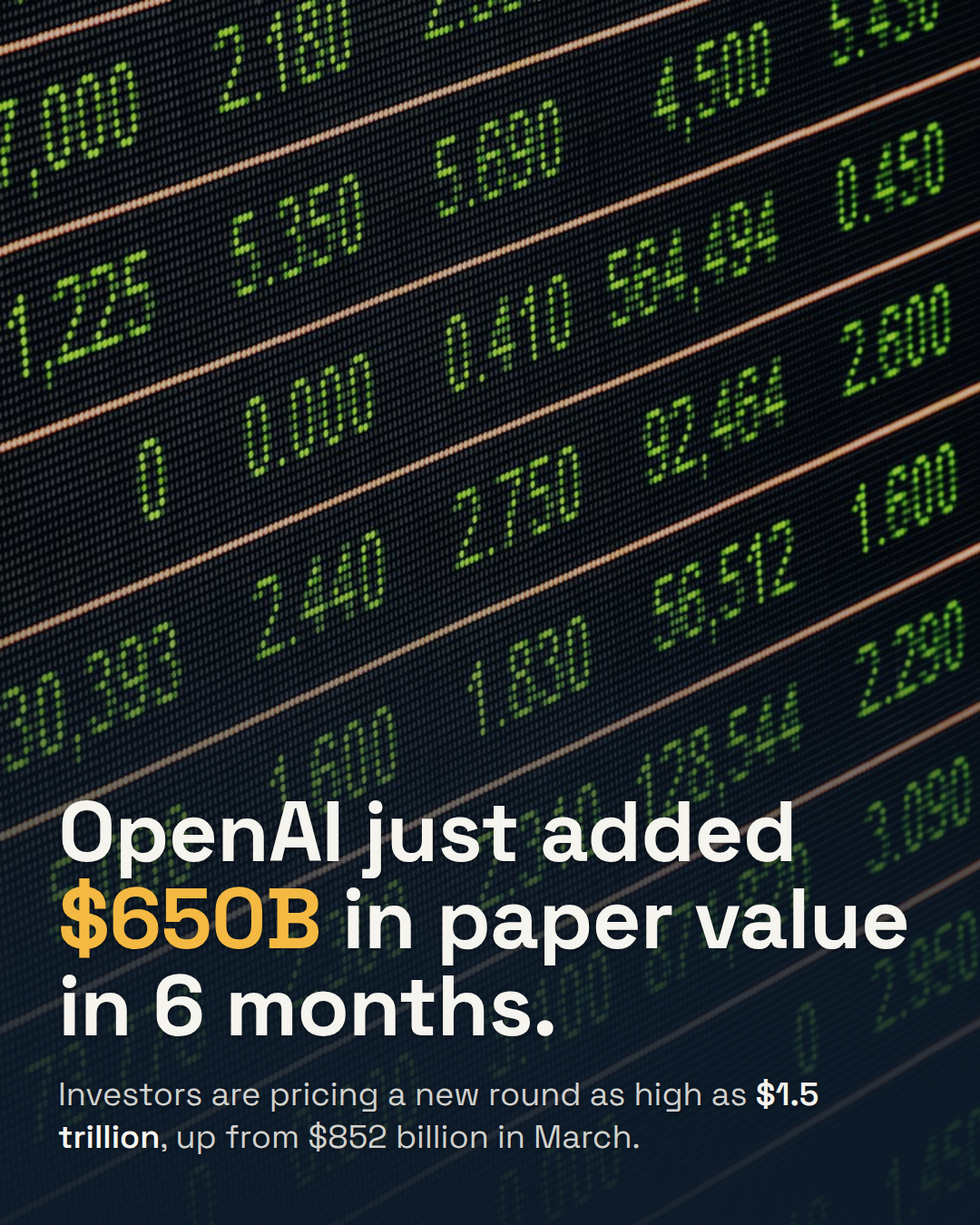
Either number is a jump. OpenAI's last primary round, a $122 billion raise led by SoftBank, closed on March 31 at an $852 billion valuation. An August secondary sale let employees cash out $7 billion of stock at that same $852 billion mark. Six months later, the low end of the new conversation is 41% higher. The high end, the figure OpenAI itself is said to be pushing for, is a 76% markup, adding roughly $650 billion of paper value in the time it takes most startups to close a Series B.
The number is the least interesting part. The talks are described by every outlet as early-stage, investor-initiated, and unformalized, meaning the $1.2 trillion to $1.5 trillion range is a negotiating position, not a signed term sheet. The signal under the headline is what that range is being priced against.
The markup isn't tied to a new financial disclosure
Public companies reprice on earnings, guidance, or a specific catalyst investors can point to. OpenAI has not published new revenue figures alongside this story. The justification circulating is product traction, Codex usage and two model releases, which is a real signal but not a number anyone outside the company can independently verify the way you can check quarterly revenue growth. That gap matters because private valuations at this scale increasingly function as a market-wide anchor: VCs benchmarking your Series A multiple, or a corp-dev team pricing an acquisition, will point to "OpenAI just re-rated 40-plus percent on traction alone" as evidence for why your own AI-adjacent multiple should also expand. You should be ready to explain, with your own numbers, why that comparison does or doesn't hold for your business, a skill we build out in FiscEdge's financial modeling course.
Your cap table already has OpenAI exposure, even if you never raised from it
If any of your existing investors also hold OpenAI, Anthropic, or adjacent AI infrastructure positions, their fund's marks, and by extension their appetite and pricing behavior for your next round, are correlated with headlines like this one, whether or not your product touches OpenAI's technology at all. A single private company re-rating by hundreds of billions of dollars on sentiment is a portfolio-concentration story for the venture ecosystem funding you. Understanding who is exposed to what, on the other side of your term sheet, is part of the same diligence we cover in FiscEdge's startup strategy course.
Employee equity math just got harder to explain
If you are building on OpenAI's API, and using its pricing and release cadence as inputs to your own roadmap, notice the pattern: this is the fourth distinct pricing event for OpenAI's equity in twelve months, a $300 billion tender, a $500 billion tender, an $852 billion primary round, and now a $1.2-1.5 trillion conversation. Each repricing changes the reference point new hires compare their own offer letters against, whether they work at OpenAI or at a startup built on top of it. If you grant equity and your team benchmarks "AI company valuations" against headlines like this one, you need a clear, repeatable story for why your strike price and your growth curve don't need to track someone else's trillion-dollar number. That's exactly the kind of investor-facing and employee-facing narrative we teach founders to build in FiscEdge's business fundamentals course.
What this changes for founders
Treat this as a data point about capital availability, not a valuation benchmark for your own company. The fact that investors are offering, unprompted, to fund OpenAI's next round at a 41% premium tells you liquidity for the very top of the AI market remains extremely deep, even as OpenAI itself has said an IPO won't happen until 2027. That liquidity has not trickled down evenly. If you are raising in the next two quarters, expect investors to reference this number in the same conversation where they tell you your own multiple needs to compress, and come prepared with your own comps, not theirs.
If you remember one thing
OpenAI's valuation may climb by hundreds of billions of dollars on investor demand alone, with no new revenue disclosure attached. That tells you where AI capital is concentrated, not what your own company is worth. Bring your own numbers to the next round, not someone else's headline.
We cover valuation benchmarking, cap table strategy, and fundraising narrative in FiscEdge's financial modeling course, startup strategy course, and business fundamentals course. Browse the full blog for more news breakdowns. Follow @fiscedge for daily Business & AI analysis.
Topics & Categorization:
How interesting did you find this article?