OpenAI's Revenue Is $20 Billion Lower Than Investors Were Told. The Chip Stack Paid for It First.
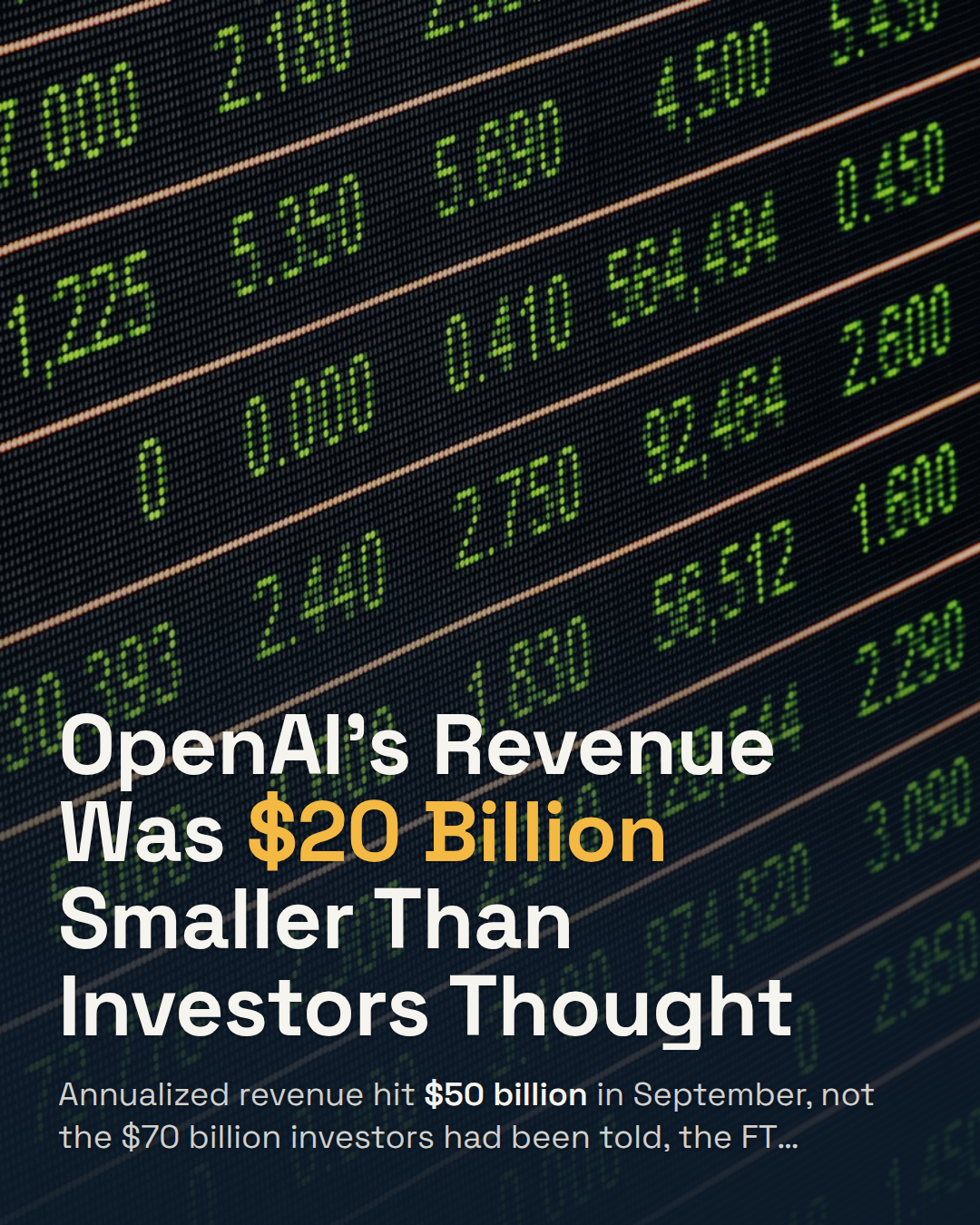
A Financial Times report put OpenAI's annualized revenue near $50 billion, $20 billion below the figure investors had circulated. Oracle, Nvidia and CoreWeave fell within hours.

Fiscedge Academy
Contributing Faculty & Practitioner
News Breakdown · FiscEdge Academy
OpenAI's annualized revenue is running at close to $50 billion as of the end of September, the Financial Times reported Thursday, citing documents shared with the company's financial backers. That is roughly $20 billion below the figure that had been circulating among investors for the past two weeks. The Nasdaq Composite fell about 1.4% the same day, its worst session since mid-August, and the stocks most exposed to OpenAI's compute buildout fell harder: Oracle dropped roughly 5.5%, CoreWeave nearly 8%, Intel about 5%, and Nvidia, AMD and Broadcom each lost 3% to 4%.
The number itself is the least interesting part. OpenAI didn't lose $20 billion in sales between one Tuesday and the next. What happened is that two different numbers, both describing the same company, finally collided in public.
Two companies, two different rulers
A source familiar with the backer documents told reporters the higher $70 billion figure never actually came from OpenAI. It was an estimate, likely built by investors trying to compare OpenAI's growth to Anthropic's on equal footing. The problem: Anthropic's headline revenue includes gross billings that flow through cloud partners, while OpenAI's $50 billion figure is net. Put two companies on different rulers and one of them will always look like it's shrinking, even when both are growing.
OpenAI's own numbers, as it happens, were not bad. The company told backers its total run rate grew 77% in the third quarter, with enterprise revenue up 107% over the same stretch. That's the kind of quarter most SaaS boards would open a bottle for. It still cost the chip stack tens of billions in market cap in a single session, because the market had been pricing in someone else's math.
Why the market punished the gap, not the growth
This is the second time in six months that an OpenAI accounting detail has moved the entire AI trade (CNBC and the Wall Street Journal have each flagged the pattern before). The reason a reporting discrepancy does more damage than a bad quarter is structural: Oracle, Nvidia, Intel, CoreWeave, AMD and Broadcom are all, in different ways, pricing their own growth off OpenAI's growth. When the market can't trust the denominator, it re-prices everyone sitting on top of it in one afternoon.
For founders, the mechanism matters more than the ticker symbols. Investors don't just value revenue, they value revenue they can audit and compare. The moment a number can't be reconciled against a peer's number using the same definition, the market assumes the worst version of the gap, not the most charitable one. OpenAI is also mid-negotiation on a new funding round reportedly targeting a $1.4 trillion valuation, which is exactly the wrong week for "how we count revenue" to become the headline instead of "how fast we're growing."
The founder lesson hiding in a hyperscaler story
Most companies reading this don't have Oracle's market cap riding on their ARR definition. They still make the same mistake at smaller scale: calling a gross-billings number "revenue," annualizing one unusually strong month, or quietly switching from net to gross between board decks because the bigger number reads better. It works until a lead investor, an acquirer's diligence team, or a competitor's S-1 forces a side-by-side comparison. The gap always surfaces at the worst possible time, in someone else's hands instead of yours.
The fix is boring and cheap: write down your revenue recognition policy before you need one, disclose gross-versus-net explicitly in every investor update, and never let your most-quoted metric be more flattering than your audited one.
If you remember one thing
A $20 billion "miss" that was really a measurement mismatch still cost the market hundreds of billions in a single afternoon. Define your own numbers before someone else defines them for you, because the market will always believe the less generous version of a number nobody can reconcile.
We teach how to build a defensible, investor-ready numbers story in FiscEdge's Advanced AI Product Manager masterclass, and the accounting fundamentals behind it in what unit economics actually means and whether financial modeling is as hard as founders assume. Browse the full blog. Follow @fiscedge for daily Business & AI analysis.
Topics & Categorization:
How interesting did you find this article?