OpenAI Will Burn $278 Billion by 2030. Its Own Numbers Show Why It Needs to Raise Again.
OpenAI's internal projections show $278 billion in negative cash flow through 2030, even as revenue climbs to $350 billion, a gap only new capital can close.

Fiscedge Academy
Contributing Faculty & Practitioner
News Breakdown · FiscEdge Academy
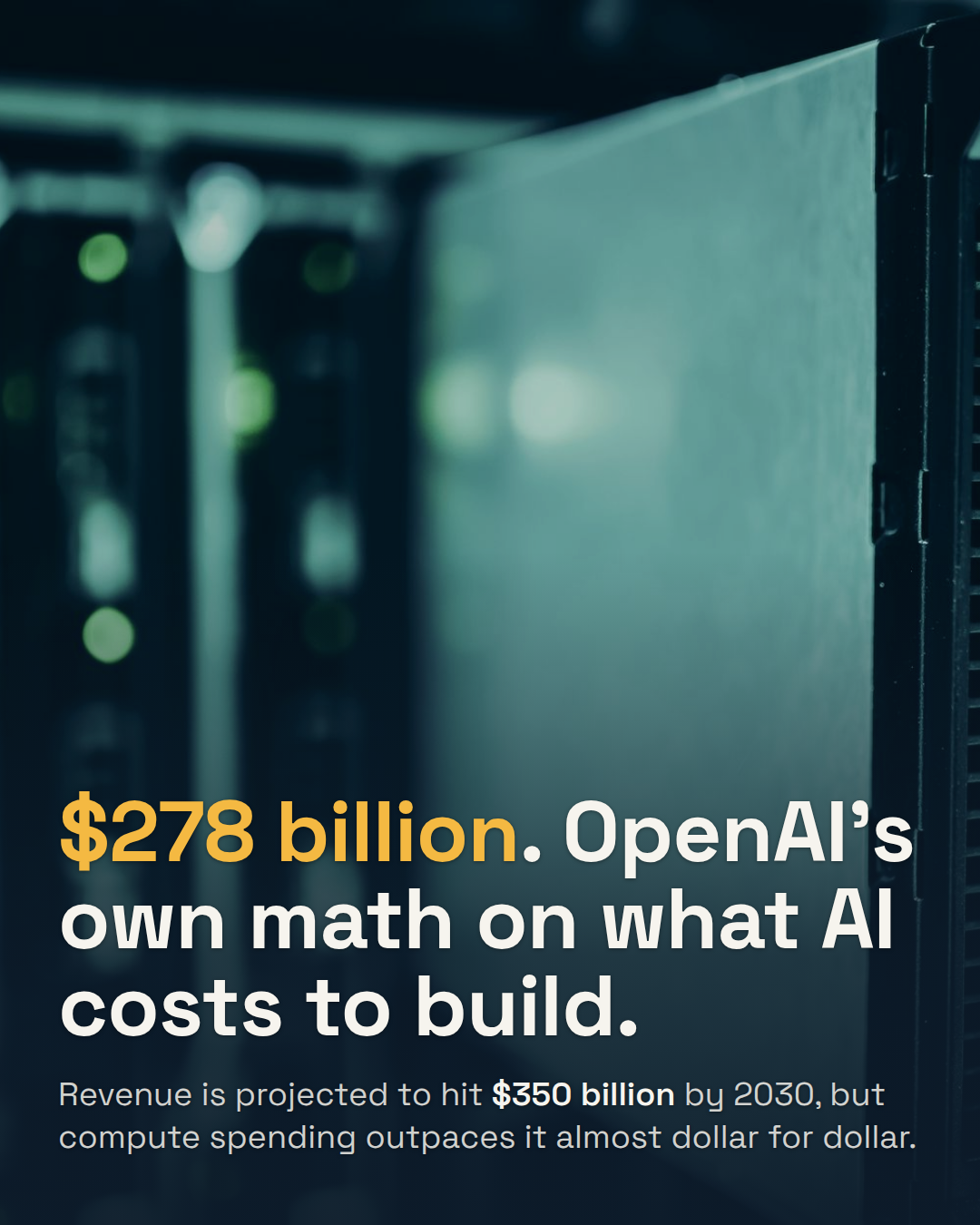
OpenAI expects to burn through $278 billion in cash between 2026 and the end of 2030, according to internal financial projections reported by the Financial Times on September 18 and independently confirmed by Reuters and The Information. The company's own materials show revenue climbing from $36 billion this year to $350 billion in 2030, total revenue across the period near $840 billion, and spending on compute and infrastructure alone reaching roughly $856 billion over the same five years. The forecast is actually an improvement: an earlier version of the same model, shown to investors in May, projected $305 billion in negative free cash flow.
The dollar figure is the least interesting part. OpenAI is showing this number to investors on purpose, in the middle of raising more money. That choice is the real story.
The number is a fundraising document, not a confession
A company does not hand a $278 billion cash-burn projection to outside investors by accident. It hands it over because the pitch only works if the shortfall is on the table: yes, we will spend nearly as much as we make for the next five years, and here is exactly why, and here is what we need from you to bridge it. The FT reported this week that OpenAI is already in early talks for a new round that could value the company at more than $1.2 trillion, and the same materials reportedly show existing capital running out by 2028. The math is not subtle. OpenAI raised $122 billion in March. On its own projection, that money funds roughly two more years of the buildout before the next check has to land.
This lands days after Sam Altman told Fortune that OpenAI will not go public in 2026, citing AI safety rather than market conditions. Put the two disclosures together and the sequencing makes sense: a company that just took its most obvious cash-raising mechanism off the table for at least a year needs private investors to believe the burn is manageable before it needs public shareholders to believe the same thing.
Compute is eating almost all of the growth
Look past the topline burn number and the more useful figure for founders is the ratio: $856 billion in projected compute and infrastructure spend against $840 billion in projected total revenue. OpenAI's own model has infrastructure costs outrunning revenue, not by a rounding error but as the central assumption of the plan through 2030. That is a company betting that scale eventually breaks the ratio in its favor, the way cloud infrastructure economics eventually did for AWS and Azure, and asking investors to fund the years before that happens.
Very few founders operate at this scale, but the pattern shows up at every size: infrastructure cost that scales with usage, funded ahead of the revenue that will eventually justify it, is now the default shape of an AI-native business. If your product sits on frontier model APIs, your own cost structure is a smaller version of the same bet OpenAI is making on itself. Knowing where your compute cost curve bends relative to revenue, before an investor asks, is the difference between a fundable growth story and a spreadsheet nobody wants to fund. FiscEdge's financial modeling course walks through building that kind of cost-against-revenue model, and our piece on what unit economics actually means is a useful primer if compute cost per user is not yet a line on your model.
What this changes for how you build and raise
Three things worth taking from this, whatever stage you are at:
- A credible burn number is now a fundraising asset, not a liability. OpenAI is using precision about how much it will lose to justify how much it needs. A founder who can show exactly where the money goes, and when the gap closes, raises faster than one who waves at "we'll figure out unit economics later."
- Compute is the new headcount. Payroll used to be the line item investors scrutinized hardest. For anything built on frontier AI, infrastructure spend is taking that role. Model it with the same discipline you'd model hiring.
- A delayed IPO does not mean less capital pressure, it means the pressure moves to private markets. OpenAI passing on a 2026 listing didn't slow its need for cash, it just changed which investors get the call. If a public-market exit is your plan for solving a cash problem, have a private-market backup ready. FiscEdge's AI for entrepreneurs course covers building that funding discipline into a product roadmap from day one.
If you remember one thing
OpenAI just showed investors a $278 billion hole and asked them to help fill it, and the market is responding by discussing a $1.2 trillion valuation anyway. The lesson is not about the size of the number. It's that a precise, honest burn forecast, tied to a clear reason the spending turns into revenue, is now the standard AI investors expect, at any company size. Build your model to survive that scrutiny before you're asked to show it.
We teach how to model compute costs, burn rate and fundraising runway together in FiscEdge's financial modeling course, and how to build AI-native products with that discipline from day one in AI for entrepreneurs. Browse the full blog for more News Breakdowns. Follow @fiscedge for daily Business & AI analysis.
Topics & Categorization:
How interesting did you find this article?