OpenAI's Revenue Run Rate Hits $40B. Its Chief Revenue Officer Just Quit.
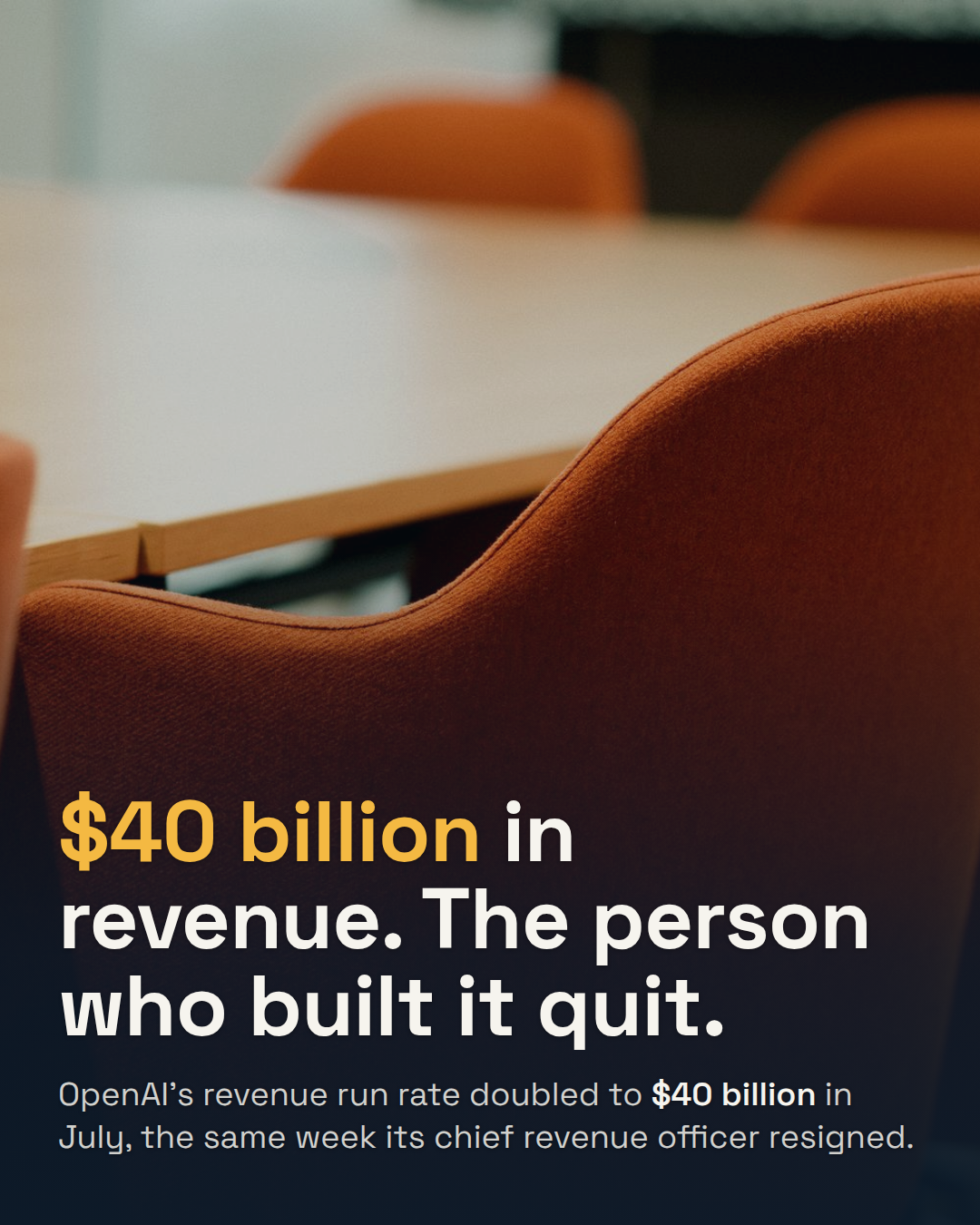
OpenAI's annualized revenue run rate topped $40 billion in July, doubling in a year, the same week its chief revenue officer resigned, the second senior exit in days ahead of its IPO.

Fiscedge Academy
Contributing Faculty & Practitioner
News Breakdown · FiscEdge Academy
OpenAI's annualized revenue run rate has topped $40 billion, according to Bloomberg, roughly doubling the pace the company closed 2025 at, when CFO Sarah Friar said the year ended above $20 billion. Co-founder and president Greg Brockman told staff the run rate grew more than 20% month over month in July alone, and enterprise revenue, driven by the Codex coding agent and ChatGPT Work, grew 32% and is now bigger than consumer revenue for the first time, according to Friar's own comments to investors.
The same week that number broke, OpenAI's chief revenue officer, Denise Dresser, resigned after eight months on the job. She is the second senior executive to leave in a matter of days, following the earlier summer departures of Brad Lightcap and Fidji Simo. Dali Rajic, formerly president and COO of the cybersecurity firm Wiz, is taking over enterprise sales.
The revenue number is the least interesting part. What matters is what's happening underneath it: a company posting the fastest acceleration in its history, sitting on a confidential IPO filing with the SEC, and losing senior leadership at the same time. For founders watching how a category-defining company handles hypergrowth right before going public, that combination is the real story.
The growth is real, and it's enterprise-led
Forget the raw $40 billion figure for a second. The composition is what's worth studying. Enterprise revenue overtaking consumer revenue is a meaningful crossover for a company that built its brand on a consumer chatbot. It means ChatGPT Work, Codex and platform sales, the products that come with contracts, seat licenses and renewal cycles, are now doing more of the work than subscriptions from individual users. A young advertising business is compounding on top of that: it reportedly crossed $100 million in annualized revenue within six weeks of launch. Three separate revenue lines accelerating at once, in the same year the company is prepping to go public, is not an accident. It's what a deliberate pre-IPO revenue mix looks like.
The exits are the signal under the headline
Denise Dresser joined OpenAI in December after more than a decade in enterprise sales roles at Salesforce, hired specifically to build out large-account revenue. Eight months later she's out, replaced from outside rather than promoted from within. Kevin McCormick, founder of AI startup SignAudit.AI, told CNBC the exit is "a huge red flag," noting that an executive walking away this close to an IPO likely means leaving real, unvested pay on the table, and that it's a bad sign for OpenAI if the next employer isn't making her whole for the loss.
That framing matters for anyone building toward an exit event. Growth numbers are relatively easy to verify. Executive churn at the top, especially in revenue and go-to-market roles, right before a liquidity event is much harder to explain away, and it's exactly the kind of detail institutional investors weigh alongside the topline growth rate. OpenAI is also navigating rising competitive pressure from Google and Anthropic, faster adoption of cheaper open-weight models, and the volatile early trading history of SpaceX's own recent listing, context that makes the timing of these departures harder to wave off as coincidence.
What this changes for founders and operators
- Track revenue mix, not just revenue. Enterprise overtaking consumer at OpenAI is a bigger signal than the $40 billion headline. If you sell to both segments, know which one is actually carrying growth before you pitch it as balanced.
- Stack new revenue lines early. Subscriptions, a platform business and a fledgling ads product compounding together is what let OpenAI double its run rate in under a year. A single revenue line rarely gets you there.
- Executive churn before a raise or exit is a real diligence flag, not noise. If you're fundraising or preparing for acquisition, expect investors to ask why a senior hire left within a year, and have a straight answer ready.
- Growth and stability get evaluated together, not separately. A hypergrowth number doesn't buy you a pass on leadership stability once you're in front of institutional capital.
If you remember one thing
A revenue number can double in a year and still not be the headline. The real diligence question, for OpenAI's investors and for any founder raising or selling right now, is whether the people who built that growth are still there to defend it.
We teach how to read growth-stage financials and revenue mix in FiscEdge's financial modeling course, and how to build durable go-to-market motions in startup strategy. For the fundamentals behind evaluating a company's numbers, read what are unit economics on the blog. Browse the full blog for more breakdowns like this. Follow @fiscedge for daily Business & AI analysis.
Topics & Categorization:
How interesting did you find this article?