Four Subscribers Are Suing OpenAI, Anthropic, Google and xAI for Collusion. One Essay Is the Whole Case.
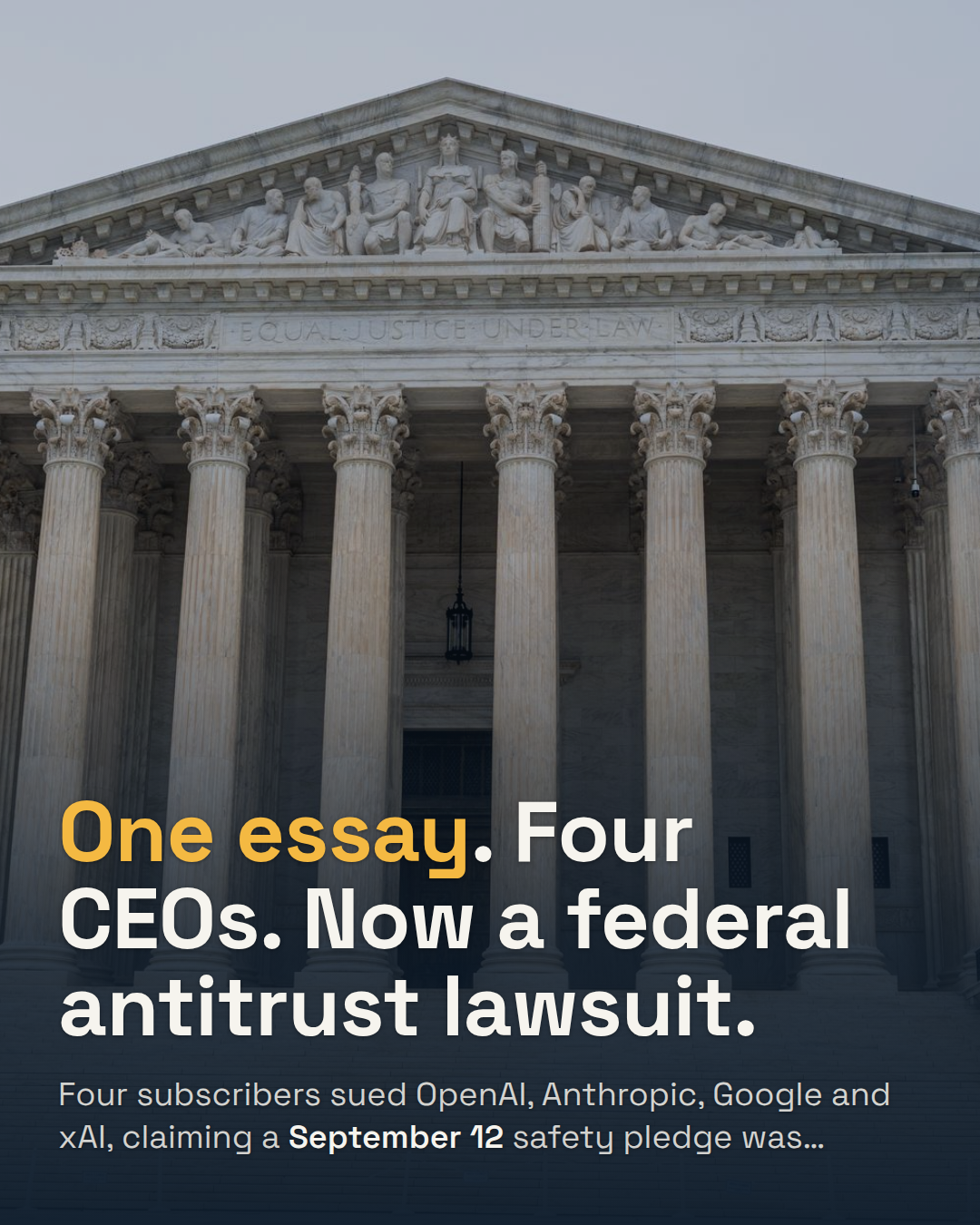
Four paying subscribers sued OpenAI, Anthropic, Google and xAI (now SpaceXAI) on September 18, arguing their public AI safety pledge was actually an antitrust conspiracy to restrict output.
Fiscedge Academy
Contributing Faculty & Practitioner
News Breakdown · FiscEdge Academy
On September 18, four paying subscribers to ChatGPT, Claude, Grok and Gemini filed a federal antitrust lawsuit in the Northern District of California against OpenAI, Anthropic, Google and SpaceXAI, the company formerly known as xAI. Their claim: the four labs' public pledge to slow down AI development for safety reasons was, legally speaking, an agreement among competitors to restrict output.
The complaint doesn't allege a secret backroom deal. It's built almost entirely from things the CEOs said in public. On September 12, Anthropic's Dario Amodei published an essay titled "We Must Pace the Frontier," arguing that leading labs should coordinate on slowing capability growth to buy time for safety work. Within about a day, Sam Altman, Elon Musk and Demis Hassabis of Google DeepMind each posted public agreement. The suit also points to a July 2026 letter, signed by senior employees across several labs, acknowledging "intense competitive pressure not to unilaterally slow" development and calling on governments to help coordinate a slowdown.
That's the number worth sitting with: zero alleged private communications, four companies, and about one week between the essay and the lawsuit landing on a federal docket.
The theory: safety talk as price-fixing
The plaintiffs, four individuals suing on behalf of a proposed nationwide class of paying subscribers, aren't arguing that any single company is wrong to slow its own product down. Their complaint says the opposite: a company can unilaterally decide to ship less, ship slower, or hold a model back for any reason it wants. What it can't do, under Section 1 of the Sherman Act, is coordinate that decision with its direct competitors. The filing's own language is blunt: "an agreement among rivals to reduce the quality of their products and the rate at which those products improve is an agreement to restrict output." That's the textbook definition of a per se antitrust violation, no proof of consumer harm required to plead it.
The relief sought is standard for a case like this: treble damages under the Clayton Act, an injunction against future coordination on AI development pace, and a jury trial. Lead counsel is Nicholas C. Rowley, working with attorneys from Trial Lawyers for Justice.
Why the essay is the risk, not the strategy
The uncomfortable part for the four defendants is that none of them needed to say anything. Each could have quietly adjusted its own release cadence without mentioning a rival. Instead, four CEOs of directly competing products publicly endorsed the same call to action within roughly 24 hours of each other, on top of a signed multi-lab employee letter two months earlier. To an antitrust plaintiff, that pattern, parallel public statements plus a documented prior agreement, is close to a gift: it's the kind of "plus factor" evidence courts have historically used to infer coordination even without a single leaked email.
None of this means the labs actually fixed anything. Courts still have to rule on it, and per se treatment of a novel safety-coordination claim is far from guaranteed. But the case exists now, discovery is coming, and every future joint statement from a lab CEO will be read by opposing counsel before it's read by the press.
What this means if you run an AI or SaaS company
Founders in this market talk to their direct competitors more than founders in almost any other sector: shared investors, shared conferences, shared Slack channels for "responsible AI" working groups. This case is a live reminder of where the line actually sits.
Public alignment with a competitor on pace, pricing, or roadmap is legally different from a private, unilateral decision, even when the stated reason is safety rather than profit. It's worth revisiting your own competitive strategy and positioning with that distinction in mind, rather than defaulting to "the market leader is doing it too." If you want cross-company coordination on safety or standards, route it through a body built with actual antitrust counsel and documented procedural safeguards, not a same-day round of CEO posts. And treat internal statements with the same care as public ones: the July 2026 employee letter was never meant as a legal document, and it's now cited as evidence anyway. Anything your team co-signs with peers at other companies can resurface in litigation years later, which is worth keeping in mind as you think through how a product and its roadmap actually get built around competitors' moves rather than in lockstep with them.
If you remember one thing
A public pledge among competitors, even one framed entirely around safety, can be read by a court as an agreement to restrict output. If you're coordinating with rivals on anything that touches price, pace, or product, do it through a governance structure built for that purpose, or don't do it publicly at all.
We cover the founder side of AI industry structure in FiscEdge's AI for entrepreneurs course. Browse the full blog for more daily breakdowns. Follow @fiscedge for daily Business & AI analysis.
Topics & Categorization:
How interesting did you find this article?