ChatGPT Ads Just Landed in 31 European Countries. OpenAI's $2.5B Bet Still Doesn't Cover the Bill.
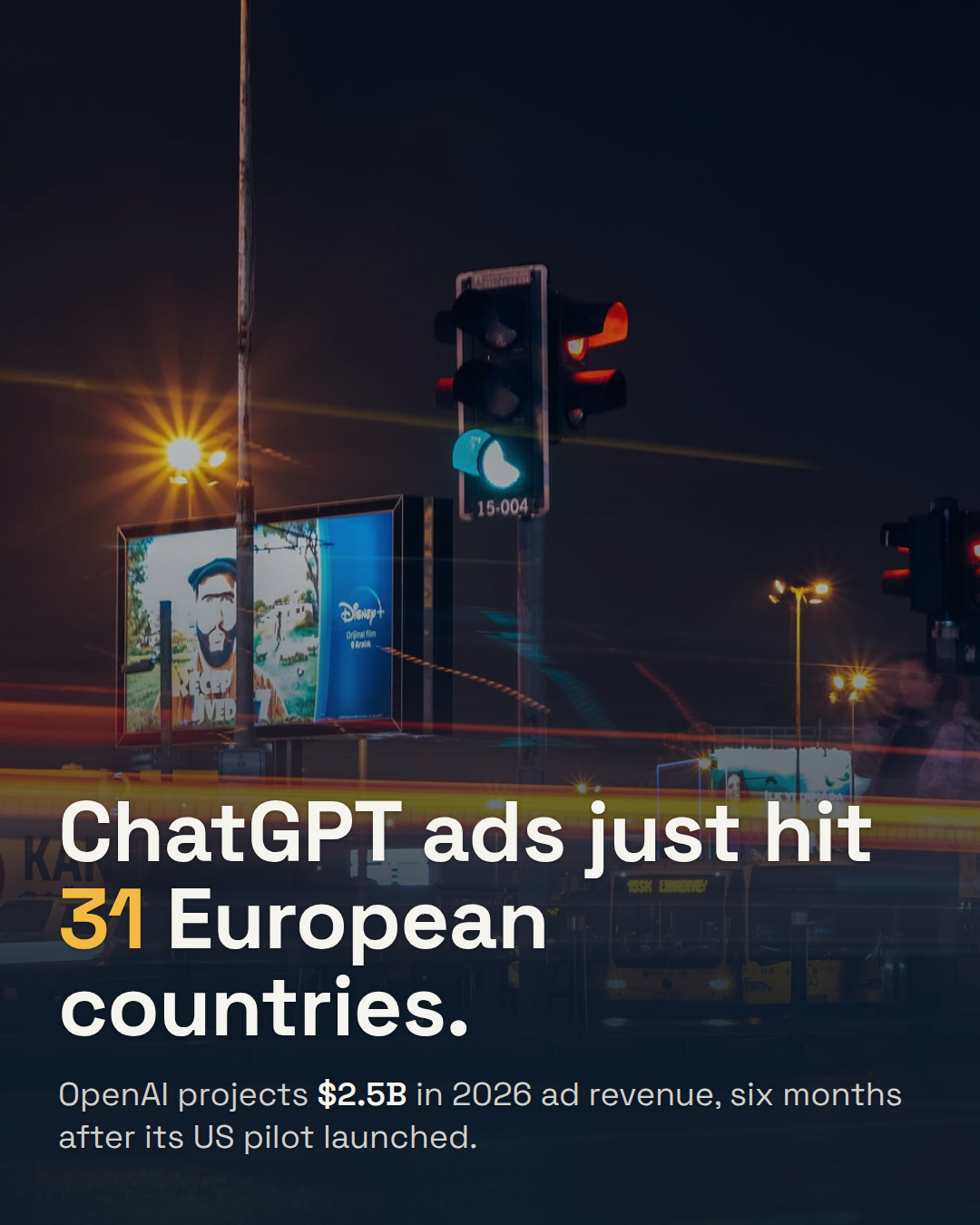
OpenAI expanded ChatGPT ads to 31 European countries this week, six months after its US pilot. Analysts expect under $1B in 2026 ad revenue, a fraction of what OpenAI spends on compute.
Fiscedge Academy
Contributing Faculty & Practitioner
News Breakdown · FiscEdge Academy
OpenAI turned on ChatGPT ads in 31 European countries this week, including Germany, France, Spain, Italy, the Netherlands, Sweden, Norway, Denmark, Ireland and Austria. The rollout lands almost exactly six months after ads first appeared for US Free and Go users on February 9, and it follows an already-completed march through Canada, Australia, New Zealand, the UK, Mexico, Brazil, Japan and South Korea.
The mechanics are unchanged from the US version: ads only show to logged-in adults on the Free and Go tiers, and Plus, Pro, Business, Enterprise and Education subscribers stay ad-free. At launch, targeting is deliberately blunt, drawn from the topic of the current conversation, approximate location, device type, time of day and language, not personal history. Advertisers reach the inventory through OpenAI's own Ads Solutions team and agency partners for now, with self-serve access through Ads Manager promised for later this year.
The number is the least interesting part. The signal under the headline is what the ad business is actually worth, and how far that is from what it needs to cover.
The revenue gap nobody is pricing in
OpenAI's own internal target puts 2026 ad revenue near $2.5 billion. Independent analyst estimates, including eMarketer's, land under $1 billion for the year, with a path past $30 billion only by 2030. In the US market alone, ChatGPT ads were already appearing in roughly 51% of replies by early July, so this isn't a shy pilot. It's a business unit running at scale, and even the bullish internal number is a rounding error against what OpenAI is committing to compute: tens of billions in chip and data center deals signed just this month alone. Ads will help. They will not close that gap on their own, not this year and probably not next.
Every AI company is converging on the same playbook
What makes this move worth watching isn't that OpenAI did it. It's that OpenAI held out longer than almost anyone expected before doing it. Google folds ads into Gemini surfaces by default. Meta AI sits inside an ad empire already. Perplexity has been testing sponsored answers since 2025. The pattern across the entire category is now identical: free tier funds distribution and training data, ads fund the free tier's marginal cost, and the paid tier is where the real margin lives. If you are building an AI product and you haven't modeled what your free users cost you per month, this is the same freemium-plus-ads math we walk through in FiscEdge's AI for entrepreneurs course, and it's no longer optional homework. It's the default operating model for the category.
What it changes if you build on or around ChatGPT
For SaaS founders and marketers, the practical part isn't the philosophy, it's the mechanics. OpenAI is running ChatGPT Ads on a cost-per-engagement model, meaning advertisers pay when a user actually interacts with an ad unit inside a conversation, not on impression. That's a materially different buy than a search or social ad, and agencies that figure out creative and targeting for a conversational surface early will have a real head start once self-serve Ads Manager opens up more broadly. The non-personalized launch design is also worth noting for a European audience specifically: it reads as a deliberate, privacy-conscious posture heading into a continent with the toughest data rules in the world, and it's a template worth studying if your own product will eventually face the same regulatory environment.
The part founders keep getting wrong
The mistake we see most often in FiscEdge cohorts is treating a free tier as a funnel and nothing else, an acquisition cost you eat until someone upgrades. OpenAI's move is a reminder that at any real scale, your free tier is its own product with its own economics, and it needs to at least approach breakeven independent of upgrade rates. That's a unit economics problem before it's a growth problem, and getting the sequencing backward is how founders end up subsidizing users who were never going to convert.
If you remember one thing
A free tier is not a temporary loss you tolerate on the way to conversions, it's a product with its own P&L, and if the largest, best-funded AI company on earth needs ads to make its free tier work, yours probably does too.
We teach this playbook in FiscEdge's startup strategy course and marketing automation and growth course. Browse the full blog. Follow @fiscedge for daily Business & AI analysis.
Topics & Categorization:
How interesting did you find this article?