OpenAI Cuts GPT-5.6 Prices by Up to 80%. Three Weeks After Launch.
OpenAI slashed GPT-5.6 Luna pricing 80% and Terra pricing 20%, days after Google cut Gemini prices too. Here's what the AI price war means for your COGS.

Fiscedge Academy
Contributing Faculty & Practitioner
News Breakdown · FiscEdge Academy
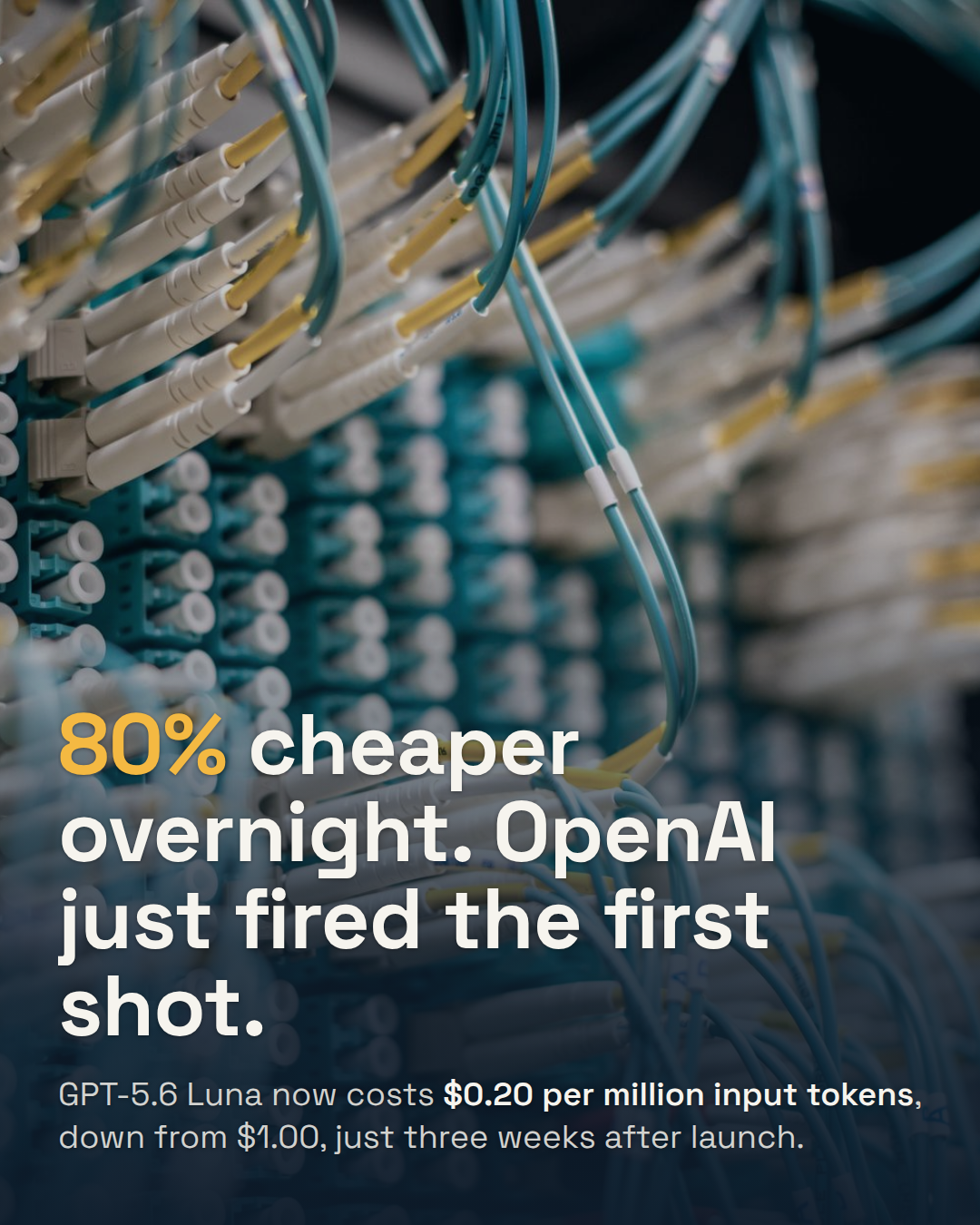
OpenAI just cut the price of its own AI models by as much as 80%, only three weeks after shipping them. GPT-5.6 Luna, the fastest and cheapest tier of the family, now costs $0.20 per million input tokens and $1.20 per million output tokens, down from $1.00 and $6.00. GPT-5.6 Terra, the mid-tier model, drops 20%, to $2.00 per million input tokens and $12.00 per million output tokens, from $2.50 and $15.00. Pricing on Sol, the top-tier flagship model, is unchanged. The move was confirmed by OpenAI's own developer announcement and independently reported by CNBC, Axios and VentureBeat.
A price cut this size, this fast, on a model this new, is not a routine adjustment. It is the least interesting number in the announcement.
The real story is why OpenAI had to move
OpenAI says the cuts are possible because of efficiency gains made during GPT-5.6's development, better internal coding processes and system optimization that lower the actual cost of serving a token. That's the official framing. The more useful framing for founders is competitive: enterprise buyers have gotten sharply more cost-sensitive about AI spend, wanting a clear return before deploying an expensive model, and OpenAI is defending workhorse-tier volume against Chinese labs like DeepSeek and against Google and Microsoft, both of which have spent the summer touting cheaper price-per-token on their own mid-tier models. This is the second major API price cut in ten days, after Google trimmed Gemini 3.6 Flash pricing to $7.50 per million output tokens in late July. When two frontier labs cut prices on their workhorse tiers within two weeks of each other, that is not coincidence, it is a price war with a clear trigger: nobody wants to lose the high-volume, low-margin traffic that actually pays the infrastructure bill.
What this changes if AI is a line item in your COGS
If your product calls Luna or Terra for classification, extraction, agent steps, or any high-volume task, your gross margin on that feature just improved without you writing a line of code. Three things worth doing this week:
- Re-run your unit economics. An 80% cut on your highest-volume tier is not a rounding error, it can be the difference between a feature that scales profitably and one that doesn't. If you haven't recalculated cost-per-user since the announcement, do it now.
- Reconsider your tiering strategy. Tasks you routed to Terra "to be safe" six weeks ago may now be cheap enough on Luna to shift down a tier, freeing budget for the workloads that genuinely need the stronger model.
- Don't assume the price holds. Two cuts in two weeks from two different labs signals this is a moving target, not a new floor. Building your pricing model around today's API cost without a buffer for the next cut, and the one after that, is planning for a market that no longer exists.
The signal under the discount
The deeper story is what this says about who actually has pricing power in AI right now. It is not the model labs, it is whoever controls the workload and can route it to the cheapest model that clears the quality bar. OpenAI, Google and Anthropic are all effectively subsidizing the workhorse tier to keep developers building on their stack, while reserving real margin for the frontier tier that fewer buyers need. For a founder, that inversion is the opportunity: the API layer is being commoditized faster than most roadmaps assume, and the products that win won't be the ones that lock into a single model, they'll be the ones built to route intelligently across whichever tier is cheapest this month.
If you remember one thing
The 80% number is a headline. The actual signal is that frontier labs are now repricing their workhorse models every few weeks under direct competitive pressure, which means your AI COGS is not a fixed cost, it's a moving one you need to actively manage, not set once and forget.
We teach the model-selection and margin math behind AI-native products in FiscEdge's building SaaS with AI course and the pricing framework in our financial modeling course. For the fundamentals of what it actually costs to build a SaaS product, start there, or go deeper on picking and combining foundation models in the AI for Entrepreneurs track. Follow @fiscedge for daily Business & AI analysis.
Topics & Categorization:
How interesting did you find this article?