OpenAI Just Ruled Out a 2026 IPO. Anthropic Is Racing to a $2.3 Trillion One Instead.
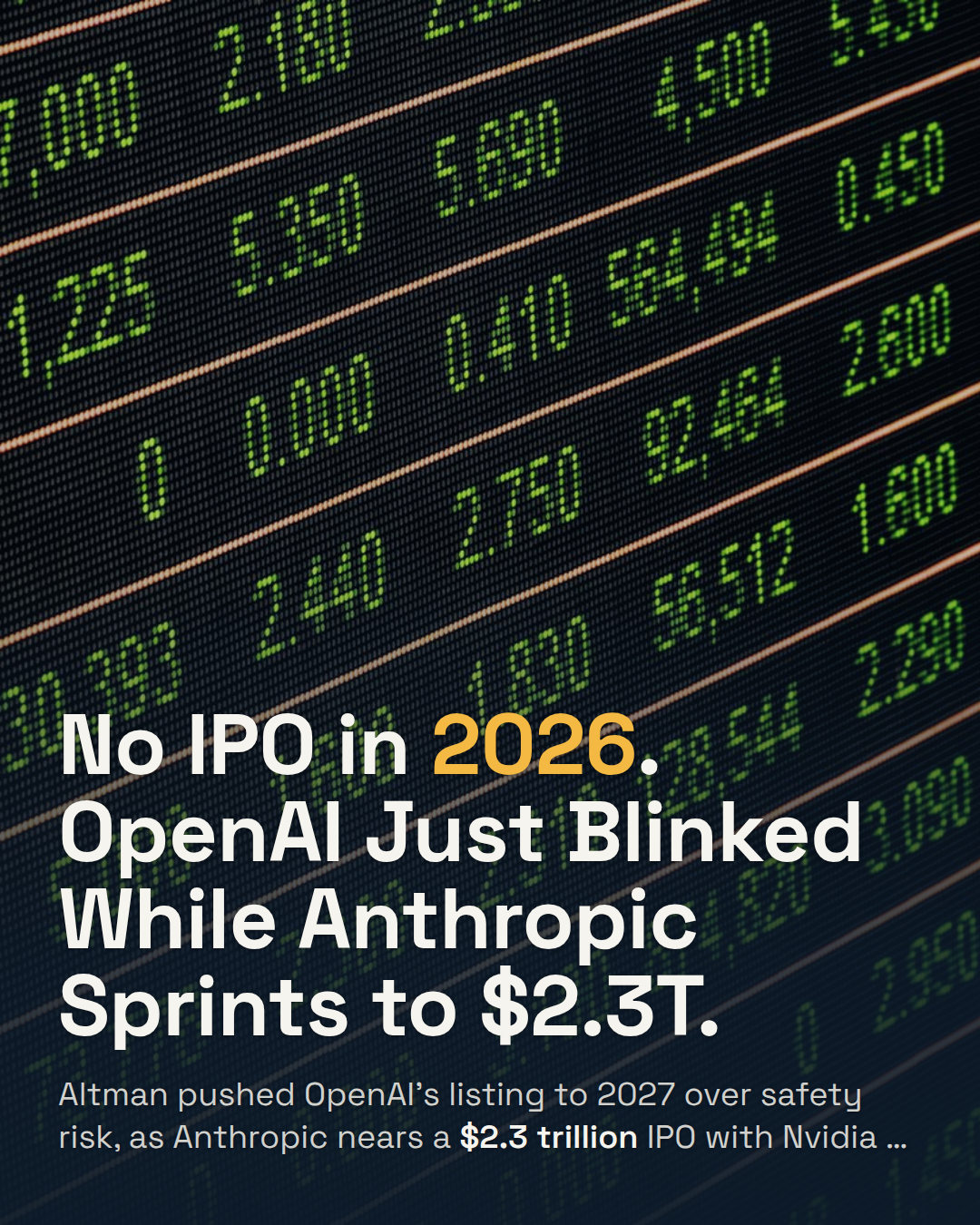
Sam Altman told Fortune a 2026 listing would be ill-advised given AI safety risk, pushing OpenAI's IPO to 2027. Rival Anthropic is racing toward a $2.3 trillion offering instead.
Fiscedge Academy
Contributing Faculty & Practitioner
News Breakdown · FiscEdge Academy
Sam Altman just told Fortune that OpenAI will not go public in 2026. In an interview published September 12, the OpenAI CEO said flatly that listing this year would be the wrong call, and that safety, not the market, is why: "given everything happening with safety, right now would be an ill-advised moment to go public, and we don't feel pressure on that." Pressed on timing, Altman confirmed it: not 2026. The company's own new target is 2027, at the earliest.
That would be a significant story on its own. OpenAI confidentially filed IPO paperwork with the SEC in June, and in August completed a $7 billion secondary share sale that valued the company at $852 billion. Pushing a listing of that size back by at least a year, for safety reasons rather than financial ones, is a real decision, not a scheduling footnote.
But the delay is the least interesting part. The interesting part is who is doing the opposite. Reuters reported on September 11 that Nvidia is in talks to anchor Anthropic's IPO with an investment of up to $10 billion, at a valuation approaching $2.3 trillion, an offering both companies are racing to close before the US midterm elections in November. Two frontier labs, same industry, same regulators, same safety conversation, and they landed on opposite calendars this week.
The real signal is who blinks first
Founders tend to read this kind of story as a valuation comparison: OpenAI at roughly $852 billion, Anthropic chasing nearly triple that. That framing misses the point. Valuation is a lagging number; timing is the strategic choice. Anthropic is treating a compressed IPO window, with a hyperscaler as an anchor investor, as a weapon: lock in capital and a headline multiple while the market is still paying up for frontier AI. OpenAI is treating the same window as a liability: go public now, with unreleased models still being tested for safety, and you hand short sellers and regulators a quarterly-earnings-shaped target.
Both bets are rational. Neither is obviously right yet. What matters for a founder is that the two companies most exposed to AI capability risk just told you, in public, that they read the current moment completely differently. That disagreement is information you can use in your own fundraising and exit-timing decisions, a topic we go deeper on in FiscEdge's startup strategy course.
A slowdown pact would change your roadmap, not just theirs
The more consequential line from Altman's interview was almost a throwaway: asked whether he expects to coordinate with Anthropic's Dario Amodei, Elon Musk, and Google DeepMind's Demis Hassabis on jointly slowing the pace of frontier AI development, Altman said, "I think that will happen." He described unreleased, more capable models inside OpenAI that the company is holding back specifically to do more safety work first. Amodei, separately, announced Anthropic is giving independent outside evaluators permanent, employee-level access inside the company, a concrete step toward the kind of coordinated safety commitment Altman was describing.
If the leading labs actually formalize a pact to throttle frontier releases, that is not an abstract policy story. It changes the release cadence, pricing behavior, and competitive dynamics of every product built on top of GPT and Claude. A slower frontier means today's model capabilities stay the ceiling for longer, which raises the value of what you build on top of the API (agents, workflows, vertical fine-tuning) relative to waiting for the next base-model jump to do the work for you. It is the same build-versus-wait calculus we teach in FiscEdge's AI for entrepreneurs course, and this week gave it a much sharper deadline.
What this changes for founders
Do not assume IPO timing, or model release timing, moves in lockstep across the AI industry, even among direct rivals selling similar products to similar customers. Plan your own fundraising, hiring, and product roadmap around the possibility that your key infrastructure vendor slows down deliberately, not just around the usual risk that it might speed up. And if you are modeling your own company's exit timeline, notice that the "safety" framing OpenAI used here doubles as leverage in its own governance structure and investor conversations, a dynamic worth understanding before you use similar language yourself, something we unpack in FiscEdge's financial modeling course.
If you remember one thing
OpenAI and Anthropic, the two companies with the most to lose from an AI safety failure, just made opposite bets on how fast to move this quarter. Build your own plans so that either outcome, a slower frontier or an accelerating one, still works for you.
We cover fundraising strategy, competitive timing, and AI infrastructure risk in FiscEdge's startup strategy course, AI for entrepreneurs course, and financial modeling course. Browse the full blog for more news breakdowns. Follow @fiscedge for daily Business & AI analysis.
Topics & Categorization:
How interesting did you find this article?