OpenAI and Microsoft Just Asked a Judge to End a 10.8 Million-Article Copyright Case. The Ruling Sets the Rules for Every AI Founder.
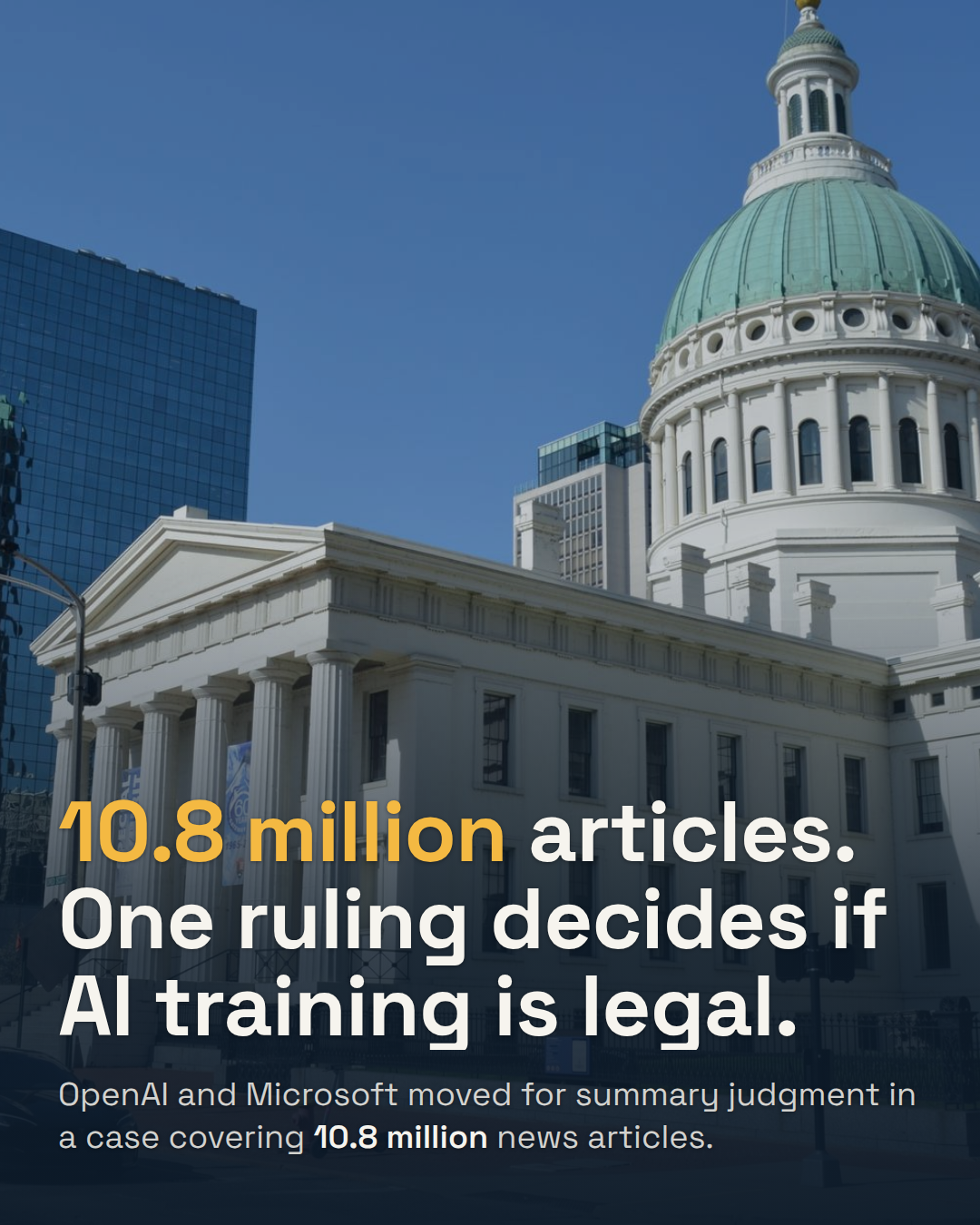
OpenAI and Microsoft asked a federal judge to end a case covering 10.8 million news articles. The ruling will set the fair-use rules every AI company trains under next.

Fiscedge Academy
Contributing Faculty & Practitioner
News Breakdown · FiscEdge Academy
On September 4, OpenAI, Microsoft, and five news organizations, including The New York Times, Ziff Davis, the Center for Investigative Reporting, and The Intercept, each filed motions for summary judgment in the consolidated AI copyright case pending before Judge Sidney H. Stein in the Southern District of New York. The case, Multidistrict Litigation No. 25-md-3143, covers 10.8 million articles. In its own filing, OpenAI cited an internal audit: across a sample of 20 million ChatGPT conversation logs, its lawyers found just 24 instances of verbatim article reproduction.
The same week, two more publishers, the Seattle Times and Newsday, filed a fresh complaint against the same two defendants, alleging systematic scraping that bypassed paywalls to build ChatGPT, Microsoft Copilot, and Bing's AI features. Neither filing is a settlement. Both sides are asking Judge Stein to rule on the underlying legal question without a trial, which means a decision could land in months, not years.
The specific numbers matter less than what happens next. Here's the signal under the headline.
The fair-use argument is finally getting tested at scale
Every AI copyright suit since ChatGPT launched has circled the same unresolved question: does training a model on copyrighted text without a license count as fair use? Courts have mostly ruled on narrower procedural issues so far. This is the first time the core question sits squarely in front of a judge on cross-motions for summary judgment, in the largest, most consolidated version of the case that exists. OpenAI's argument rests on three legs: pretraining on "a broad and undifferentiated sweep of internet text" is transformative, its Browse feature's copies made before publishers updated their robots.txt files were impliedly licensed, and the DMCA claim fails for lack of evidence that copyright management information was stripped intentionally. Publishers counter that OpenAI and Microsoft built billion-dollar products on their journalism without paying for it, and that measuring harm by whether individual articles get regurgitated verbatim ignores the market OpenAI created by replacing the need to visit the source at all.
Robots.txt just became a legal instrument
The "implied license" argument is the part worth sitting with. OpenAI is telling the court that if a publisher didn't block crawlers in its robots.txt file before a certain date, that silence functioned as consent to scrape and train. That reframes a technical SEO setting most founders never think about twice into a legal fence around their own content. If Judge Stein accepts that framing, even partially, every company running a content site, a documentation hub, or a blog that drives inbound leads needs to treat robots.txt configuration as a licensing decision, not an engineering afterthought.
What a ruling actually changes for AI builders
If you're shipping features on top of GPT, Claude, or Gemini APIs, you don't carry direct liability here, but you're not insulated from the outcome either. A loss for OpenAI doesn't just mean damages, it means frontier labs have to license training data going forward instead of scraping it, and that cost lands somewhere. It's not a coincidence that OpenAI's own GPT-6 Astra launched at 2.5x its predecessor's API price the same week this case moved to summary judgment; data licensing, compute, and legal exposure are converging on the same line item.
If your product scrapes, summarizes, or republishes third-party content, whether that's a research agent, a RAG pipeline pulling from the open web, or a browse-and-cite feature, this case is the actual rulebook, not a hypothetical. A ruling that fair use doesn't cover Browse-style copying would force a redesign of any feature that fetches and caches full-text content on the fly. Founders building this way should treat the outcome as a live constraint on their architecture, the kind of regulatory-risk planning we walk through in startup strategy.
And if you're building the underlying model layer yourself rather than calling someone else's API, the standard this case sets, transformative use versus market substitution, is the test your own training pipeline gets measured against. That's a design decision, not a legal afterthought, which is why data provenance is a first-class topic in AI for entrepreneurs.
If you remember one thing
The question of whether AI companies can keep training on the open web without paying for it just moved from op-ed debate to a judge's docket, with a ruling window measured in months. If your product depends on cheap training data, on scraping content live, or on running a content site that could end up as either plaintiff or defendant, Judge Stein's ruling is the event to track, not the next model release.
We cover regulatory risk, data strategy and fundraising narrative in FiscEdge's startup strategy course and AI for entrepreneurs. Browse the full blog for more news breakdowns. Follow @fiscedge for daily Business & AI analysis.
Topics & Categorization:
How interesting did you find this article?