Oracle's Cloud Backlog Hit $664 Billion. It Still Had to Sell $20 Billion in Stock.
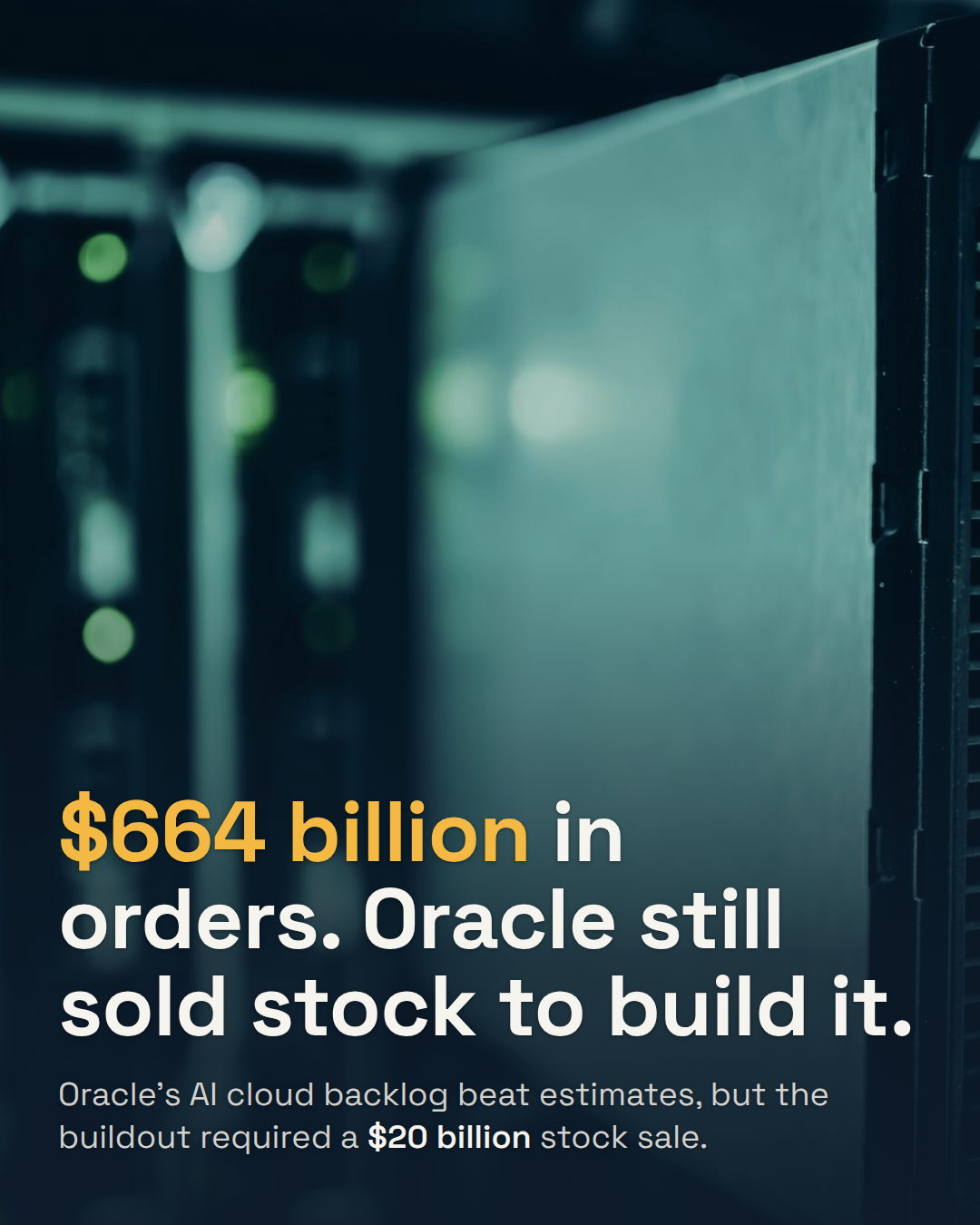
Oracle's AI cloud backlog hit $664 billion this quarter, but funding the buildout behind it required a $20 billion stock sale. Compute is capital-intensive, and that cost reaches every AI-dependent founder eventually.

Fiscedge Academy
Contributing Faculty & Practitioner
News Breakdown · FiscEdge Academy
Oracle's fiscal first-quarter results, released after market close on September 10, showed its cloud backlog, remaining performance obligations (RPO), climbing to $664 billion. That is up from $638 billion just one quarter earlier and up $209 billion year-over-year, and it beat Wall Street's estimate of roughly $640 billion. Oracle signed more than $30 billion in new AI cloud contracts during the quarter alone. The stock jumped as much as 7% the next day, one of its sharpest post-earnings moves this year.
Cloud infrastructure revenue, the line that actually bills AI labs for compute, rose 121% year-over-year to $7.4 billion. That growth rate is faster than any other major cloud provider has posted this earnings season, which is why Oracle now gets discussed alongside AWS, Azure and Google Cloud rather than as the database company still trying to catch up to them.
The backlog's fine print
The headline number is the least interesting part. Building the data centers behind $664 billion in orders costs real money today, not three years from now when the contracts pay out. Oracle spent $28.5 billion on capital expenditures in the quarter, versus $8.5 billion a year earlier, and it reiterated full-year guidance of $90 billion to $95 billion in total capex, with net cash capex capped at $70 billion.
To fund that gap, Oracle completed a $20 billion at-the-market equity sale during the quarter and expects to raise roughly $40 billion more in debt and equity before the fiscal year ends, on top of $125 billion in senior notes and other long-term borrowings already outstanding. A company that just beat every estimate on the call and watched its stock pop still had to go back to shareholders and lenders to pay for the buildout that same backlog demands.
The signal under the headline
The more telling detail is how the newest contracts are structured. Oracle said the bulk of this quarter's $30 billion-plus in new AI deals came through prepayment or "bring-your-own-hardware" arrangements, meaning the customer, not Oracle, puts up the capital. That is a direct response to the capex problem above: Oracle cannot keep raising $20 billion a quarter forever, so it is pushing more of the balance-sheet risk of the AI buildout onto the AI labs buying the capacity.
That shift matters beyond one earnings call. It is the same dynamic behind Nvidia's circular financing deals with OpenAI, and Amazon's AI-linked bond sales earlier this year: the capital intensity of frontier AI is getting distributed across every company in the stack, one balance sheet at a time, rather than absorbed by any single vendor. If you sell into this ecosystem, or price a product that assumes cheap, elastic compute, the financing structure underneath your supplier is now part of your own risk model.
What this changes if you build on AI
Two things to take from this if your product runs on rented AI compute. First, cheaper inference is not guaranteed on the timeline you might be modeling. A backlog this large, funded this expensively, gives providers more reason to hold pricing firm rather than race each other down, at least until enough of that capacity actually comes online. Stress-test your unit economics against flat or rising compute costs, not just falling ones, the same discipline we walk through in FiscEdge's unit economics breakdown.
Second, notice the contrast with how most SaaS businesses are built. Oracle needs $90 billion in annual capex and repeated trips to capital markets to grow into this backlog; a software company selling on top of that infrastructure typically needs neither. That asymmetry, capital-light software riding on capital-heavy infrastructure, is worth understanding deeply before you raise a round or model your own burn, and it's a core thread in FiscEdge's financial modeling course and AI for entrepreneurs track.
If you remember one thing
A record AI backlog and a record capital raise happened in the same earnings call, at the same company, in the same week. Demand for AI compute is real, but so is the bill for building it, and that bill is increasingly being handed to whoever is next in the chain. Know where you sit in that chain before you build your pricing around today's compute costs.
We cover AI infrastructure economics and vendor cost modeling in FiscEdge's financial modeling course and AI for entrepreneurs track. Browse the full blog for more news breakdowns. Follow @fiscedge for daily Business & AI analysis.
Topics & Categorization:
How interesting did you find this article?