Oracle Invoked Force Majeure on Its $165 Billion AI Data Center. The Gas Pipeline Wasn't Ready.
Oracle sent a force majeure notice on Project Jupiter, its $165 billion Stargate data center, after New Mexico permit fights delayed the gas pipeline meant to power it. AI capex has a fragility problem.

Fiscedge Academy
Contributing Faculty & Practitioner
News Breakdown · FiscEdge Academy
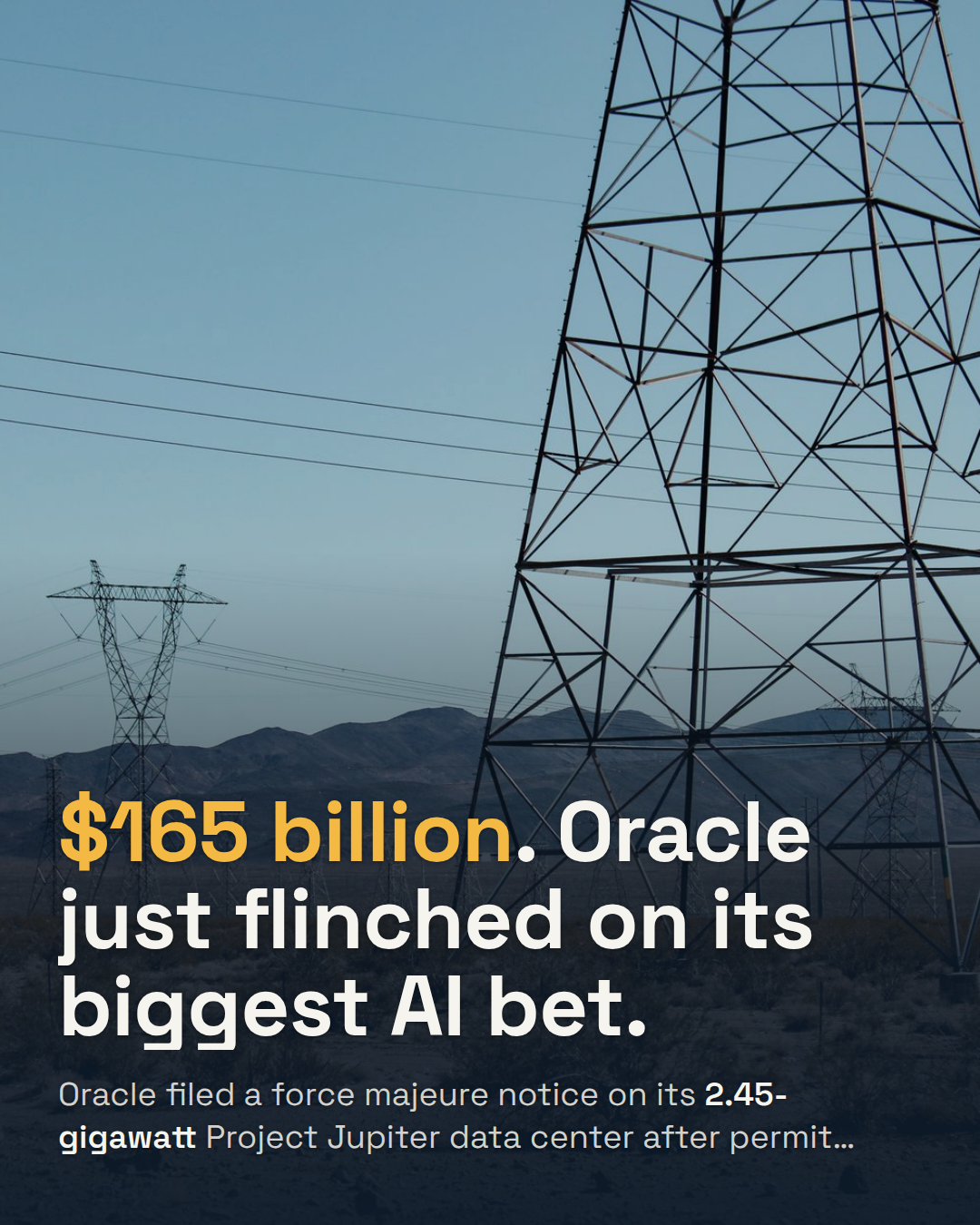
Oracle sent a force majeure notice this week to Blue Owl Capital's Stack Infrastructure, the developer building Project Jupiter, the $165 billion, 2.45-gigawatt AI data center campus in Santa Teresa, New Mexico, that anchors part of the OpenAI-Oracle-SoftBank "Stargate" build-out. The notice asks for the right to delay payments if the facility, targeted to open in 2028, slips further behind schedule. Oracle shares fell 3.5% on the news, closing at $139.53.
The trigger is mundane by AI-hype standards: a natural gas pipeline. Energy Transfer's line, meant to help power the site alongside Bloom Energy fuel cells, was supposed to go into service this month. After the New Mexico State Land Office repeatedly denied the right-of-way permits it needed across state trust land, the pipeline's in-service date slipped to February 2027, nearly six months late. Debt tied to the project's financing was already trading below 90 cents on the dollar before Oracle's notice went out, meaning credit markets had priced in the risk before the headline did. Oracle's public line has not changed: "Project Jupiter remains on our planned schedule," the company told CNBC. "We are fully committed to New Mexico and confident in our path forward."
The stock drop is the least interesting part. The signal under the headline is that the biggest AI infrastructure commitments on the planet are built on contracts, permits, and utility timelines exactly as fragile as the ones any founder signs for a much smaller office lease or cloud contract, and the companies signing them are already reaching for the escape clause.
Force majeure is a tenant's insurance policy, not a bug
A force majeure clause exists so that neither party eats 100% of the cost when something genuinely outside their control (a natural disaster, a war, a government permit denial) blows up a timeline. Oracle invoking it here is not evidence of bad faith. It is evidence that Oracle's lawyers did their job when the master lease was signed. The lesson for any founder negotiating a multi-year vendor, office, or infrastructure contract: read the force majeure clause before you sign, not after your counterparty invokes it. Ask specifically whether "regulatory delay" and "permit denial" count, because that is exactly the scenario playing out in New Mexico, and it is a far more common failure mode than the fires and floods most templates are written around. A quick pass through FiscEdge's financial modeling course covers how to model contract and vendor risk into a runway plan, not just revenue.
The AI capex story has a financing layer most founders never see
Project Jupiter is not Oracle spending its own cash. It is a special-purpose financing structure, backed by an Industrial Revenue Bond and third-party developer capital from Blue Owl, that lets Oracle book enormous AI compute commitments off its own balance sheet while still promising the capacity to OpenAI. That structure is exactly why the debt market moved first: bondholders can see covenant and completion risk long before a press release does. If you are building on top of any hyperscaler's "we're adding capacity" promise (more GPUs, more inference throughput, lower token prices), understand that the promise is frequently a financing bet with its own failure modes, not a guaranteed engineering roadmap. FiscEdge's AI for entrepreneurs course walks through how to build a product roadmap that survives a vendor's capacity slipping by a year.
What this changes for how you plan
Three things worth doing this week if your product leans on AI infrastructure at all:
- Stress-test your vendor's timeline commitments, not just their pricing. If a foundation model provider, cloud vendor, or GPU broker has promised capacity tied to a specific data center coming online, find out which one and check whether it has permitting or utility dependencies still open.
- Separate "AI is getting cheaper" from "this specific deal is getting cheaper." Price drops that ride on new capacity coming online are conditional on that capacity actually arriving on schedule. Bake a delay scenario into your unit economics, the same way you would model a key-person or key-vendor risk. Our piece on what unit economics really means for a SaaS business is a good refresher on building that discipline into your model.
- Watch the debt, not just the stock. Equity markets reacted to a headline. Bond markets had already marked the project's debt down. If you want an early warning system for a platform you depend on, credit spreads and bond pricing move before consumer-facing news does.
If you remember one thing
The most expensive AI infrastructure bets on the planet run on the same permits, pipelines, and force majeure clauses as a small business lease, they just have more zeros attached. If your roadmap depends on someone else's data center opening on time, find out today whether it is still on schedule, not after your vendor sends its own force majeure notice.
We cover AI infrastructure and vendor risk in FiscEdge's startup strategy course and how to model it into your numbers in financial modeling. Browse the full blog for more breakdowns like this one. Follow @fiscedge for daily Business & AI analysis.
Topics & Categorization:
How interesting did you find this article?