Oura Filed for a $16 Billion IPO. The Ring Is the Loss Leader for a Subscription.
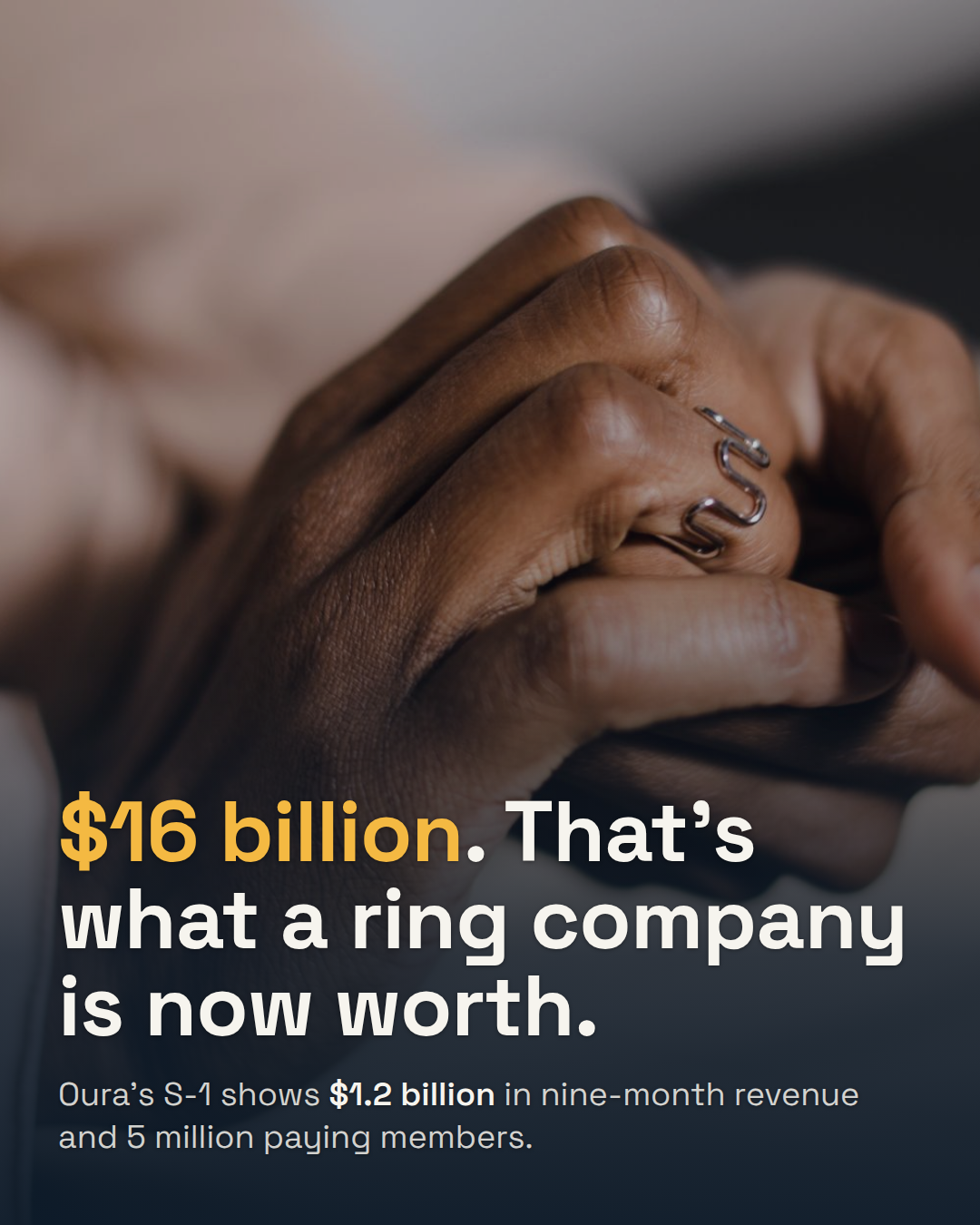
Oura filed to list on the Nasdaq at a valuation above $16 billion after nine-month revenue hit $1.2 billion. For founders, the ring is the funnel, the subscription is the business.

Fiscedge Academy
Contributing Faculty & Practitioner
News Breakdown · FiscEdge Academy
Oura Health filed its S-1 with the SEC on September 3, targeting a Nasdaq listing under the ticker OURA. The filing puts hard numbers behind a run that has been rumored since August: revenue for the nine months ended June 30 hit $1.2 billion, up 74% from $697.6 million a year earlier, and full fiscal 2025 revenue came in at $907.9 million, up 123% from $406.8 million the year before. Paid members doubled year over year to 5 million. Goldman Sachs, Morgan Stanley, JPMorgan, Allen & Company and Jefferies lead the offering, and reports ahead of the filing point to a raise as large as $3 billion at a valuation north of $16 billion, up from the $11 billion the company was worth at its Series E just eleven months ago.
None of those numbers is the interesting one. The interesting number is buried in the accounting: Oura reported a $924.3 million net loss attributable to common stockholders for the nine-month period, a figure that will show up in every headline this week and means almost nothing about the health of the business. Here's the signal under it.
The $924 million "loss" isn't a loss
That figure is driven almost entirely by a $985 million deemed dividend paid to holders of redeemable convertible preferred stock, a one-time accounting entry tied to Oura's pre-IPO capital structure, not cash burned running the company. Strip it out and a hardware company selling a $300 to $500 device is converting sales into a 5-million-member subscription base fast enough to more than double revenue two years running. This is a confusion every founder should learn to spot, in their own cap table and a competitor's: a headline loss that is really a paper transfer between shareholder classes, sitting on top of a business growing just fine. Misread the two as the same thing and you will misprice your own company the first time a term sheet uses one against the other, which is exactly what financial modeling is supposed to prevent.
The signal under the headline: the ring is the acquisition channel
Oura doesn't make its money selling rings. It makes a ring, prices it near cost or with a thin hardware margin, and then converts the buyer into a monthly subscriber paying for the software that reads the sensor data: sleep score, readiness, recovery trends. That is why 3.1 million rings shipped in the nine-month period against 5 million total paid members, a ratio that only works if churn on the subscription side is low and the attach rate on new hardware sales is close to universal.
Peloton and Ring both tried versions of this; Oura's team treated the subscription as the product from day one instead of bolting it on once hardware sales plateaued. The hardware is the cheapest, highest-intent lead magnet a consumer company can build: a customer who paid $300 for a device has already selected themselves out of the tire-kicker pool before the recurring charge ever hits their card. The read for any SaaS founder selling into consumers isn't "sell hardware." It's that the unit economics of a business look completely different once you separate the cost of acquiring a customer from the cost of the object that acquired them.
What this changes for how you build
Separate your acquisition cost from your product cost when you model the business. Oura's S-1 works because a reader can see the ring's bill of materials and the subscription's gross margin as two different lines. If your own model blends a one-time cost into a recurring revenue number, you can't tell whether you have a good subscription business or a bad hardware business wearing a subscription's clothes.
A doubling members number matters more than a doubling revenue number. Revenue growth can come from price increases on an unchanged base. Oura's member count roughly doubled alongside its revenue, which is the harder, more durable thing to fake, and the metric a public-market investor will actually price. Track the version of that number in your own business before you ever put it in a deck, a discipline we walk through in startup strategy.
Expect the accounting to get reported wrong. The deemed-dividend loss will show up as a near-billion-dollar loss in outlets that don't read past the summary page. Knowing how to read a real S-1, not the headline about it, is a document-literacy skill worth building before you ever raise a round of your own.
One caveat: the $16 billion figure and the $3 billion raise are reporting ahead of the roadshow, not numbers Oura has confirmed in the filing itself. Price ranges move, sometimes down, once bankers take the story to institutional investors. Treat the valuation as a marker of ambition until the amended S-1 sets an actual range.
If you remember one thing
The scariest number in a filing is often the least real one. Learn to find the accounting entry behind a headline loss before you decide what a business is actually worth, because your acquirer, your investor and your competitor will use the same trick against you the day it's convenient.
We break down cap tables, valuations and go-to-market economics in FiscEdge's financial modeling course and startup strategy course. Browse the full blog. Follow @fiscedge for daily Business & AI analysis.
Topics & Categorization:
How interesting did you find this article?