Owner Raises $240M at a $2.3B Valuation. Its AI Now Runs More US Locations Than Domino's.
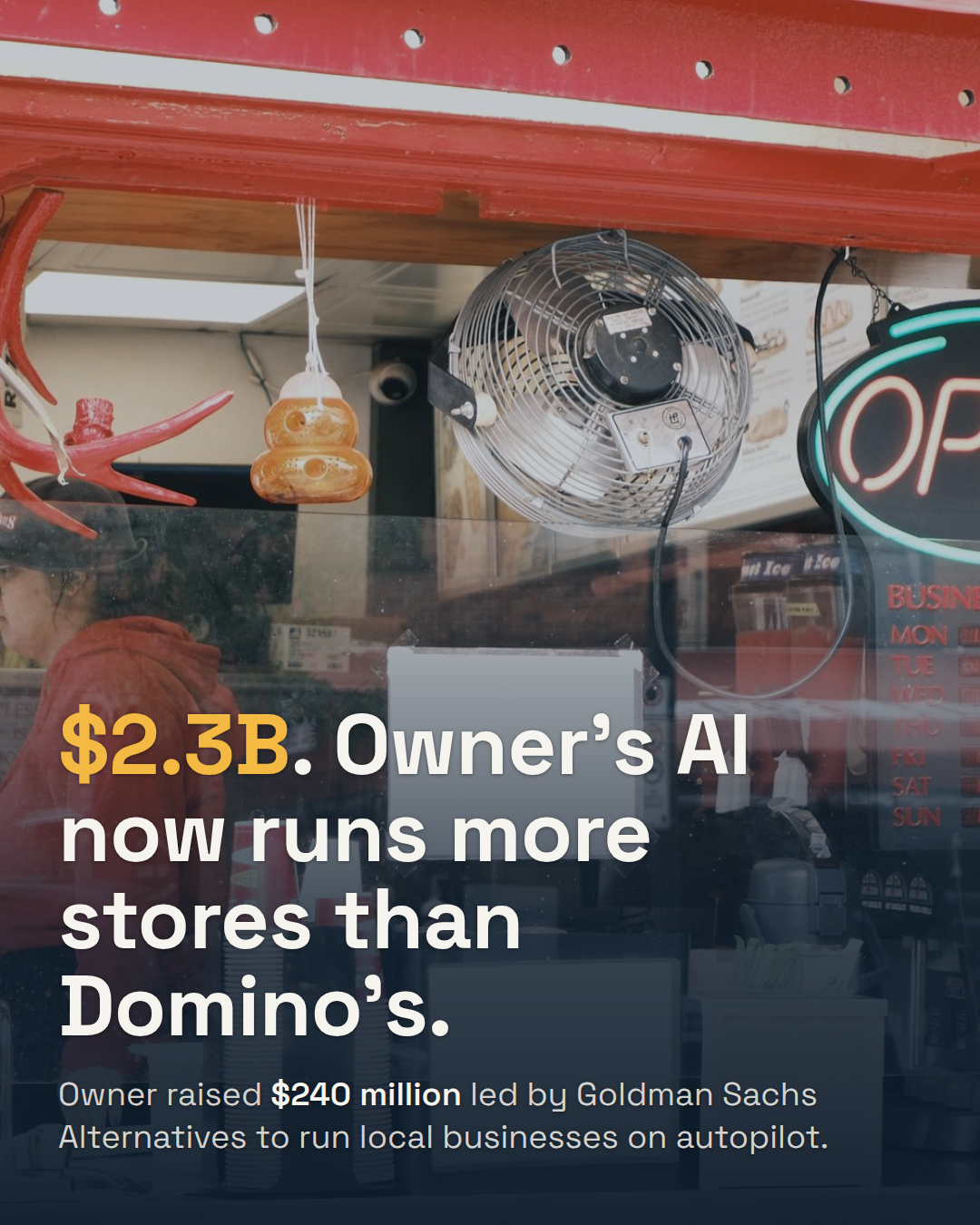
Owner raised $240 million at a $2.3 billion valuation, and its AI agents now run more US restaurant locations than Domino's or Taco Bell.

Fiscedge Academy
Contributing Faculty & Practitioner
News Breakdown · FiscEdge Academy
Owner, the AI platform that runs websites, ordering, marketing and phone calls for local businesses, closed a $240 million Series D at a $2.3 billion valuation, led by Growth Equity at Goldman Sachs Alternatives. Existing backers Meritech, Redpoint, Headline, and angel investor Jack Altman returned for the round, which brings Owner's total funding to roughly $393 million across three rounds in under two years: $33 million in early 2024, $120 million last May, and now this one.
The company has surpassed $100 million in annual recurring revenue and says its AI agents now power more US locations than Domino's or Taco Bell, with more than 100 million American consumers having used a business running on its platform. Owner was formed in 2020 when co-founder and CEO Adam Guild, who started the company after watching his mother struggle to market her dog-grooming business, merged his startup with one built by co-founder and CTO Dean Bloembergen, a veteran of restaurant-tech deployments at Blaze Pizza and Sharky's.
The number is the least interesting part
A $2.3 billion mark for a company selling websites and ordering software to independent restaurants sounds, on its face, like a category mismatch. Restaurant tech is not supposed to command SaaS multiples; it is supposed to be Toast terminals and a Squarespace template. The valuation only makes sense once you see what Owner is actually selling: not a tool a restaurant owner operates, but a set of AI agents that operate the tools for them. Website, online ordering, CRM, customer support, POS, and now AI phone ordering, bundled into one product that a single-location owner with no marketing budget and no engineering team can turn on and largely ignore.
That is the signal under the headline: Goldman's growth-equity arm is not pricing a website builder, it is pricing the disappearance of an entire stack of vendor relationships a small business used to manage by hand. Owner's own pitch is that it functions as the "AI CMO and CTO" a local business could never otherwise afford. Investors underwriting a $2.3 billion check are betting that vertical AI agents can do to SMB software what payroll processors did to bookkeeping: collapse a dozen fragmented tools and vendors into one subscription that runs mostly on its own.
Why the Domino's comparison matters more than the valuation
The detail worth sitting with isn't the round size, it's the claim that Owner's AI now runs more US locations than Domino's or Taco Bell. Those chains got their scale through decades of franchise agreements and centrally managed marketing budgets. Owner got there by selling AI agents one independent restaurant at a time, then plugging each one into shared infrastructure for phone ordering, CRM, and marketing automation. That is the real proof point behind the valuation: distribution built on automation can now outpace distribution built on capital and franchising, at least in location count.
For founders, that reframes what "scale" means in a vertical AI business. It is no longer just revenue growth or logo count, it is how much of a customer's operating stack an agent can absorb without a human on either side doing manual setup.
What this means if you're building or raising right now
- Bundling beats point solutions when AI removes the integration cost. Owner didn't out-feature Toast or Squarespace on any single product; it removed the need to stitch five vendors together. If you're building a vertical SaaS product, ask whether AI lets you sell the whole workflow instead of one slice of it, a positioning question we work through in building SaaS with AI.
- "Powers more locations than [household name]" is a distribution story, not just a customer-count story. Investors are rewarding companies that can prove agents run at scale with minimal human overhead per account. Model that ratio, revenue and locations per support headcount, into your own metrics before your next raise, a core piece of the financial modeling work we teach founders preparing for growth rounds.
- Growth-stage capital is now underwriting SMB AI agents like infrastructure, not like software. A $2.3 billion valuation on roughly $100 million in ARR, about 23x, prices this closer to how markets value payments or vertical infrastructure companies than a typical SaaS multiple. If you're pitching agentic AI for small businesses, anchor your narrative to operational takeover, not feature count, something we unpack further in AI for entrepreneurs.
- Serial fundraising at accelerating multiples is now normal for AI-native rollups. Three rounds, $393 million, in under two years is a pace most founders should plan dilution around rather than be surprised by.
If you remember one thing
Owner's $2.3 billion valuation isn't a bet on restaurant software, it's a bet that AI agents can absorb an entire small business's vendor stack, website, ordering, CRM, phone, and marketing, into one subscription that scales without local implementation. If you're building for SMBs, the winning pitch right now is "we run this for you," not "we help you run this."
We teach how to position and fund vertical AI products in FiscEdge's building SaaS with AI and financial modeling courses. Browse the full blog for more breakdowns like this one. Follow @fiscedge for daily Business & AI analysis.
Topics & Categorization:
How interesting did you find this article?