The Pentagon Just Turned AI Into a Three-Way Vendor War. 1.7 Million Users Are Already Inside.
The DoD added ChatGPT Mil and Grok for Government to its GenAI.mil platform alongside Gemini, proving federal buyers now run multi-vendor AI stacks instead of picking one winner.
Fiscedge Academy
Contributing Faculty & Practitioner
News Breakdown · FiscEdge Academy
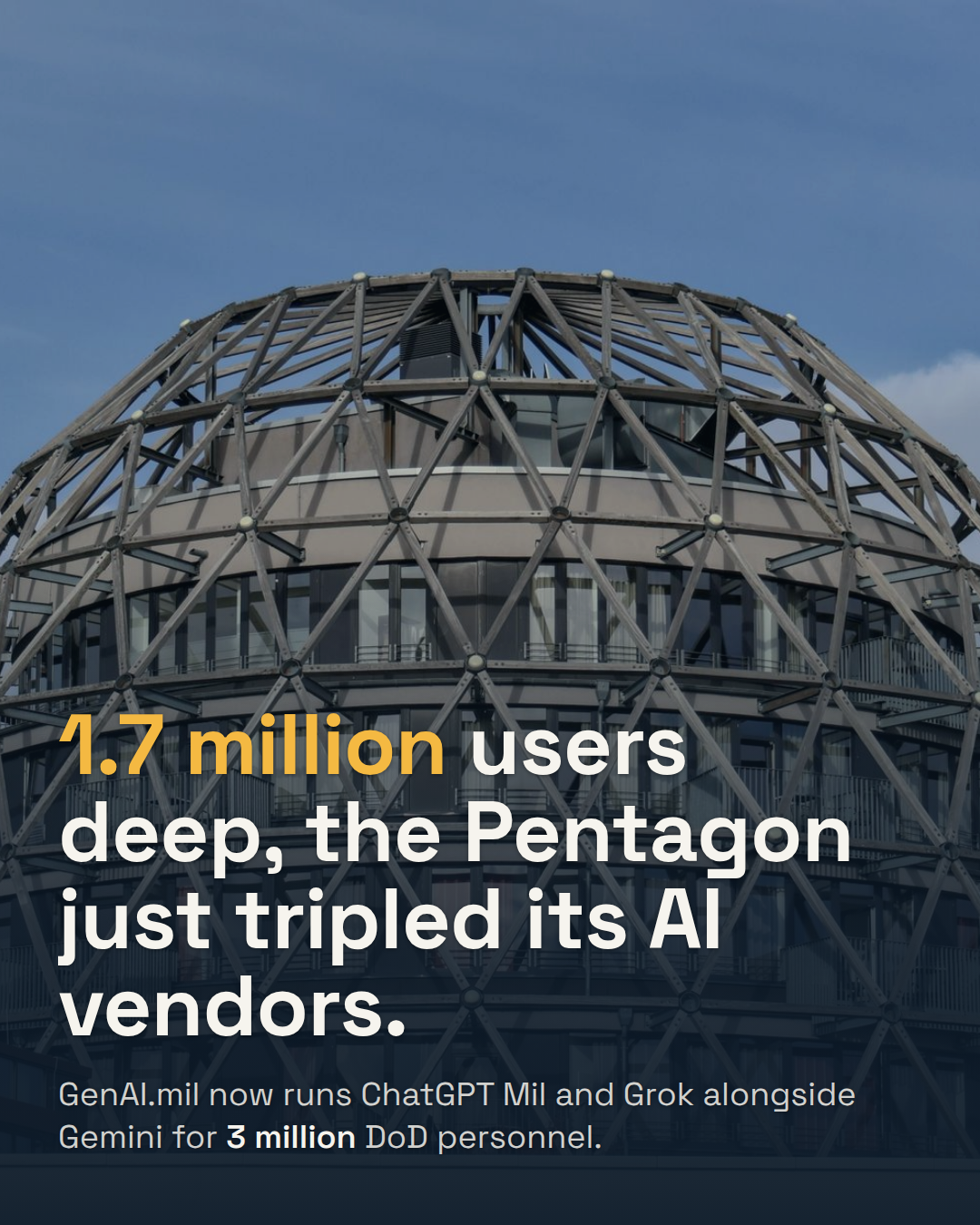
The Pentagon just stopped picking a favorite AI vendor. On August 31, the Department of Defense added OpenAI's ChatGPT Mil and xAI's Grok for Government to GenAI.mil, its internal generative AI marketplace, putting them alongside Google's Gemini for Government on the same secure platform. The numbers behind the move are the real story: GenAI.mil launched on December 9, 2025 with Gemini as its only model, passed 1 million unique users within a month, hit 1.5 million by June, and now sits at 1.7 million of the department's 3 million personnel, more than half the DoD's workforce, before a second and third vendor were even fully live.
That adoption curve is the least interesting part of this story. Here's the signal under the headline: the largest employer in the United States just proved that "pick one AI vendor and standardize" is not how serious enterprise buyers are actually running their AI stacks anymore. They're running three at once, on one platform, and deciding per task which model does the job.
A marketplace, not a monopoly
ChatGPT Mil, built out of OpenAI's OpenAI for Government program, is scoped for document-heavy unclassified work: chat, files, projects and custom GPTs for planning, logistics, policy drafting and compliance checklists. Grok for Government arrives through Starshield, xAI's hardened government stack built with SpaceX, aimed at more sensitive, security-cleared use cases. Gemini for Government has been the incumbent since launch. All three now compete for the same 3 million potential users inside one procurement framework, not three separate contracts fighting for exclusivity.
That framework has a paper trail. The DoD's Chief Digital and Artificial Intelligence Office previously issued AI adoption contracts with the same $200 million ceiling to four labs at once: OpenAI, Google, xAI and Anthropic. Anthropic isn't on GenAI.mil yet, and it spent part of August in a legal fight over an earlier DoD blacklisting that a federal judge ruled illegal retaliation, which makes a future fourth seat plausible. The Grok addition has already drawn a letter from Senator Elizabeth Warren questioning the model's content-safety guardrails for military use, a reminder that "add the vendor" and "the vendor is trusted" are not the same milestone.
Why this matters if you sell to enterprise or government buyers
Multi-vendor-by-design is now the reference architecture, not a hedge. If the Pentagon, with the most conservative procurement process in the country, is comfortable running three frontier model providers concurrently inside nine months of launch, every enterprise buyer smaller than the DoD is watching that as permission to do the same. The founders who lose here are the ones who built a product, an integration, or a pricing model that assumes a customer standardizes on a single LLM provider. The founders who win are the ones whose tooling is model-agnostic by default, because their actual buyer, whether it's a Fortune 500 IT department or a federal agency, increasingly is too.
There's a second lesson in the adoption math itself. Going from zero to 1.7 million active users in under nine months, inside an organization famous for slow procurement, is a faster enterprise rollout curve than most SaaS companies see from a single paying logo. If you're building for enterprise, GenAI.mil is now a usable benchmark for how fast a well-scoped, well-supported AI tool can actually spread once it clears procurement, not the multi-year timeline founders often assume government-adjacent buyers require.
If you remember one thing
The Pentagon didn't choose a winner between OpenAI, Google and xAI, it built a marketplace and let a workforce of three million people choose per task. That's the direction every serious enterprise AI buyer is heading, and it means the safest long-term position for a founder isn't betting on which model wins, it's making sure your product doesn't care which one your customer picks this quarter.
We cover how to build for a multi-model world, not a single-vendor bet, in FiscEdge's AI for entrepreneurs track. If you're architecting a product that needs to stay vendor-agnostic as customers shift providers, building SaaS with AI walks through the pattern. And if enterprise or government procurement is part of your go-to-market, startup strategy covers how to sell into buyers who move slower but pay bigger. Browse the full blog for more news breakdowns. Follow @fiscedge for daily Business & AI analysis.
Topics & Categorization:
How interesting did you find this article?