Riot Platforms Signs a $9.1 Billion Lease With Anthropic. A Bitcoin Miner Just Became an AI Landlord.
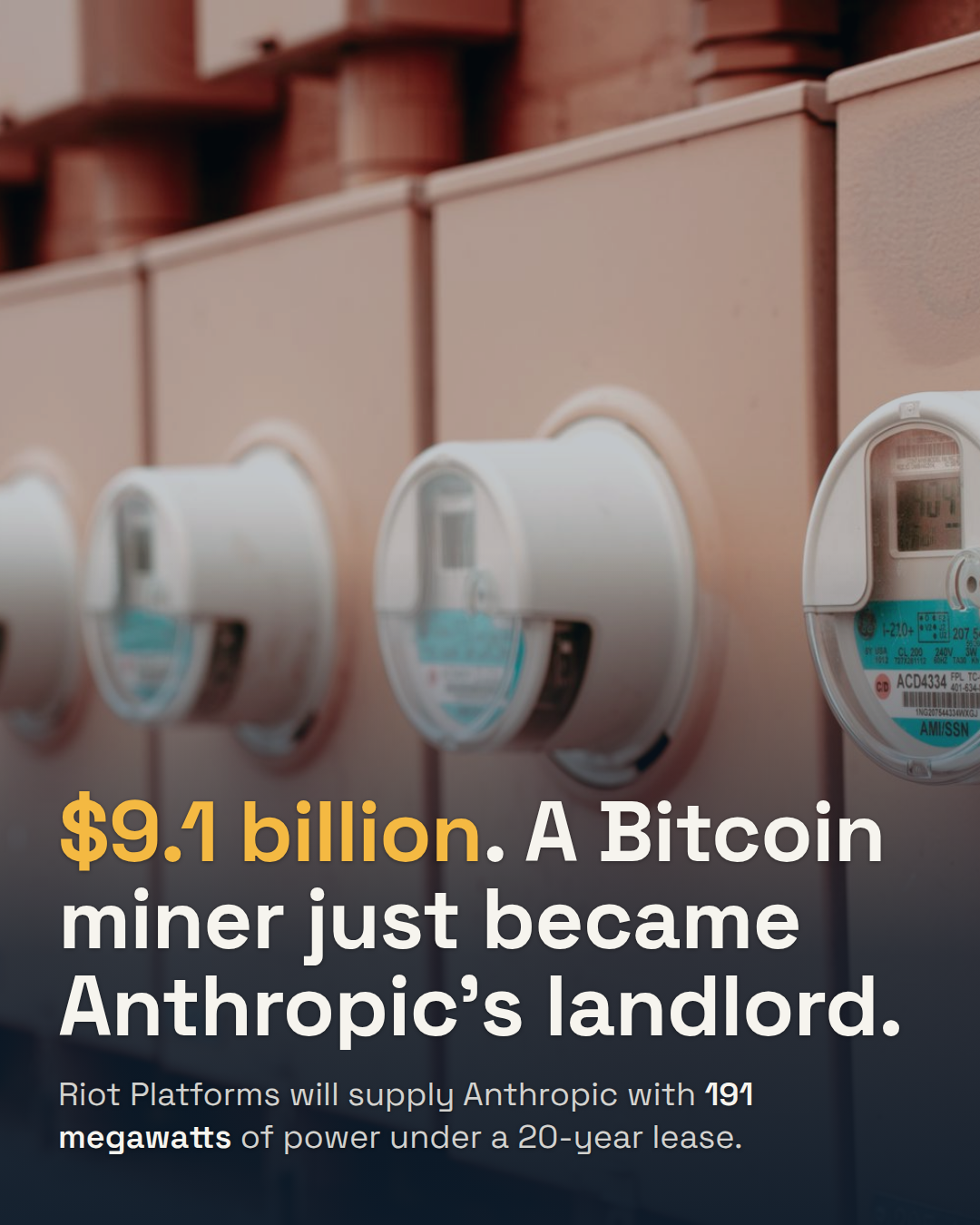
Riot Platforms, a Bitcoin miner, signed a 20-year, $9.1 billion lease to supply Anthropic with 191 megawatts of computing power in Texas, and its stock jumped 25% overnight.
Fiscedge Academy
Contributing Faculty & Practitioner
News Breakdown · FiscEdge Academy
Riot Platforms, a company that spent the last decade mining Bitcoin, just signed a 20-year lease worth $9.1 billion to supply computing power to Anthropic. The deal, disclosed alongside Riot's second-quarter earnings on August 10 and confirmed by Bloomberg the next morning, covers 191 megawatts of IT capacity at Riot's Rockdale, Texas campus. Two five-year extension options built into the contract could push the total value to $16.1 billion. Riot's stock, which had fallen more than 5% the day before the announcement, surged roughly 25% overnight.
Riot's own earnings release never named the customer, calling it only a "leading frontier AI lab." It took Bloomberg, citing people familiar with the matter, to identify the tenant as Anthropic. That gap, an AI lab's identity moving markets before the AI lab itself says a word, is the least surprising part of a deal that is really about something else entirely: who gets to build data centers now, and why it is no longer the companies you'd expect.
The number that matters isn't the $9.1 billion
Riot Platforms reported $174.2 million in quarterly revenue and a $237.2 million net loss for Q2 2026. A company posting nine-figure losses just locked in a contract worth more than 50 times its quarterly revenue, and Wall Street cheered. Bernstein raised its price target to $35, Citi to $32. That reaction only makes sense once you see what Riot is actually selling: not chips, not a model, not software. It is selling grid interconnection, land, and permits it already secured years ago as a crypto miner, at exactly the moment those three things became the binding constraint on the entire AI industry.
Every GPU Nvidia ships needs a building with power flowing into it, and that building takes years to permit and connect to a grid, far longer than it takes to fab a chip. Bitcoin miners spent the 2020s accumulating exactly that: cheap land, existing utility contracts, and substations built for continuous, high-density power draw. Riot did not pivot into AI by building something new. It pivoted by discovering that the infrastructure it already owned to mine coins was, structurally, identical to what a frontier AI lab needed to run inference.
Anthropic is renting because owning takes too long
For Anthropic, the logic is a financing problem, not a technology one. The company has said it plans to spend $50 billion on US data centers, has committed more than $100 billion to AWS over the next decade for up to 5 gigawatts of Trainium capacity through Project Rainier, and this week formed a separate venture, Theseus Infrastructure, with Macquarie Asset Management and Singapore's GIC, to let someone else's balance sheet fund future sites. The Riot lease fits the same pattern: Anthropic gets guaranteed capacity coming online in stages, 96 megawatts by December 2027 and the full 191 by June 2028, without spending years or capital acquiring land and power itself. Increasingly, the company that owns the compute is not the one that trained the model.
What this means if you build anywhere near AI
If your product's cost structure depends on inference pricing, and most AI-native SaaS does, this is a supply-side signal worth tracking directly. Power, not GPU count, is now the scarcest input in the stack, and it is priced in 20-year contracts, not spot markets. That means inference costs are unlikely to fall as fast as chip benchmarks alone would suggest, because the bottleneck moved upstream to something with a multi-year construction timeline. Founders modeling unit economics on an "AI costs will keep dropping" assumption should stress-test that against flat or rising power costs, not just falling chip prices; financial modeling is the right place to run that scenario before a vendor renewal surprises you.
It's also a reminder that an unconventional asset base, land, permits, existing utility contracts, can turn into a moat overnight once an adjacent industry hits a bottleneck you happen to already own the fix for. Spotting that kind of repositioning before the market prices it in is exactly what the startup strategy course works through with real cases like this one.
If you remember one thing
A Bitcoin miner just out-earned its own quarterly revenue by more than 50 times in a single contract, not because it built new technology, but because it already owned the power and permits an AI lab could not secure fast enough on its own. If you are budgeting AI costs for the next three years, budget for power, not just chips.
We teach this playbook in FiscEdge's AI for entrepreneurs track. Browse the full blog for more news breakdowns. Follow @fiscedge for daily Business & AI analysis.
Topics & Categorization:
How interesting did you find this article?