Robinhood Wants to Sell You a Piece of Y Combinator. The Fee Is 20% of Your Gains.
Robinhood Ventures Fund II opens for trading August 13 with a $200 million target and access to 80 Y Combinator-linked startups. No minimum to invest, but a hedge-fund-style profit cut applies.

Fiscedge Academy
Contributing Faculty & Practitioner
News Breakdown · FiscEdge Academy
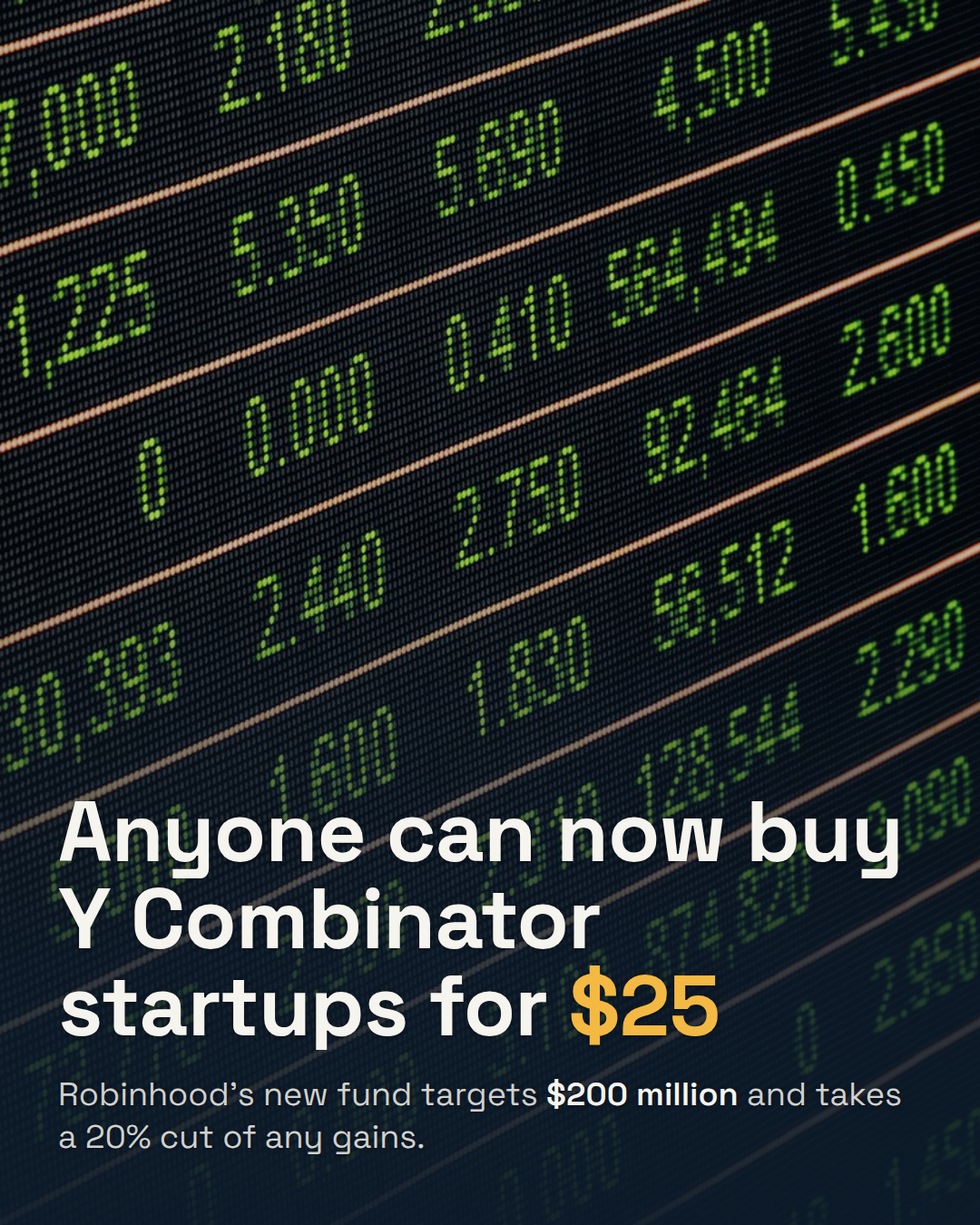
Robinhood Ventures Fund II (ticker: RVII) is set to start trading on the NYSE on August 13, targeting roughly $200 million in its IPO at $25 a share. There is no investment minimum and no accreditation requirement: for the first time, anyone with a Robinhood account can put money into a portfolio built around Y Combinator, the accelerator behind Airbnb, Stripe, Coinbase and DoorDash.
The fund will hold stakes in roughly 80 early-stage private companies, either current or former YC batch participants or startups whose founders went through the program. And it comes with a fee structure straight out of a hedge fund: a 2% annual management fee plus a 20% incentive fee on realized capital gains.
That fee is the least interesting part of the headline, and also the most important part of the story. Robinhood is not really selling access to Y Combinator. It is selling a new financial product category, and the fine print tells you more about where that category is headed than the ticker does.
The fine print nobody's re-posting
RVII is a business development company, a type of closed-end fund regulated under the Investment Company Act of 1940. Once shares list, there is no redemption window back to the fund; investors who want out sell to another buyer on the open market, at whatever price supply and demand set. Closed-end funds routinely trade at a discount to their underlying net asset value, sometimes 10-20%, because private holdings are illiquid, hard to price, and impossible to verify in real time.
Robinhood already ran this experiment once. Ventures Fund I (RVI) listed on the NYSE in March at $25 a share, opened below that price, and as of March 31 had returned 0.85% on NAV and 6.16% on share price since its September 2025 launch, a gap that shows exactly how disconnected a closed-end fund's trading price can get from what it actually holds. RVI also charged just a 1% management fee for its first six months and no performance fee at all. RVII's 20% cut of the gains is new, and it only shows up once the fund is already profitable, which is precisely the point: by the time investors notice the fee, they are already committed.
Why this matters more to founders than to retail investors
The real signal is what Robinhood is testing: whether "buy a slice of a startup portfolio" can become a retail product line, the way spot Bitcoin ETFs turned crypto exposure into a checkbox on a brokerage app. If RVII's IPO clears its $200 million target, expect competitors, and expect more accelerators and fund platforms to package pre-IPO exposure the same way.
For founders, that changes two things worth tracking. First, cap table dynamics: a wave of retail capital chasing YC-adjacent deal flow can push up valuations at the seed and Series A stage even for companies that never take a dollar from Robinhood directly, simply because more capital is competing for the same pipeline. Second, exit optionality: vehicles like this create secondary-market demand for private shares before a traditional IPO, which is one more lever founders and early employees can eventually use for liquidity, alongside tender offers and direct secondaries.
What to actually do with this
If you are raising right now, do not assume "YC-affiliated" is doing more work than it is. RVII isn't a Y Combinator fund; it's a Robinhood-managed vehicle that leans on YC's brand recognition to sell shares to retail investors. Founders don't get a check from this fund by being in a YC batch; the fund's managers pick the roughly 80 names.
If you are an operator sizing up whether a structure like this belongs in your own fundraising or treasury strategy, the underlying mechanics (fee waterfalls, NAV versus market price, incentive-fee timing) are the same ones covered in a solid financial modeling course, and worth understanding before any vehicle like this touches your cap table or your personal portfolio.
If you remember one thing
A 20% incentive fee only gets charged on gains, which means the fund's manager makes money exactly when you do, and nothing when you don't except the flat 2%. That alignment sounds better than it is: it also means the fee structure was priced for an environment where private markets keep going up. Read every closed-end fund's fee schedule as a bet on that assumption, not just a cost line.
We teach the mechanics behind vehicles like this in FiscEdge's financial modeling course, and how to think about capital strategy as a founder in startup strategy. If fee structures and fund math still feel opaque, start with what unit economics actually means. Browse the full blog for more breakdowns like this one. Follow @fiscedge for daily Business & AI analysis.
Topics & Categorization:
How interesting did you find this article?