Schneider Electric Buys PTC for $22.6 Billion. The Real Story Is the Multiple, Not the Price.
Schneider Electric is paying $22.6 billion for PTC, under 10 times ARR, in its third industrial software acquisition this year. The multiple is the real signal for SaaS founders eyeing an exit.
Fiscedge Academy
Contributing Faculty & Practitioner
News Breakdown · FiscEdge Academy
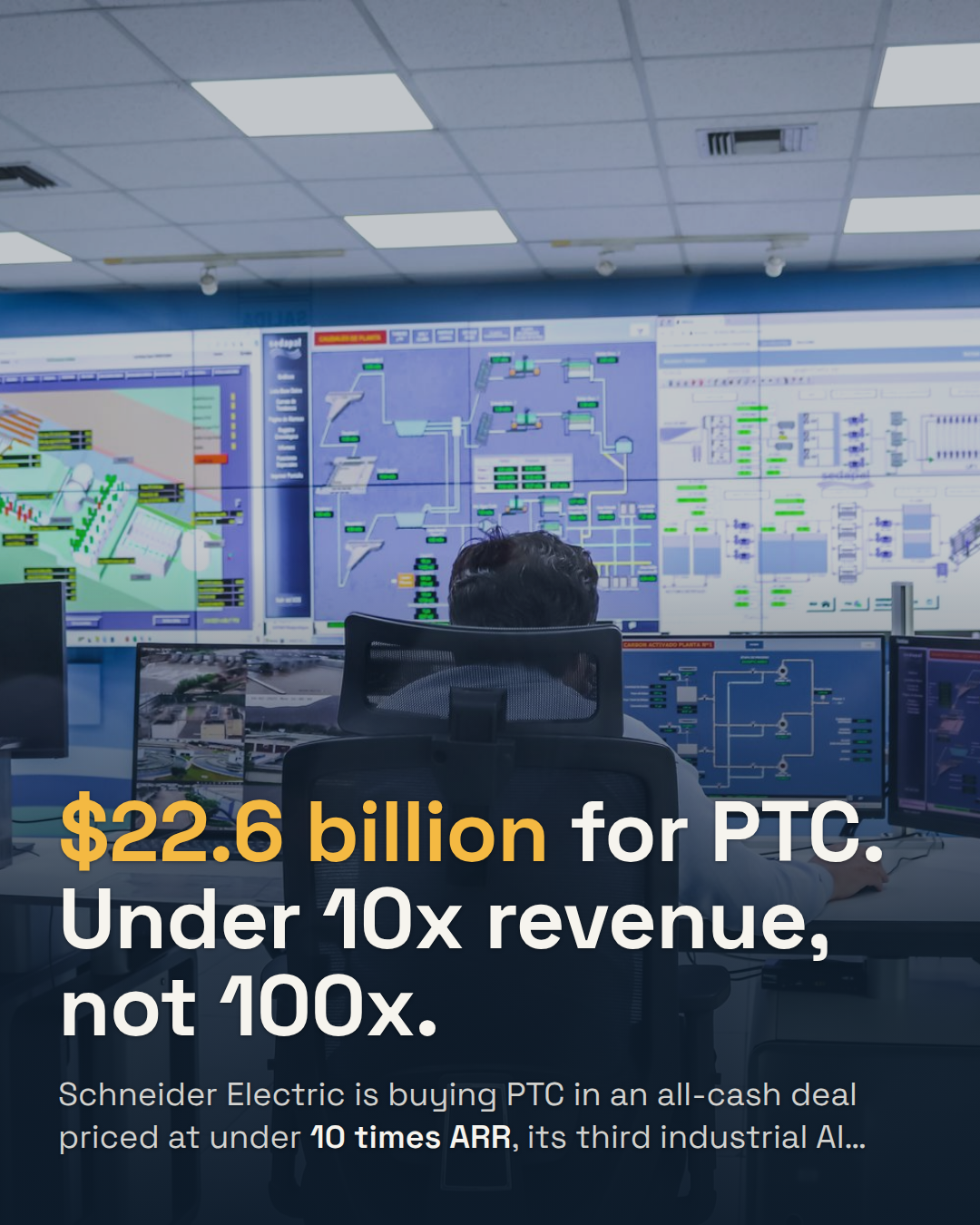
Schneider Electric agreed to buy PTC Inc. for $205 a share in an all-cash deal, valuing the US industrial software company's equity at $22.6 billion and its enterprise value at $23.7 billion. The companies announced the deal October 5, and PTC filed the agreement with the SEC the same day. Deal coverage calls it the largest acquisition in Schneider Electric's history.
PTC's own numbers set the price. The company had guided fiscal 2026 revenue of $2.69 billion to $2.75 billion and reported constant-currency annual recurring revenue of $2.448 billion, up 9.1% year over year, even after stripping out two divested product lines. Run the math and Schneider paid roughly 8.7 times trailing revenue and close to 9.7 times ARR for a company growing in the high single digits, not the triple digits chased by this year's AI darlings.
The number is the least interesting part. Here's the signal under the headline: this is Schneider Electric's third industrial-software acquisition in under four months, and the strategy behind all three is identical.
A rollup, not a one-off
In June, Schneider agreed to pay $3.1 billion for Cognite, a Norwegian industrial-data and AI platform, to slot into AVEVA, the UK software business it already fully owns. Now it is adding PTC's engineering and product-lifecycle data on top. Combined, Schneider has committed more than $25.7 billion to industrial software acquisitions in a single year, on top of the AVEVA buyout that preceded both.
Schneider is not buying features. By its own account, the goal is a unified data foundation that connects engineering intent (PTC), operational data (Cognite), and plant operations (AVEVA) into one context layer that AI agents can act on, not just query. That is the tell for any founder building a vertical AI product: the incumbents are not trying to out-build you on the model. They are trying to buy the data plumbing underneath it, because an agent is only as useful as the context it can see.
What the multiple actually says
Compare this deal to the funding rounds dominating headlines this year, where frontier-model and agent startups routinely raise at 30x, 50x, even 100x revenue on the promise of future growth. PTC got bought at under 10x ARR despite a genuine, durable moat, more than 30,000 customers, and a buyer willing to pay a real control premium for a strategic fit.
That gap is the whole story for SaaS founders plotting an exit. The market is pricing two very different things right now: speculative AI-native growth gets speculative multiples, while profitable, moderate-growth enterprise software gets priced like enterprise software, strategic premium included. If your SaaS company is compounding ARR at 9% with solid retention and you are hoping a strategic acquirer rewrites that math because "AI" is in your pitch deck, the PTC print says otherwise. The premium goes to whoever owns indispensable data, not whoever has the newest demo.
The synergy numbers matter more than the sticker price
Schneider is modeling roughly €250 million in annual run-rate cost synergies by year three and about €800 million in revenue synergies, numbers large enough to functionally lower the real price it is paying once the deal closes, expected in the third quarter of 2027 pending regulatory clearance. Founders selling into a strategic buyer should expect the same scrutiny: acquirers increasingly underwrite deals on what the combined data asset can do, not on your standalone P&L. If you cannot show how your product becomes the context layer for someone else's AI roadmap, you are negotiating from a weaker position than your ARR chart suggests.
If you remember one thing
Buyers are no longer paying up for AI features bolted onto a product. They are paying up for being the trusted, structured data layer an AI agent needs to act safely, and that layer earns a premium even at single-digit growth. If your roadmap cannot answer "what data do we own that nobody else can reconstruct," the PTC deal is a preview of how a strategic buyer will price you.
We teach this playbook in FiscEdge's Advanced AI Product Manager masterclass, where we break down how AI-native products get valued and acquired. If you are building the agent layer itself, the AI Agents Prototyping masterclass covers the data-context problem Schneider just paid $22.6 billion to solve. For the unit-economics side of an exit, see what SaaS founders get wrong about unit economics. Browse the full blog for more breakdowns. Follow @fiscedge for daily Business & AI analysis.
Topics & Categorization:
How interesting did you find this article?