SK Hynix Prices a $28B Nasdaq Debut. Demand Was 7x Oversubscribed.
SK Hynix priced its Nasdaq ADR offering at $149, raising roughly $28B in the second-biggest US listing on record. For founders, memory chips just became a capital markets story.
Fiscedge Academy
Contributing Faculty & Practitioner
News Breakdown · FiscEdge Academy
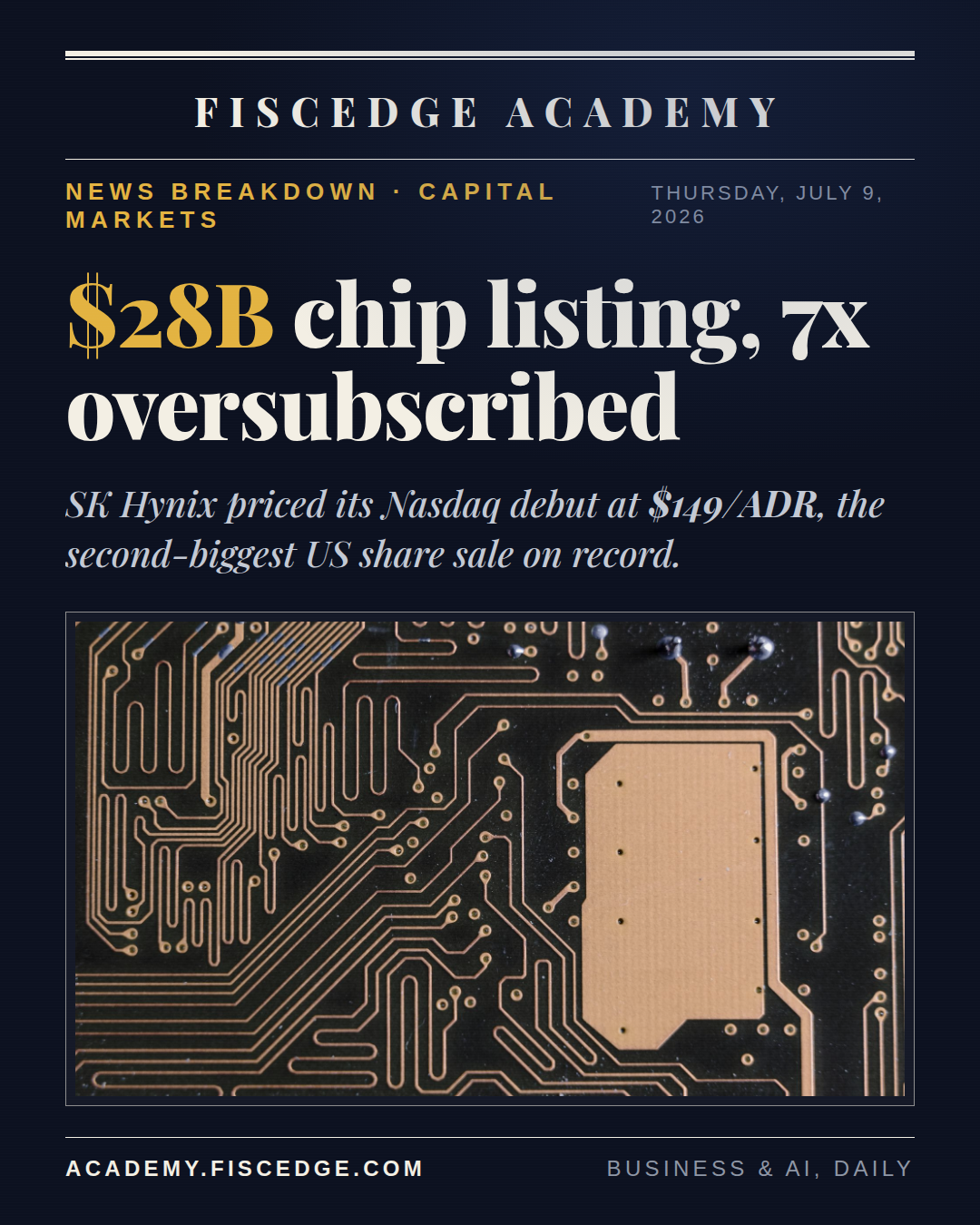
SK Hynix priced its Nasdaq listing today at $149 per ADR, about 3.1% above Thursday's closing price in Seoul, raising roughly $28 billion. Shares start trading Friday under the ticker SKHY. The order book was oversubscribed more than 7 times, with around 1,000 institutional investors joining the marketing call and long-only funds including Baillie Gifford, Coatue Management and Situational Awareness Partners indicating interest in as much as $7 billion of ADRs combined.
That makes it the second-biggest U.S. share sale on record, behind only SpaceX's roughly $85.7 billion IPO last month, and ahead of Saudi Aramco's $25.6 billion listing in 2019 and Alibaba's roughly $25 billion debut in 2014. But the size record is the least interesting part. The signal under the headline is what SK Hynix is actually selling, and why Wall Street is fighting to buy it.
A memory chip company just out-hyped most AI software startups
SK Hynix isn't a foundation-model lab or an agent startup. It makes DRAM and, critically, high-bandwidth memory (HBM), the specialized chips that sit next to GPUs and feed them data fast enough to actually use their compute. SK Hynix holds roughly 56.4% of the global HBM market, the largest share of any supplier, and HBM revenue has grown more than 400% year over year as Nvidia, Amazon and Microsoft scramble to lock in supply for their AI accelerators.
The financials back up the demand story. In Q1 2026, SK Hynix posted revenue of 52.58 trillion won, up 198% year over year, with operating profit of 37.61 trillion won and an operating margin above 72%. Those are software-company margins on a hardware balance sheet, which is exactly why long-only funds are treating this listing like a growth-stock allocation, not a legacy chipmaker one.
Where the money actually goes
SK Hynix says proceeds go toward new fabs in Yongin and Cheongju, South Korea, plus ASML extreme ultraviolet lithography scanners needed to produce next-generation memory at scale. About 89% of the disclosed spending stays in Korea. Investors buying U.S.-listed ADRs today are, in practice, funding domestic Korean chip capacity, not a U.S. expansion. That's an unusual but increasingly common structure: raise dollars in the world's deepest capital market, deploy them wherever the physical build actually needs to happen.
Why founders should care about a chip listing
Three things matter here even if you never touch hardware:
1. AI compute costs are downstream of memory, not just GPUs. Every price you pay for cloud inference, GPU instances, or managed AI infrastructure is gated partly by HBM supply. A 7x-oversubscribed raise for the company that controls over half the world's HBM output is a strong signal that the memory shortage, and the pricing power it gives suppliers, isn't clearing soon. Budget your AI infra costs assuming elevated pricing persists through 2026, not assuming a near-term drop.
2. This is a vote on AI infrastructure durability, not hype. Retail froth doesn't oversubscribe a $28 billion offering 7x with long-only institutional money. When funds like Baillie Gifford and Coatue commit billions to a memory chipmaker's U.S. listing weeks after backing SpaceX's IPO, that's a read on multi-year AI capex, the kind of signal worth weighing before you assume the AI funding cycle is near a top.
3. Cross-border listing is now a playbook, not an exception. A foreign company can list ADRs on Nasdaq to tap U.S. capital while keeping nearly all its capital spending onshore. If you're building anything hardware- or infrastructure-adjacent and eyeing U.S. investors eventually, this listing structure, and the demand it just proved, is worth studying alongside the fundraising fundamentals covered in startup strategy.
None of this means every SaaS founder needs to think about wafer fabs. But if your product touches inference costs, GPU-backed features, or AI-driven infrastructure, the physical bottleneck upstream of your P&L just got priced by the market at $28 billion of fresh conviction.
If you remember one thing
The AI boom's hardware constraint, memory chips, just became a headline capital-markets event on its own, separate from any model launch. If compute and inference costs are a real line item in your business, plan for elevated pricing to persist, because the market just bet $28 billion that HBM scarcity isn't ending this year.
We break down capital-raising mechanics like this in FiscEdge's financial modeling course, and cover how AI infrastructure costs should shape your pricing in AI for Entrepreneurs. If you're weighing your own AI-dependent unit economics, our breakdown on unit economics is a good place to start. Browse the full blog for more. Follow @fiscedge for daily Business & AI analysis.
Topics & Categorization:
How interesting did you find this article?