SpaceX Closed a $60 Billion Deal for a Coding App. It's the Biggest Startup Buyout Ever.
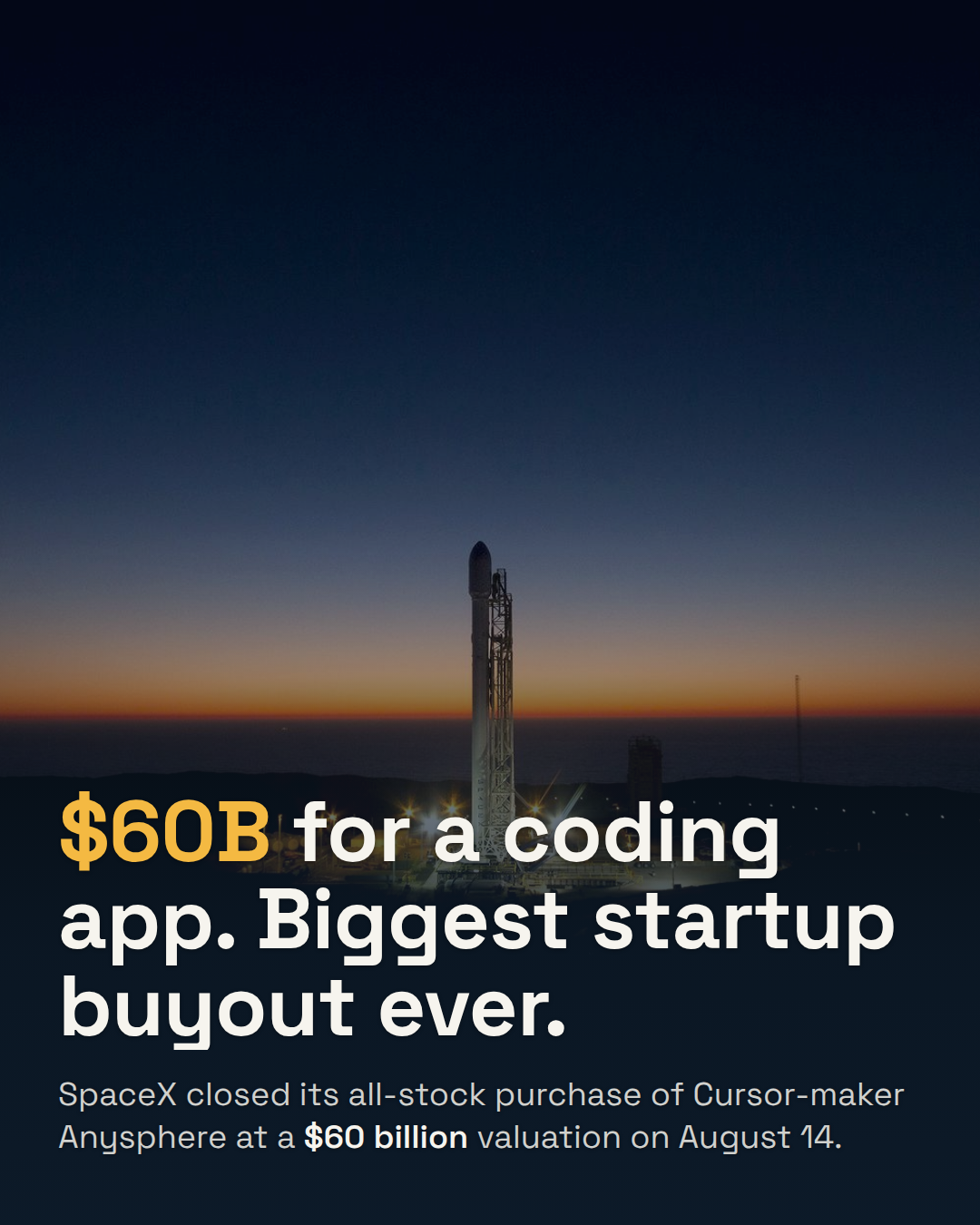
SpaceX completed its $60 billion all-stock acquisition of Cursor-maker Anysphere on August 14, the largest venture-backed startup buyout on record, as Elon Musk pushes into enterprise AI.
Fiscedge Academy
Contributing Faculty & Practitioner
News Breakdown · FiscEdge Academy
SpaceX closed the largest acquisition of a venture-backed startup in history on August 14: a $60 billion all-stock deal for Anysphere, the four-year-old company behind the AI coding tool Cursor. The price is nearly double what Google paid for cybersecurity firm Wiz ($32 billion) last year, and it lands just weeks after SpaceX's own Nasdaq debut, the biggest IPO on record.
The number that should actually stop founders isn't the $60 billion. It's the revenue curve behind it. Cursor's annual recurring revenue went from $100 million in January 2025 to $500 million by June, crossed $1 billion in November, hit $2 billion in February 2026, and reached $4 billion by the time the deal was announced that June. Anysphere is now guiding to more than $6 billion in ARR by year-end. That's roughly a 15x ARR multiple on the deal, for a company that quadrupled its revenue twice in under eighteen months.
The signal under the headline
This isn't really an aerospace company buying a dev tool. It's Elon Musk assembling an enterprise AI stack to compete directly with Anthropic and OpenAI, using freshly minted public stock as acquisition currency. SpaceX gets a coding product used by millions of developers and, more importantly, distribution into every enterprise Cursor already sells to. Anysphere's four cofounders, all MIT graduates who started the company in 2022, are each walking away with a stake worth roughly $2.7 billion.
The deal also confirms something the market has been pricing in all year: AI-native tools that reach massive ARR fast are getting bought, not just funded. Wiz went to Google. Windsurf's team went to OpenAI. Now Cursor goes to SpaceX. The pattern is the same each time, a product-led company scales revenue at a speed venture math wasn't built for, and a cash-or-stock-rich incumbent decides buying the growth curve is cheaper than building a competitor from scratch.
What this means if you're building an AI product
Distribution is the acquisition trigger, not the technology. Cursor didn't get bought because its autocomplete was unreplicable. It got bought because it had $4 billion in in-market ARR and a logo list any enterprise sales team would kill for. If you're building an AI-native SaaS product, revenue velocity and account penetration are the assets that actually move a term sheet, not the model underneath.
ARR multiples for AI-native products are being reset in real time. A 15x multiple on a company still growing at triple-digit rates is not a typo, it's the going rate right now for AI tools with genuine enterprise traction. Founders modeling their own valuation off 2022-era SaaS multiples (5-8x ARR) are underpricing what they're building. Understanding how buyers actually price recurring revenue is worth revisiting; we break down the mechanics in our guide to how unit economics drive what a SaaS business is really worth.
Stock-funded M&A is back as a growth lever. SpaceX used its own newly public shares to fund the deal instead of cash. Expect more of this from companies that just IPO'd or raised at nosebleed valuations, they have currency to spend and a incentive to buy revenue quickly before public markets start asking harder questions about organic growth. If you're on the target side of one of these conversations, the leverage sits with whoever has defensible ARR growth, not whoever has the best deck.
Vertical AI tools remain the fastest path to scale. Cursor didn't try to be a general-purpose model provider. It built one workflow, AI-assisted coding, and rode it to $4 billion in ARR in under three years. That's the same playbook worth studying if you're scoping your own AI product; we walk through how to scope and ship a focused AI-native product in our course on building SaaS with AI.
If you remember one thing
The $60 billion price tag is the headline, but the real lesson is the shape of the curve that got Cursor there, four years from founding to the largest startup buyout ever, on the back of one narrow, well-executed AI workflow. Depth in a single high-value use case now beats breadth, and buyers are proving it with real checks.
We teach the founder side of this playbook in FiscEdge's AI for entrepreneurs course and startup strategy course, including how to price and position an AI-native product for acquirers. Browse the full blog for more breakdowns like this one. Follow @fiscedge for daily Business & AI analysis.
Topics & Categorization:
How interesting did you find this article?