SpaceX Joins the Nasdaq-100. $4.3 Billion in Buying Follows Automatically.
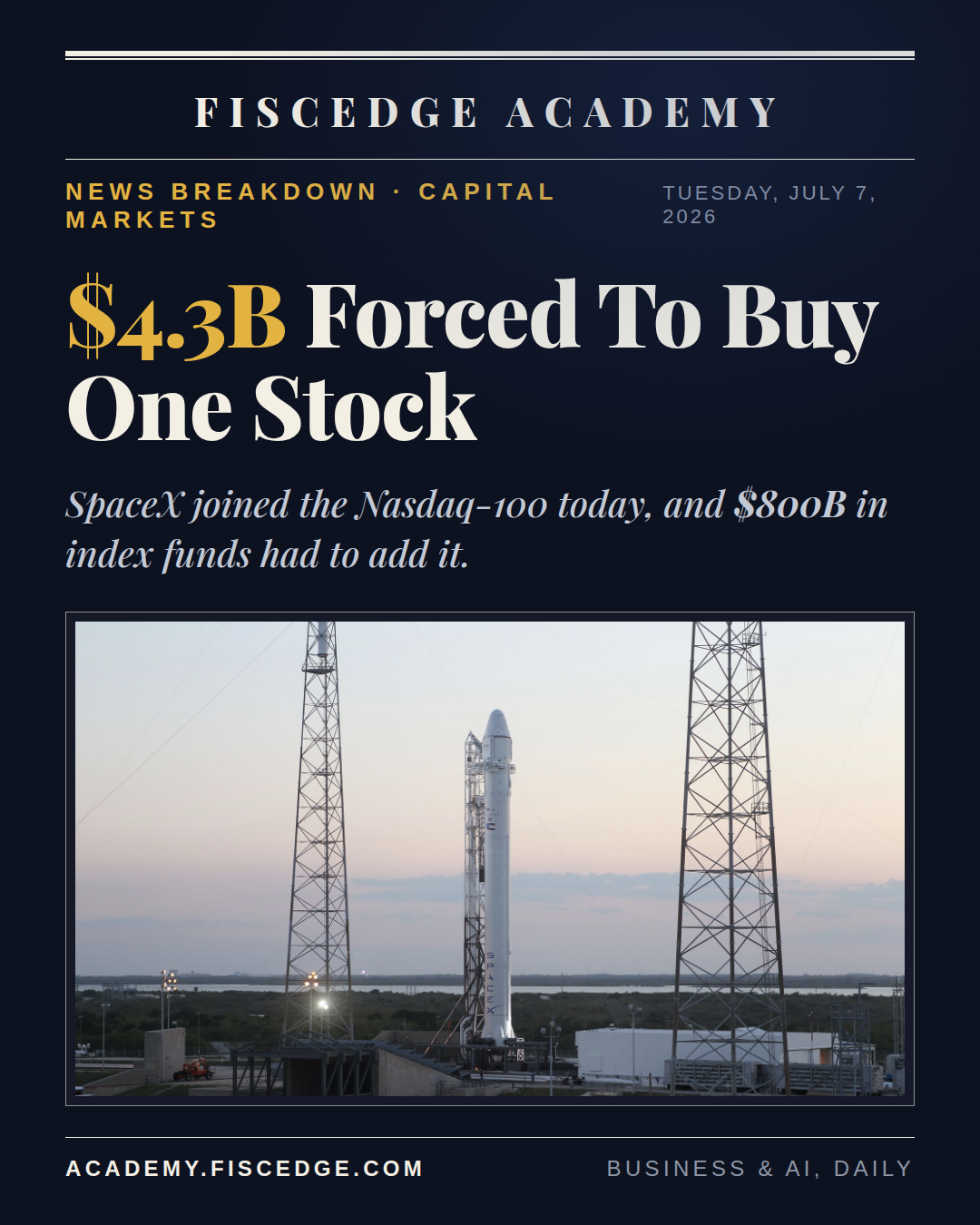
SpaceX entered the Nasdaq-100 on July 7 under a new fast-track rule, triggering an estimated $4.3 billion in forced index-fund buying. It is a lesson in how float and index rules shape exit value.

Fiscedge Academy
Contributing Faculty & Practitioner
News Breakdown · FiscEdge Academy
SpaceX officially joined the Nasdaq-100 on July 7, less than a month after its June 12 debut, which was already the largest IPO in history and left the company valued at more than $2 trillion. Nasdaq let it in early under a new "fast-track entry" rule that allows a mega-IPO to join the index after just 15 trading days instead of the usual multi-month wait, as long as it ranks among the index's top 40 companies by market cap.
That single rule change now has consequences measured in billions. Roughly $800 billion in assets, everything from the QQQ and QQQM ETFs to 401(k) plans that track the Nasdaq-100, is benchmarked to that index. All of it had to make room for SpaceX overnight. JPMorgan estimates the inclusion triggers about $4.3 billion of mechanical, price-insensitive buying as fund managers rebalance to match the new index weights.
The dollar figure is the least interesting part. The signal under the headline is that a stock exchange rewrote its own rulebook specifically to pull a single company's demand curve forward, and the reason it had to is even more revealing.
The float trick that makes the number bigger
SpaceX kept almost all of its equity locked up with insiders and early private investors, leaving a free float of only about 4.3% of total shares. A float that thin would normally earn a tiny index weight, since index math weights by tradable shares, not total valuation. Nasdaq's new methodology instead scales a large IPO's float-adjusted weight up by 3x for its first 15 days, phasing toward a 33.3% float ratio cap. In practice, SpaceX's 4.3% float is being treated as if it were closer to 12.9% for weighting purposes. The result: index funds are adding a position worth roughly 0.5% to 0.7% of total fund value today, on a stock whose actual public float is a fraction of that.
Why this matters even if you'll never IPO
Most founders reading this will never list on Nasdaq. That's not the point. The point is what this episode reveals about how public markets actually allocate capital in 2026: increasingly through mechanical index rules rather than active judgment. When Nasdaq and FTSE Russell rewrite fast-entry provisions to accommodate a $2 trillion IPO, they're admitting that the size and pace of AI-era mega-listings (SpaceX, and the wave of AI infrastructure and defense-tech companies expected to follow it) have outgrown the old rulebook. Being big enough, fast enough, wins you programmatic demand that has nothing to do with fundamentals. That's a different kind of moat than product-market fit, and it's one that's decided years before an S-1 gets filed, in how a cap table and lockup schedule are structured.
The exit-planning lesson hiding in the mechanics
If you're building toward any kind of liquidity event, whether that's a strategic acquisition, a growth round with secondary sale, or eventually a public listing, the SpaceX float mechanics are a preview of questions your own investors will eventually ask: how much of the company will actually be tradable at exit, and who controls the timeline for unlocking it? Founders who treat cap table design as a back-office formality tend to get surprised by exactly this kind of structural detail later. It's the same discipline we walk through in how to think about ownership and dilution: ownership structure isn't just about who gets what, it's about what kind of exit is even mechanically possible.
Index inclusion is a demand hack, not a verdict on the business
It's worth separating two things that are getting conflated in today's coverage: SpaceX's index inclusion says nothing new about whether the company is worth $2 trillion. That valuation question was settled, for better or worse, at the IPO. What inclusion adds is a captive buyer base that has to own the stock regardless of price, a dynamic we cover when we teach founders to read unit economics separately from market price action, since the two can diverge for long stretches once passive capital gets involved.
If you remember one thing
An index isn't a passive mirror of the market anymore, it's a rulebook, and rulebooks get rewritten for companies large enough to justify it. When you're negotiating your own cap table, lockups, and float, you're not just managing dilution today, you're pre-deciding whether structural, price-insensitive demand can ever find your stock later. Plan the mechanics of your eventual exit as deliberately as you plan the product.
We teach cap table and exit mechanics in FiscEdge's startup strategy course, and how to model the numbers behind a raise or a listing in financial modeling. Browse the full blog for more breakdowns like this one. Follow @fiscedge for daily Business & AI analysis.
Topics & Categorization:
How interesting did you find this article?