Stoke Space Raises $1 Billion at a $10 Billion Valuation. Its Rocket Has Never Flown.
Stoke Space raised $1 billion at a $10 billion valuation, pushing total funding to $2.3 billion before its Nova rocket has flown once. The founder lesson: milestones get priced too.

Fiscedge Academy
Contributing Faculty & Practitioner
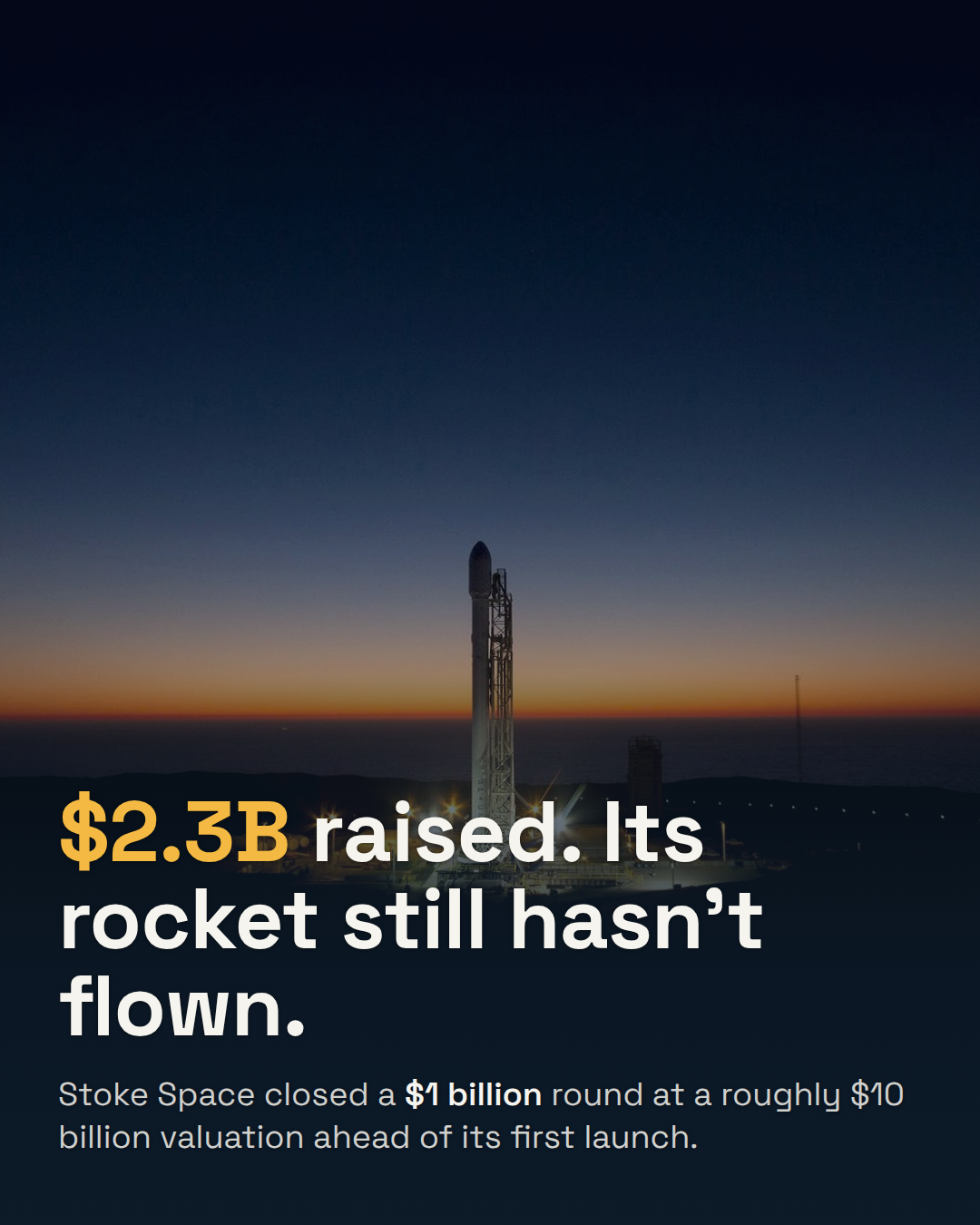
News Breakdown · FiscEdge Academy
Stoke Space closed the initial $1 billion tranche of a Series E round on September 8, co-led by Point72 Ventures and Spark Capital, pushing its total capital raised to $2.3 billion. Investors are valuing the Kent, Washington rocket company at roughly $10 billion. Nova, the fully reusable rocket the money is funding, has never flown.
That is not a typo or an early-stage exaggeration. Stoke has raised $2.1 billion of that total since January 2025 alone, across a Series C, a Series D, a Series D extension, and now this Series E, all before a single orbital launch. The company's own timeline has already slipped once, from a first flight targeted for late 2026 to early 2027. The number worth sitting with isn't the valuation. It's the size of the check investors are willing to write against a product that, by the company's own schedule, is still roughly a year from proving itself in the sky.
The signal under the headline
Stoke's round isn't really a rocket story. It's the clearest example yet of a financing pattern spreading across every capital-intensive frontier in 2026: growth investors pricing companies off technical milestones instead of revenue, at valuations that used to require years of paying customers to justify. The same week Mistral AI closed a €3 billion round on the strength of chip-supplier relationships rather than profitability, Stoke closed $1 billion on the strength of a heat shield and a launch-pad refurbishment. Different sector, same underlying bet: de-risking the engineering is worth as much to a growth investor now as de-risking the market used to be.
Why "fully reusable" is worth $10 billion to someone
Nova's pitch is that both stages come back, not just the booster the way SpaceX's Falcon 9 does. If Stoke pulls it off, the economics of medium-lift launch reset again the way Falcon 9 reset them a decade ago, and Stoke becomes one of a handful of companies that can offer it. Investors aren't pricing today's Stoke Space. They're pricing the option on being early into whichever companies end up controlling reusable launch capacity once the market consolidates, the same logic that has justified enormous, pre-revenue rounds across AI infrastructure all year. That bet only pays off if the technical milestone lands on schedule, and Stoke has already missed one.
What this means if you're the one raising
Almost no founder reading this will ever pitch a rocket company. But the mechanism Stoke is riding, capital chasing a technical proof point instead of a revenue number, shows up at every stage below it: an AI startup raising on a model benchmark, a hardware company raising on a working prototype, a biotech raising on a trial readout. If you're raising on a milestone instead of an ARR line, be explicit with investors about what "de-risked" actually means, what happens to the valuation if the milestone slips again, and how much runway you have if it does. Modeling that scenario before the term sheet, not after a missed date, is the difference between a down round and a bridge you saw coming. It's the kind of scenario work we walk through in financial modeling, and the broader question of how to price a company with proof but not revenue is core to startup strategy.
If you remember one thing
A missed technical milestone is a different kind of red flag than a missed revenue number, but it's still a red flag. Price it that way, whether you're the one raising or the one writing the check.
We teach how to model milestone-based and pre-revenue rounds in FiscEdge's financial modeling course, and how to structure the pitch itself in startup strategy. For the fundamentals behind reading a cap table and a term sheet, see what unit economics actually means. Browse the full blog. Follow @fiscedge for daily Business & AI analysis.
Topics & Categorization:
How interesting did you find this article?