Stripe Is in Talks to Buy OpenRouter for $10B. It Was Worth $1.3B in May.
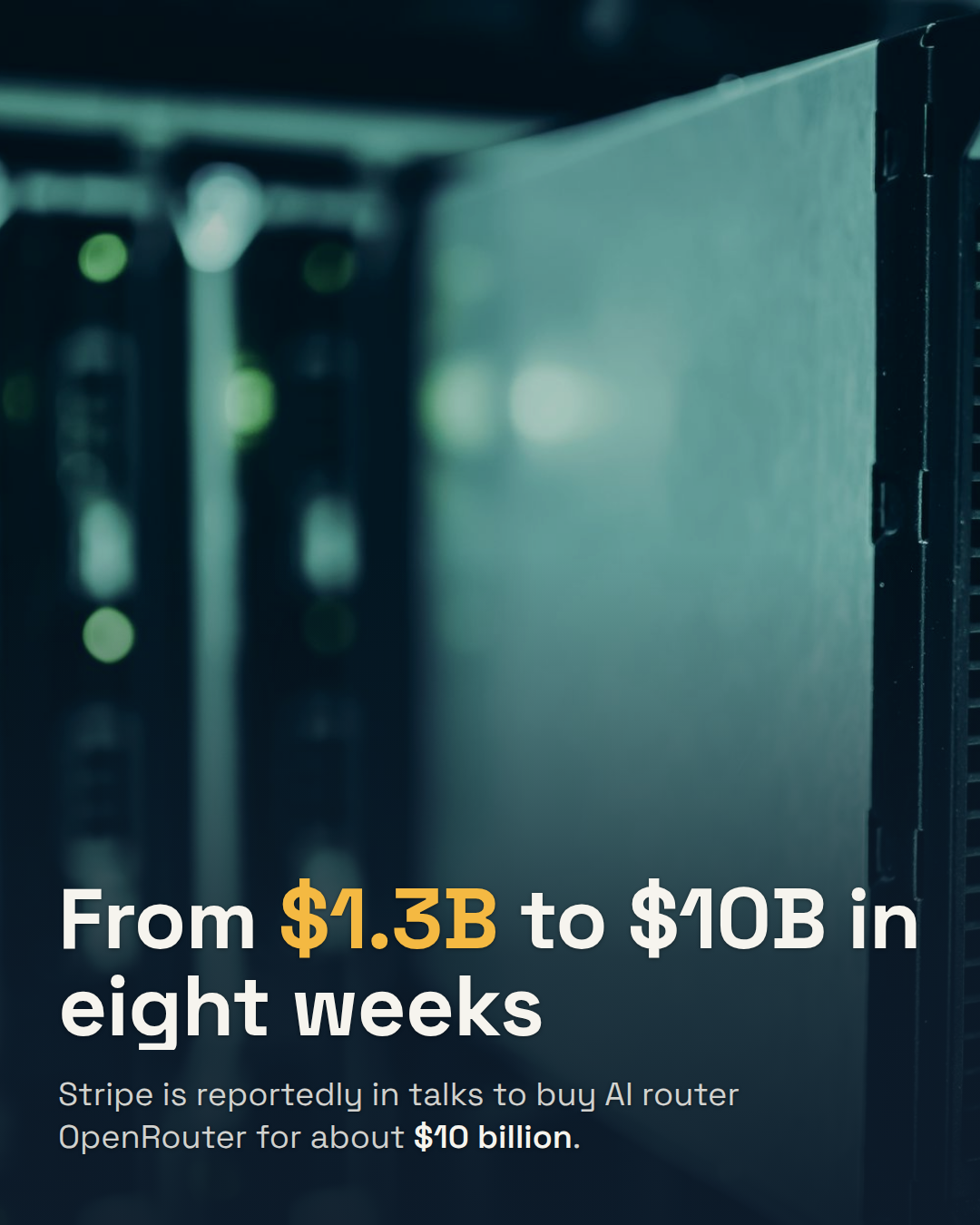
Stripe is reportedly in talks to buy AI model marketplace OpenRouter for about $10 billion, up from a $1.3 billion valuation set two months earlier.

Fiscedge Academy
Contributing Faculty & Practitioner
News Breakdown · FiscEdge Academy
Stripe is in talks to acquire OpenRouter, the AI model marketplace, for roughly $10 billion, the Wall Street Journal reported on July 24. Two months ago, OpenRouter wasn't worth a tenth of that. Its Series B, announced May 26 and led by Alphabet's growth fund CapitalG with NVIDIA's NVentures, ServiceNow Ventures, MongoDB Ventures, Snowflake Ventures, Databricks Ventures and returning backers Andreessen Horowitz and Menlo Ventures, raised $113 million at a $1.3 billion valuation. Nothing is signed. Reuters and multiple outlets note the talks are fluid and could still collapse or attract a competing bidder. But the number on the table right now is roughly 7.7x where the company was priced eight weeks ago.
The valuation jump is the least interesting part. The interesting part is what Stripe would actually be buying, and why a payments company wants it.
What OpenRouter actually sells
OpenRouter isn't a model. It's the switchboard between more than 400 models from labs like OpenAI, Anthropic, Google and dozens of open-weight providers, letting developers call any of them through one API and switch on price, latency or capability without rewriting code. That neutrality is the entire business: OpenRouter doesn't need any single lab to win, it profits from the fact that nobody knows yet which one will. The scale backs it up. The platform is running at roughly 1.5 quadrillion tokens a year, serves 8 million-plus developers, and grew annualized revenue from about $19 million at the end of 2025 to roughly $50 million by March 2026. Weekly token volume alone has gone from 5 trillion to 25 trillion in six months.
Why Stripe, not a hyperscaler
Google, Microsoft or Amazon buying a model router would look like a lab trying to own the neutral layer above its own competitors, undermining the exact thing that makes OpenRouter useful. Stripe doesn't have that conflict, and it already sits inside OpenRouter's plumbing: OpenRouter runs its billing through Stripe today. Buying the router doesn't just add a product line, it turns Stripe into the toll both for inference spend across millions of AI applications, the same way it became the default toll booth for SaaS subscriptions a decade ago. It also isn't an isolated move. Nine days earlier, Stripe and private equity firm Advent International jointly offered $53.4 billion to buy PayPal outright, a deal that would make a venture-backed company the acquirer of an S&P 500 one. Stripe itself is valued around $159 billion. Read together, these aren't two unrelated headlines, they're one company trying to own both sides of AI-era commerce: the card rails and the infrastructure metering what AI actually costs to run.
What this changes for founders and operators
- If your product routes through OpenRouter, watch who owns the meter. A payments company acquiring your model router has every incentive to bundle its own payment rails, financing or take rate into that layer. Model-agnostic infrastructure stops being neutral the moment its owner has a stake in what you spend, not just what model you call.
- Usage-based infrastructure is re-rating fast, and that's your comp for raising. OpenRouter's business model is a fee on token volume that scales with everyone else's AI spend, not a wrapper on one model. If you're building metering, orchestration or routing infrastructure and fundraising, this is the multiple a real strategic acquirer will pay for that position: 7.7x in under two months once someone with distribution wants in.
- The "neutral middleware" layer just proved it's worth owning. Plenty of founders treat "which model do we call" as a solved, boring problem to abstract away. The market just valued the company that abstracts it at $10 billion. If you're the layer between your customer and a commodity choice, that layer itself may be your most defensible asset, not a feature you bolt on.
- Expect payments and infra vendors to keep consolidating upward. If Stripe absorbs both a card-network-scale rival (PayPal) and an AI-infrastructure layer (OpenRouter) in the same month, other processors (Adyen, Square, Checkout.com) have obvious incentive to make similar moves. Founders building on any single vendor's rails should model what happens to pricing and lock-in when that vendor becomes an infrastructure owner, not just a processor.
If you remember one thing
OpenRouter didn't get valuable by building a better model, it got valuable by owning the neutral point where every model competes for your call, and a payments company just proved that position is worth $10 billion less than two years after launch. If you're building the layer that sits between a customer and a commodity decision, model, vendor, provider, that layer is not a convenience feature. It's the business.
We break down deals like this one in FiscEdge's AI for entrepreneurs track, and if you're building the metered, usage-based side of a SaaS product, building SaaS with AI is the right next read. Learn to model deals like this one yourself in financial modeling. Browse the full blog for more breakdowns like this. Follow @fiscedge for daily Business & AI analysis.
Topics & Categorization:
How interesting did you find this article?