Tesla Posted Record Revenue. The Stock Crashed 14.5% Anyway.
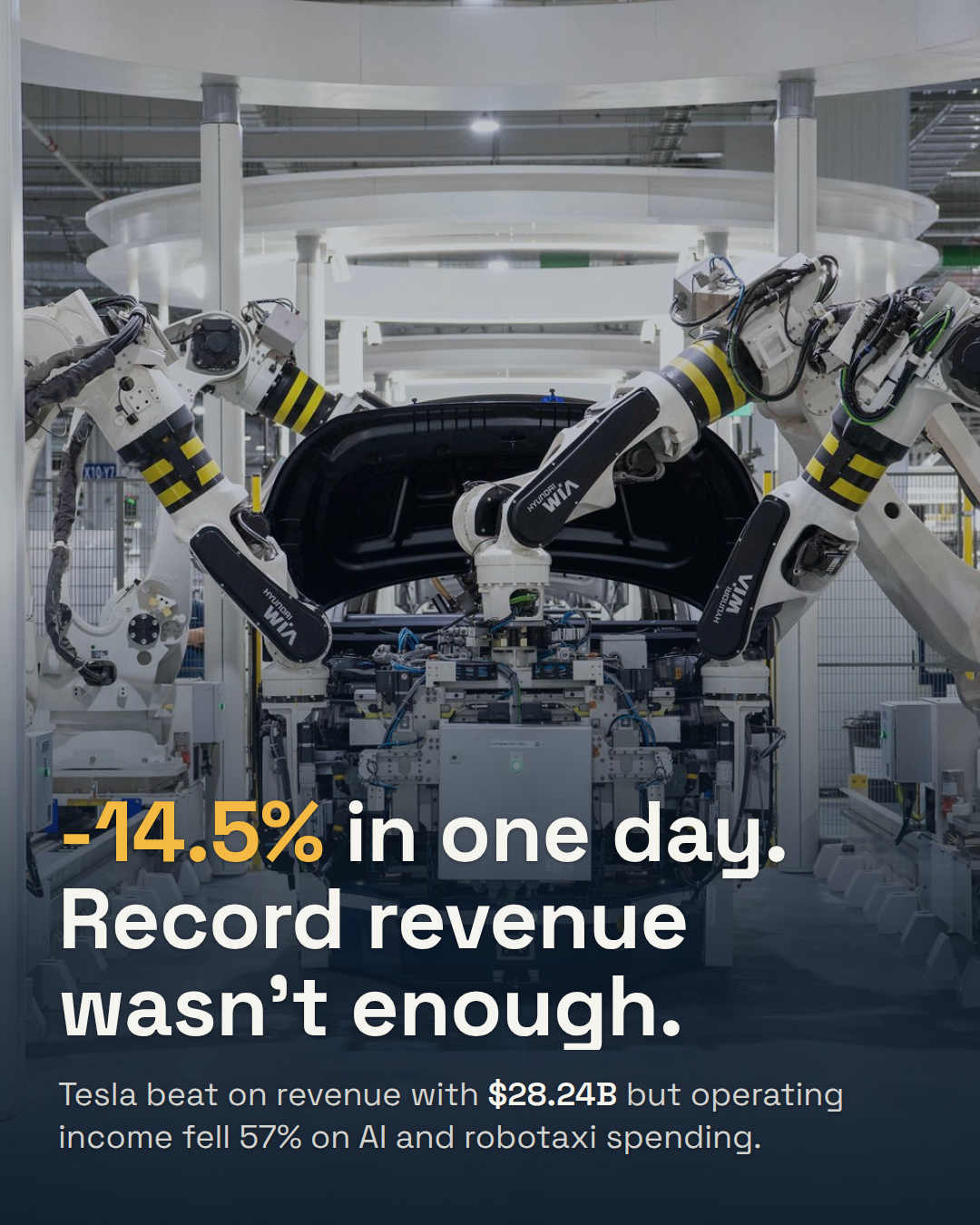
Tesla beat Q2 estimates with $28.24B in revenue, but operating income fell 57% on AI and robotaxi spending, sending shares down 14.5% in a day.

Fiscedge Academy
Contributing Faculty & Practitioner
News Breakdown · FiscEdge Academy
Tesla just posted its best second quarter on record and the market punished it for it. Q2 2026 revenue hit $28.24 billion, up 26% year over year and comfortably ahead of the roughly $26.4 billion Wall Street expected, on record deliveries of 480,126 vehicles. None of that mattered. Shares fell 14.5% on July 23, closing near $319.69 after opening around $374, the stock's worst single day in over a year. Adjusted earnings per share came in at $0.33, well short of the $0.53 analysts had modeled.
The gap between the two numbers is the whole story. Tesla beat on the top line and missed badly underneath it: operating income fell 57% to $398 million, compressing operating margin to just 1.4%. Automotive gross margin excluding regulatory credits landed at 16.3%, below the 18.4% Wall Street had priced in. Capital expenditure jumped 142% to $5.79 billion, and free cash flow turned negative at -$1.09 billion. Operating expenses rose 47% to $4.35 billion, driven largely by spending on AI, Optimus and robotaxi programs plus the stock-based compensation tied to them.
The number that matters isn't the revenue beat, it's the margin
A car company can grow revenue 26% and still get sold off hard if the market decides the growth is arriving at the wrong price. That's what happened here. Tesla is simultaneously running a capital-intensive core auto business under margin pressure and pouring billions into AI, humanoid robotics and autonomous driving that haven't generated revenue yet. Investors have historically given Tesla a pass on this trade because Elon Musk's AI story has carried the stock for years. This quarter, for the first time in a while, the market drew a hard line: prove the spending converts into profit, or the multiple compresses.
The signal under the headline isn't "Tesla had a bad quarter." It's that public markets are applying the same scrutiny to Tesla's AI capex that they're now applying to every hyperscaler, Alphabet included, which sold off this same week on a capex raise of its own. The era where "we're investing in AI" was a sufficient answer to a margin miss appears to be ending. Investors want a visible path from spend to cash, and they're pricing stocks on how convincingly a company can show one.
What this changes for founders and operators
- "We're investing in AI" is no longer a free pass with investors. Tesla's opex jumped 47% on AI, Optimus and robotaxi spend, and the market punished it instead of rewarding the ambition. If you're raising or pitching a board on AI initiatives, come with a monetization timeline attached to the spend, not just a roadmap.
- Gross margin and operating margin are now separate scorecards, and both get checked. Tesla's auto gross margin missed by roughly two points and that alone helped wipe out a chunk of the stock's value even with a revenue beat. Know the difference between the two lines in your own model, because investors clearly do.
- Capex growing faster than revenue is a red flag the market is actively pricing, not future-proofing. Tesla's capex grew 142% against 26% revenue growth. If your own burn rate on infrastructure, compute or headcount is outpacing your revenue growth by that kind of multiple, expect the same question from any investor doing real diligence.
- Deliveries and demand are not the same as unit economics. Tesla hit a record delivery quarter and it barely moved the needle on the stock reaction. Growth metrics that don't translate into margin are increasingly treated as vanity numbers by sophisticated capital, plan your own KPIs accordingly.
Why this is bigger than one earnings call
This is the second consecutive week a major AI-exposed company has beaten on revenue and sold off on spending discipline, after Alphabet's capex-driven selloff just one day earlier. Together they mark a shift in how public markets are grading the AI buildout: growth and bookings still matter, but they no longer buy unlimited patience on cash burn. For founders building anything adjacent to AI, robotics or autonomous systems, this is the environment your own investors are watching when they read your burn multiple, and it's worth modeling your fundraise story around a credible path to margin, not just a growth curve.
If you remember one thing
Revenue growth gets the headline, margin gets the stock price. Tesla grew revenue 26% and still lost 14.5% of its value in a day because the spending behind that growth, an AI and robotaxi bet with no revenue yet, is outrunning the profit needed to justify it. Whatever you're building, know the difference between a number that impresses a reporter and a number that survives an investor's model, because right now the market is only rewarding the second one.
We teach how to read a margin miss like this one and separate growth from cash conversion in FiscEdge's financial modeling course. If your product roadmap leans on AI features investors will scrutinize the same way, our AI for entrepreneurs track covers how to frame that spend credibly. For the gross margin versus operating margin distinction that decided this stock move, start with what are unit economics. Browse the full blog for more breakdowns like this. Follow @fiscedge for daily Business & AI analysis.
Topics & Categorization:
How interesting did you find this article?