Uber Cut 3,300 Jobs, 10% of Staff. The Freed-Up Cash Is Funding a $10 Billion Robotaxi Bet.
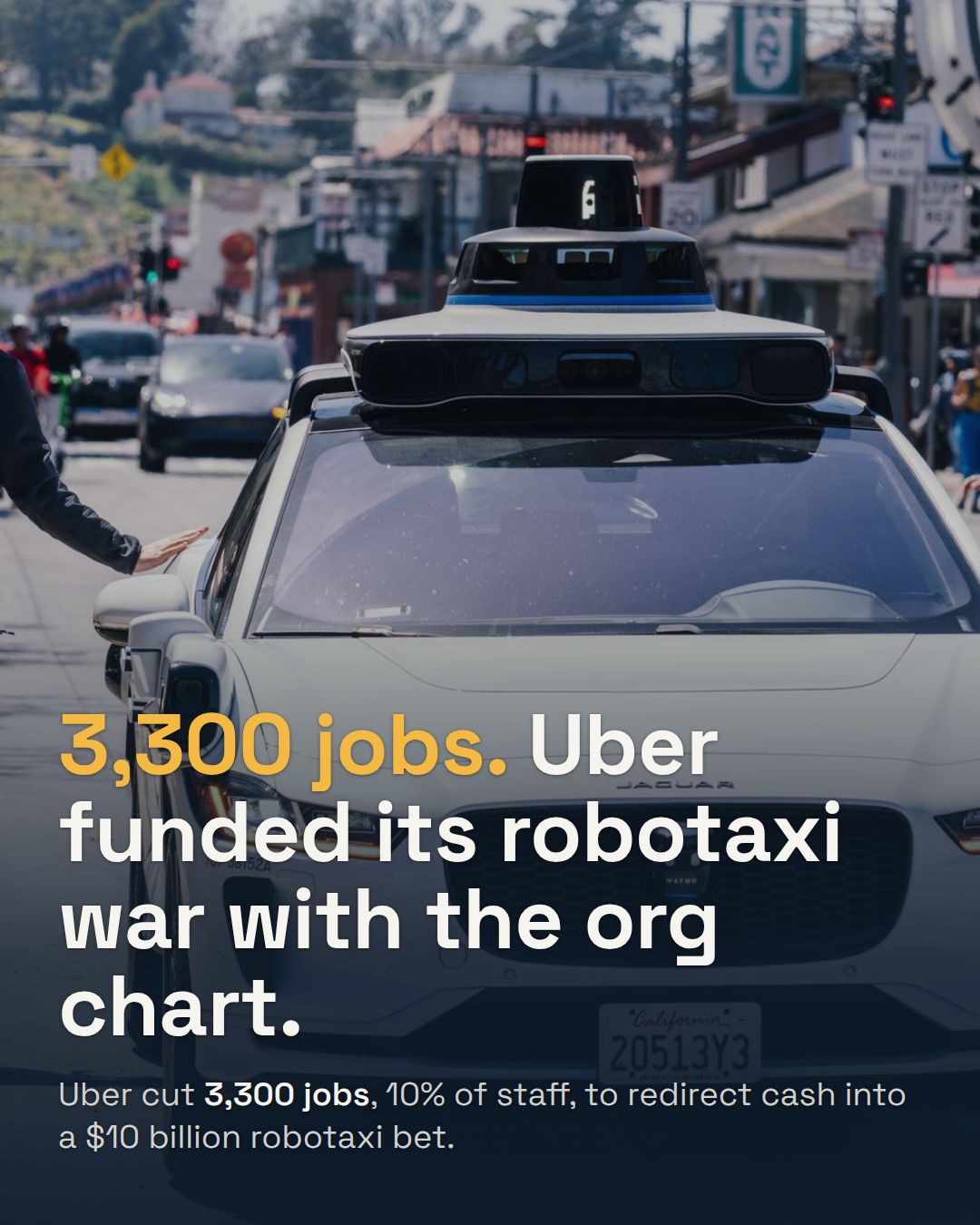
Uber laid off 3,300 people and cut its management ranks by 20%, redirecting the savings into a robotaxi build-out. Investors read it as strength, not distress.

Fiscedge Academy
Contributing Faculty & Practitioner
News Breakdown · FiscEdge Academy
Uber is cutting 3,300 jobs, about 10% of its global workforce, in the company's largest round of layoffs since the pandemic. Headcount drops from roughly 34,000 to around 30,000. The cuts hit the management ranks hardest: CEO Dara Khosrowshahi is eliminating 20% of manager roles, cutting the number of one and two person teams in half, and removing staff who sit more than seven layers below him on the org chart.
Uber's stock rose more than 2% in premarket trading on the news. That reaction is the first clue that this is not a distress story.
This is not the 2020 version of this headline
The last time Uber cut this deep, in May 2020, it shed 6,700 jobs because ride demand had collapsed overnight and the company was burning cash it didn't have. Nothing like that is happening now. Uber posted a record $2.8 billion in free cash flow last quarter, and Khosrowshahi told staff the point of the cuts is to "generate savings that we intend to reinvest in growth, innovation, and the capabilities that will matter most over the coming years."
In an email obtained by Bloomberg, he was specific about what had gone wrong structurally: years of growth had produced "more layers, more coordination, more fragmented ownership, and in some cases structures that made sense when businesses were smaller but no longer serve us well at our current scale." That is a description of organizational debt, and it is accumulating at a company most founders would consider a model of operating discipline.
Where the freed-up cash is actually going
Uber has already committed more than $10 billion to its autonomous vehicle build-out: roughly $7.5 billion toward buying and operating its own robotaxi fleet, and over $2.5 billion into equity stakes in AV developers and manufacturers it partners with. The near-term target is 120,000 robotaxis live in at least 15 cities by the end of 2026, scaling to 28 cities by 2028.
That is a fundamentally different cost structure than the asset-light marketplace Uber built its first decade on, where drivers supplied the cars and Uber supplied the app. Owning fleets and subsidizing AV partners is capital-intensive in a way ride-hailing never was, and it is happening while Uber's core delivery and rides business faces real competitive pressure from robotaxi operators who don't pay a human driver at all. Delayering the org chart is how Uber is funding that shift without touching the AV budget or spooking investors on margin.
The signal under the headline
The number that matters here is not 3,300. It's 20%, the share of management roles being eliminated, and the "seven layers from the CEO" rule Uber applied to decide who stays. That is a span-of-control audit, the kind most companies only run when a board forces one after growth has already gone sideways. Uber ran it voluntarily, from a position of record cash flow, and the market rewarded it immediately.
For founders scaling a team, the lesson isn't "cut people." It's that management layers are one of the few costs that compound silently. Nobody approves a new layer of middle management in a single decision the way they approve a new AWS bill or a new hire's salary; it accretes one promotion, one reorg, one well-intentioned "let's add a lead for this" at a time, until a company the size of Uber needs a public restructuring to unwind it. A SaaS company at 50 or 200 employees can run the same audit on its own org chart for free, long before a board makes it do so.
The other lesson is about capital allocation discipline. Uber didn't fund its robotaxi bet by raising a new round or issuing debt against future earnings, it funded it by removing a cost structure that had stopped earning its keep. That is the same discipline investors expect in a Series B pitch deck: show what you're cutting, not just what you're building, and the math for the new bet gets easier to defend.
If you remember one thing
Management layers are a cost that grows without anyone deciding to add them, and the companies that audit span-of-control before a downturn forces the question are the ones whose stock goes up on layoff day, not down.
We teach the operating discipline behind decisions like this in FiscEdge's business fundamentals course, and the capital allocation math in financial modeling. For the AI-and-automation side of what's squeezing incumbents like Uber, see AI for entrepreneurs. Browse the full blog for more daily breakdowns. Follow @fiscedge for daily Business & AI analysis.
Topics & Categorization:
How interesting did you find this article?