Unitree Prices a $9 Billion Robot IPO. Retail Investors Oversubscribed It 8,000 Times.
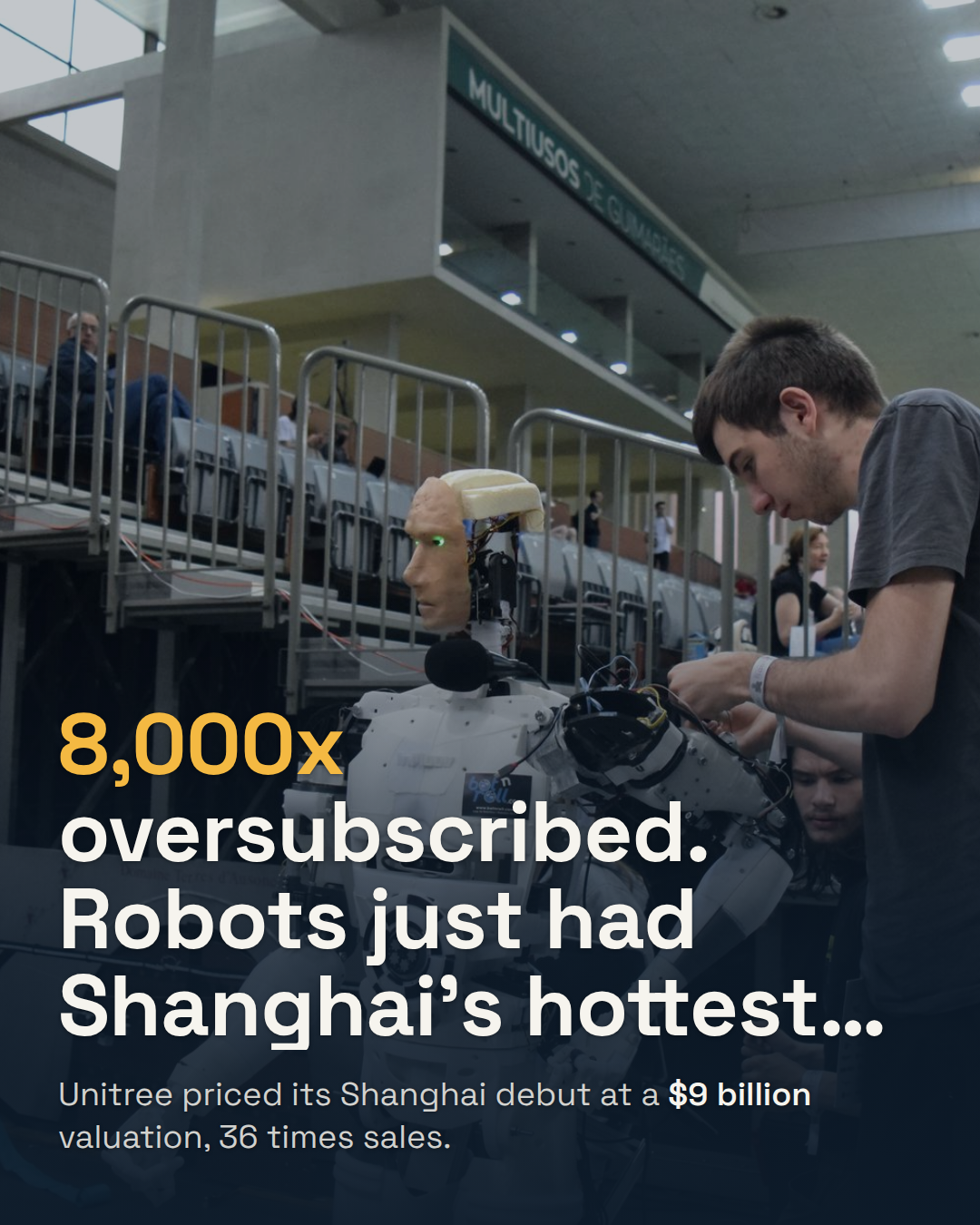
Unitree priced its Shanghai IPO at a $9 billion valuation and 36 times sales, raising $905 million after retail investors oversubscribed it more than 8,000 times, a STAR Market record.

Fiscedge Academy
Contributing Faculty & Practitioner
News Breakdown · FiscEdge Academy
Unitree Robotics priced its Shanghai listing at 150.80 yuan a share, raising $905 million (about 6.1 billion yuan) and valuing the humanoid robot maker at roughly $9 billion. The company starts trading on Shanghai's STAR Market on August 19, becoming the first pure-play, general-purpose humanoid robotics company to go public on mainland China's markets.
The valuation is the smaller number. The retail tranche of the offering was oversubscribed more than 8,000 times, a record for a technology listing on the STAR Market, China's Nasdaq-style board for growth companies. Unitree's application was accepted on March 20 and cleared the entire regulatory review in 104 days, a pace regulators fast-tracked specifically for a company they wanted trading before rivals could catch up.
The number that matters isn't the valuation
Here's the signal under the headline: Unitree priced at roughly 219 times its 2025 earnings and about 36 times sales, according to Reuters. For context, that is a multiple hot US SaaS IPOs rarely clear even at peak AI-bubble enthusiasm, where 15-20x forward revenue is considered a stretch. Investors are not pricing Unitree like a robotics manufacturer with 1.7 billion yuan (roughly $250 million) in 2025 revenue. They are pricing it like the category-defining platform for an entire industry that does not fully exist yet.
That bet has a real business underneath it, which is what makes the multiple interesting rather than just frothy. Unitree is already profitable, ships humanoid units at roughly 60% gross margins, and quadrupled revenue year over year on about 5,500 units shipped in 2025. It is, by Reuters' count, the world's largest humanoid robot maker by sales today, ahead of Tesla's Optimus program and fellow Chinese lister UBTech. Founder Wang Xingxing kept about 23.8% equity and roughly 69% of voting rights through the raise, an unusually tight founder-control structure for a company this size going public.
Why this matters outside China's stock market
Humanoid robotics has spent the last two years as a demo reel: viral videos of machines dancing, running, throwing punches. An 8,000x-oversubscribed IPO is the market telling you the demo phase is closing. Public investors, not just venture funds making a speculative bet, are now underwriting the thesis that general-purpose robots reach commercial deployment on a timeline close enough to matter for a stock price today.
For founders building anywhere near hardware, robotics, or physical-world AI, that changes the fundraising conversation. A liquid public comparable at a $9 billion valuation and a 36x sales multiple gives every humanoid and embodied-AI startup a fresh reference point to point at in a pitch deck, whether or not the comparison holds up under scrutiny. It also tells you where growth-stage capital is rotating: after eighteen months of software-only AI rounds, hardware-adjacent AI just got its most emphatic public-markets validation yet.
What this changes for founders and operators
- Expect "the Unitree comp" in every embodied-AI pitch for the next year. Founders in robotics, drones, and physical automation will use this valuation as an anchor point. Push past the multiple and ask what revenue, margin and unit-shipment numbers actually back it, the way Unitree's did.
- Watch for a second wave of Chinese hardware listings. Regulators cleared this IPO in 104 days on purpose. That is a policy signal, not an accident, and it usually precedes more fast-tracked listings from adjacent sectors.
- Founder control structures are back in focus. A 69% voting stake surviving a public listing is a reminder to structure your own cap table and voting rights deliberately from the earliest rounds, not to patch it in later when investors have leverage.
- Gross margin, not just growth rate, is what earns a premium multiple. Unitree's 60% margins at 4x revenue growth are doing real work in justifying its price. If you're building toward a raise, know your margin story as well as your growth story.
If you remember one thing
Public markets just put a $9 billion, 36-times-sales price tag on a humanoid robotics company with real revenue and real margins behind it, and retail investors lined up 8,000 deep to buy in. Whether or not you build in hardware, that is the clearest signal yet that the AI capital cycle is rotating from software demos into physical-world deployment, and every founder adjacent to that shift now has a real, liquid comparable to reckon with.
We cover how to read valuation multiples like a public-markets investor in FiscEdge's financial modeling course. If you're building anywhere near AI hardware or embodied agents, our AI for entrepreneurs track breaks down where the capital is actually flowing. Not sure your margins can carry a premium multiple? Start with what are unit economics. Browse the full blog for more breakdowns like this. Follow @fiscedge for daily Business & AI analysis.
Topics & Categorization:
How interesting did you find this article?