Valar Atomics Raises $1B at a $6B Valuation. A Nuclear Reactor Just Powered an Nvidia AI Chip.
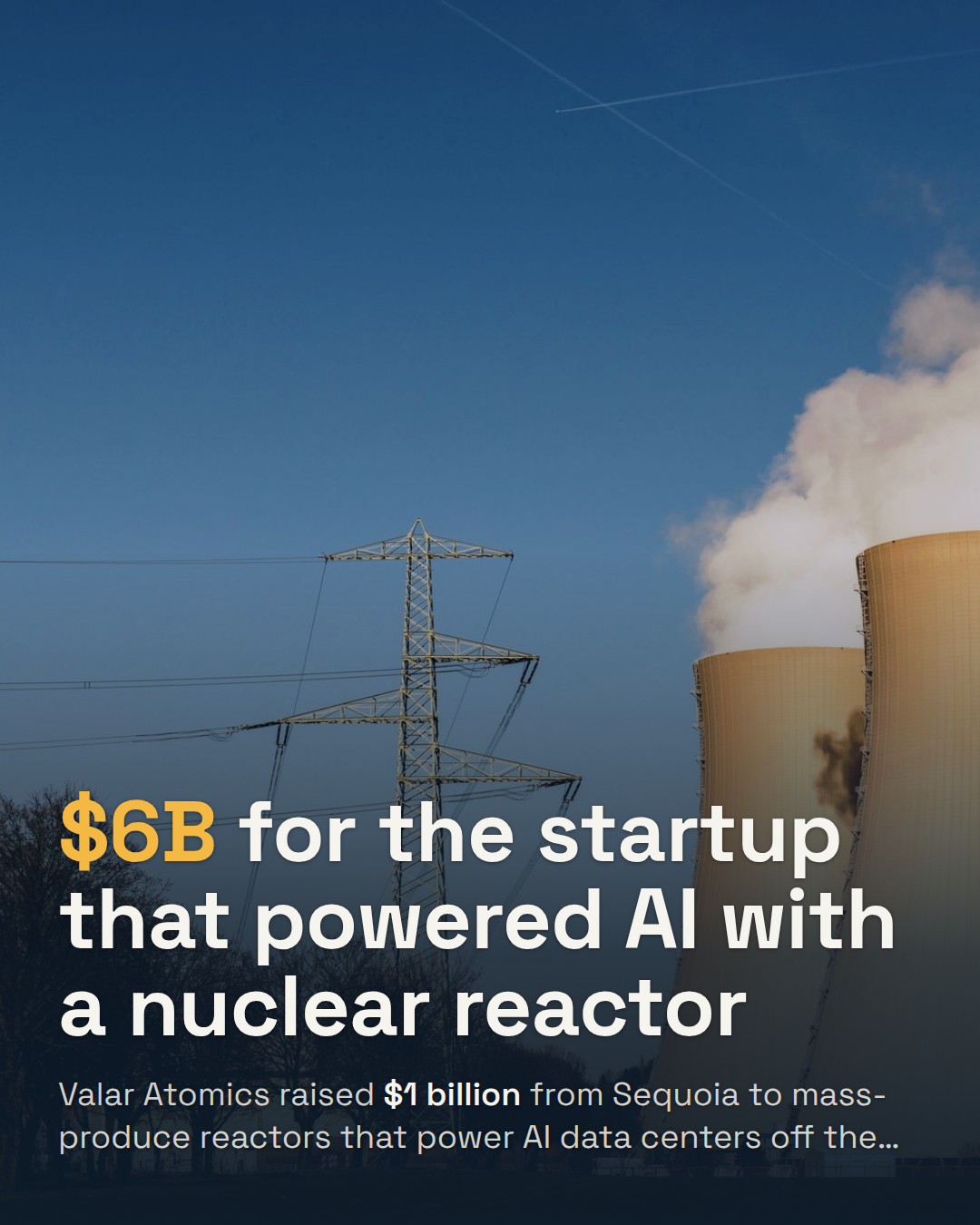
Sequoia led a $1B round for Valar Atomics at a $6B valuation, tripling its price in four months after its microreactor became the first to directly power an Nvidia AI chip.

Fiscedge Academy
Contributing Faculty & Practitioner
News Breakdown · FiscEdge Academy
Valar Atomics just closed a $1 billion Series B led by Sequoia Capital at a $6 billion valuation, tripling the price investors paid four months ago in its $450 million round at a $2 billion valuation. Apandion Capital, Atreides Management, Conviction, Dream Ventures, HOF Capital, Point72, Riot Ventures, Snowpoint Ventures and Valor Equity Partners all joined the round. Separately, the company lined up a $200 million credit facility led by Erebor and JPMorgan, with Crescent Cove and Hercules Capital also participating.
The number is the least interesting part. Six weeks before the round closed, Valar's microreactor became the first advanced nuclear reactor in history to directly power an AI chip, and that single demonstration is what just tripled a three-year-old startup's price tag.
The reactor that already powered an Nvidia chip
On June 18, at the San Rafael Energy Research Center in Orangeville, Utah, Valar's Ward 250 high-temperature gas reactor achieved self-sustaining nuclear criticality and used the output to run Nvidia Blackwell GPUs live. Founder and CEO Isaiah Taylor, 27, called it the first time in history a startup has generated nuclear power, and the first time an advanced reactor has directly powered AI infrastructure. Nvidia was there for the demo, and the two companies are now working on something bigger: a feasibility study for a 30-megawatt nuclear-powered AI data center in Emery County, Utah, cooled by the Ward 250's helium loop with close to zero local water use.
That is the pitch investors just bought into. Not "we might build reactors for data centers someday," but "we ran a reactor that powered an AI chip six weeks ago, and now we want to build a production line of them."
Why the money moved this fast
A round that triples a company's valuation in four months should raise an eyebrow, and it should here too. But look at what changed between the $450 million round in April and this one: April bought a promise, August bought a working reactor with a named hyperscaler customer already lined up for a follow-on facility. Sequoia partner Shaun Maguire led the deal on the back of that proof point, not a roadmap slide.
It also confirms where AI-adjacent venture capital is actually flowing right now. Every hyperscaler earnings call this year has repeated the same line: the constraint on AI growth isn't chips, it's power. Data centers are running into grid interconnection queues that stretch years, and utilities can't build gas or nuclear capacity fast enough. Investors who spent 2023 and 2024 chasing model companies are now chasing the physical bottleneck underneath them, and Valar's raise is the clearest proof yet that a working demonstration of "AI compute that doesn't need the grid" commands a premium most software rounds can't touch.
What this changes for founders and operators
- "Hard tech" is where the capital is rotating. If your startup sits anywhere near AI infrastructure, energy, cooling or interconnects, this round is the latest signal that VCs are actively looking for physical-world bottlenecks to fund, not just another model wrapper or agent layer.
- A live demo beats a roadmap, every time. Valar didn't triple its valuation on a pitch deck. It ran the reactor, powered the chip, and let investors watch. If you're raising, the fastest way to move a term sheet is to compress "what we will build" into "what we just did," even at small scale.
- Named enterprise partnerships de-risk deep tech rounds. The Nvidia feasibility study did as much work in this raise as the reactor itself, because it told investors a real customer is already committed to buying the next version. If you're in a capital-intensive category, a signed pilot with a recognizable name is worth more than a large addressable market slide.
- Watch the infrastructure layer if you're building anything AI-adjacent. Compute costs, power availability and colocation timelines are about to become variables you actually have to plan around, not assumptions you can wave away. Founders modeling AI-heavy product economics should be building power and compute cost curves into their financial models now, not after the constraint bites.
If you remember one thing
Valar didn't raise $1 billion because nuclear power is a good story, it raised it because a three-year-old startup put a reactor on the grid, powered an AI chip with it, and had a hyperscaler ready to build the next one before the round even closed. Proof, not narrative, is what moved a 3x valuation in four months, and that is as true for a SaaS seed round as it is for a nuclear Series B.
We break down how to build the kind of proof-first fundraising story investors chase in FiscEdge's startup strategy track, and how to model capital-intensive unit economics in financial modeling. If you're building anything in the AI infrastructure stack, AI for entrepreneurs and our explainer on what actually drives unit economics are the right next reads. Browse the full blog for more breakdowns like this. Follow @fiscedge for daily Business & AI analysis.
Topics & Categorization:
How interesting did you find this article?