Amazon's Zoox Started Charging for Rides Today. It Took Six Years and a Federal Exemption.
Zoox began charging fares in Las Vegas on August 10, the first commercial launch for a robotaxi with no steering wheel, after a first-of-its-kind NHTSA exemption.

Fiscedge Academy
Contributing Faculty & Practitioner
News Breakdown · FiscEdge Academy
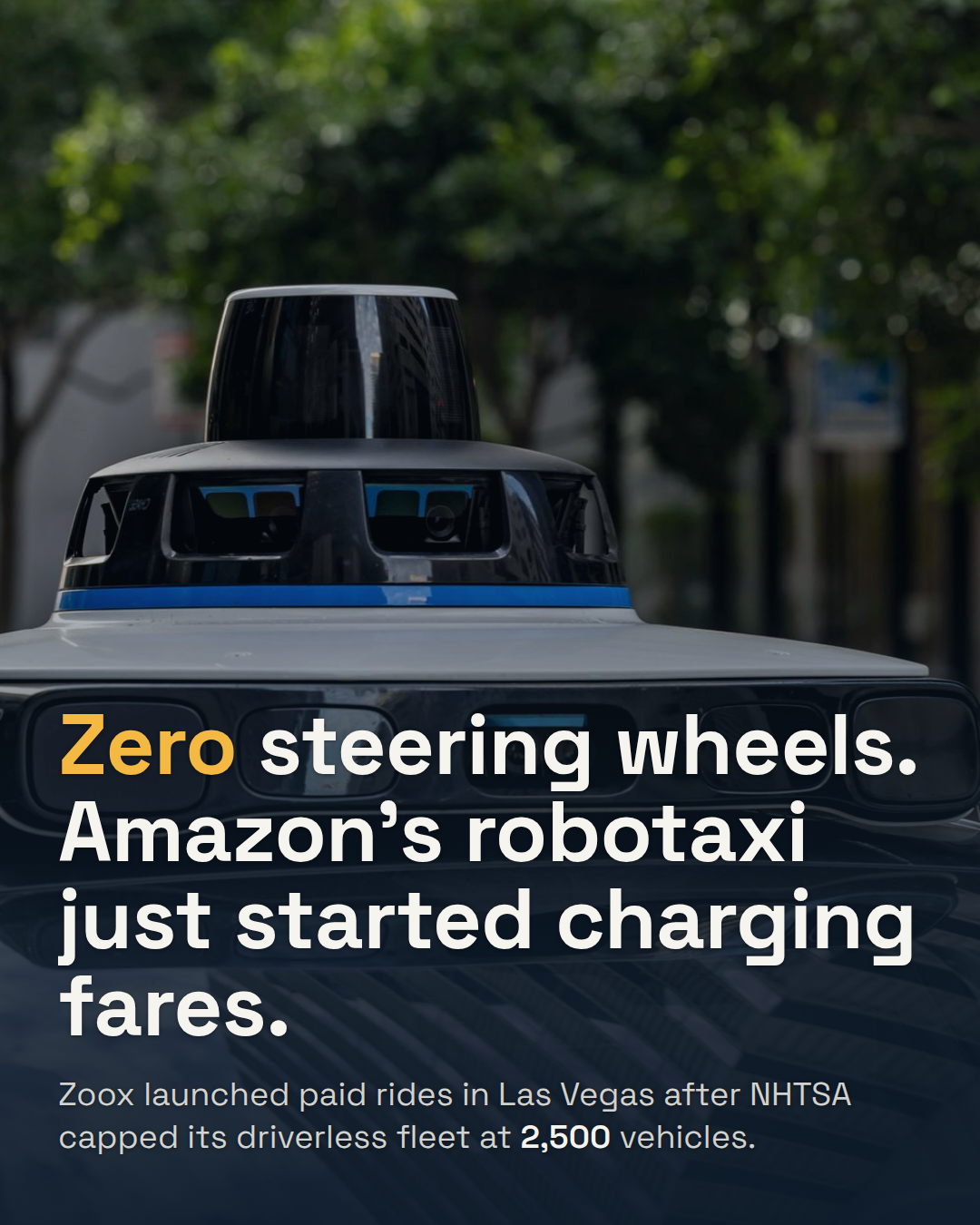
Amazon's Zoox started charging fares today. On August 10, the company began collecting money for rides in a vehicle that has no steering wheel, no pedals, and no driver's seat, after federal regulators handed it the first-ever commercial exemption granted to a purpose-built robotaxi. The exemption caps Zoox at 2,500 vehicles operating nationally for two years, and every ride now comes with real-time reporting obligations the company did not have when the rides were free.
The fare itself is the least interesting number in this story. The interesting part is that Zoox has been driving paying-ready passengers around Las Vegas and San Francisco for free since late 2025, technically capable of doing exactly what it did today for the better part of a year. What changed on August 10 was not the car. It was the paperwork.
The exemption is the product
Zoox's vehicle is a purpose-built pod: two rows of seats facing each other, a top speed of 75 miles per hour, and structurally no human controls to fall back on. That design made it ineligible for a normal vehicle exemption, because federal motor vehicle safety standards still assume a steering wheel exists. In July, the National Highway Traffic Safety Administration granted Zoox a temporary exemption anyway, the first the agency has ever issued to a robotaxi built this way, and it comes with strings: Zoox must report crashes, software lockups, and any incident where a vehicle inappropriately blocks traffic, and NHTSA can pull the exemption if a systemic safety pattern shows up in that data.
That is the actual unlock. Zoox had working technology for years. What it did not have was a federal framework willing to let a car with no steering wheel take money from a stranger. Founders building anything that touches physical safety, human transport, or medical outcomes should read that gap correctly: the hardest part of the roadmap was never going to be the engineering.
Las Vegas just became a two-robotaxi city
Las Vegas is now the first US market where riders can choose between two fully driverless, fully paid robotaxi services on the same streets: Zoox and Waymo. Waymo is the incumbent by a wide margin, running roughly half a million paid rides a week across multiple cities as of early 2026 and publicly targeting a million a week by year-end. Zoox is starting from zero commercial rides in a market where a well-funded, higher-scale competitor already has brand recognition and route data.
Zoox is pricing to match, not undercut: fares are calculated on a base charge plus distance and time, in the same range as the "comfort" tier of a normal ride-hailing app, with destination fees layered on for trips like airport runs. San Francisco stays free-rides-only for now. Zoox still needs separate approval from the California DMV and the California Public Utilities Commission before it can charge a fare there, which means the country's most robotaxi-saturated state is, for the moment, the one place Zoox still can't get paid.
What six years of patience bought
Amazon bought Zoox in 2020 for a reported $1.2 billion, a steep discount to the roughly $3.2 billion the startup had commanded in its last private round before running low on cash. Six years passed between that acquisition and the first dollar Zoox has ever collected from a rider. A standalone startup burning venture money on that timeline would have run out of runway waiting for NHTSA to write a new category of rule into existence. Amazon could absorb six years of zero robotaxi revenue because the balance sheet funding it was never Zoox's own.
That is the part worth modeling if you are building anything gated by a regulator that has never approved your category before: the timeline is not set by your product roadmap, and your cap table needs to survive it anyway.
The founder lesson: build the compliance case as hard as the product
The reporting conditions attached to Zoox's exemption, instant crash and lockup disclosure, a live data feed regulators can use to revoke access, are a template worth studying regardless of industry. Agencies increasingly appear willing to approve a narrow, heavily monitored exemption faster than a broad, unconditional one. If you are building in a frontier-regulated category, whether that is autonomous systems, health data, or embedded finance, the pitch to your regulator is a product in its own right, and it should be built with the same rigor as the pitch to your investors. The startup strategy course covers how to sequence a regulated go-to-market so the approval, not the demo, becomes your unlock. And because a reg-gated revenue ramp behaves nothing like a normal SaaS curve, model it explicitly rather than assuming a straight line; financial modeling walks through building scenarios around exactly this kind of delayed, conditional monetization, the same discipline behind getting your unit economics right before you scale.
If you remember one thing
Zoox didn't spend six years building a better car. It spent six years waiting for a regulator to invent a category that would let its car get paid, and Amazon's balance sheet was the only thing patient enough to survive that wait.
We teach this playbook in FiscEdge's startup strategy course and financial modeling track. Browse the full blog for more news breakdowns. Follow @fiscedge for daily Business & AI analysis.
Topics & Categorization:
How interesting did you find this article?