China Just Started Mass-Producing Its Own Chipmaking Machines. ASML Fell 4.6% in a Morning.
A Shanghai firm tied to Huawei began limited production of homegrown DUV lithography tools, and ASML stock dropped 4.6% on the report. Export controls may be backfiring.

Fiscedge Academy
Contributing Faculty & Practitioner
News Breakdown · FiscEdge Academy
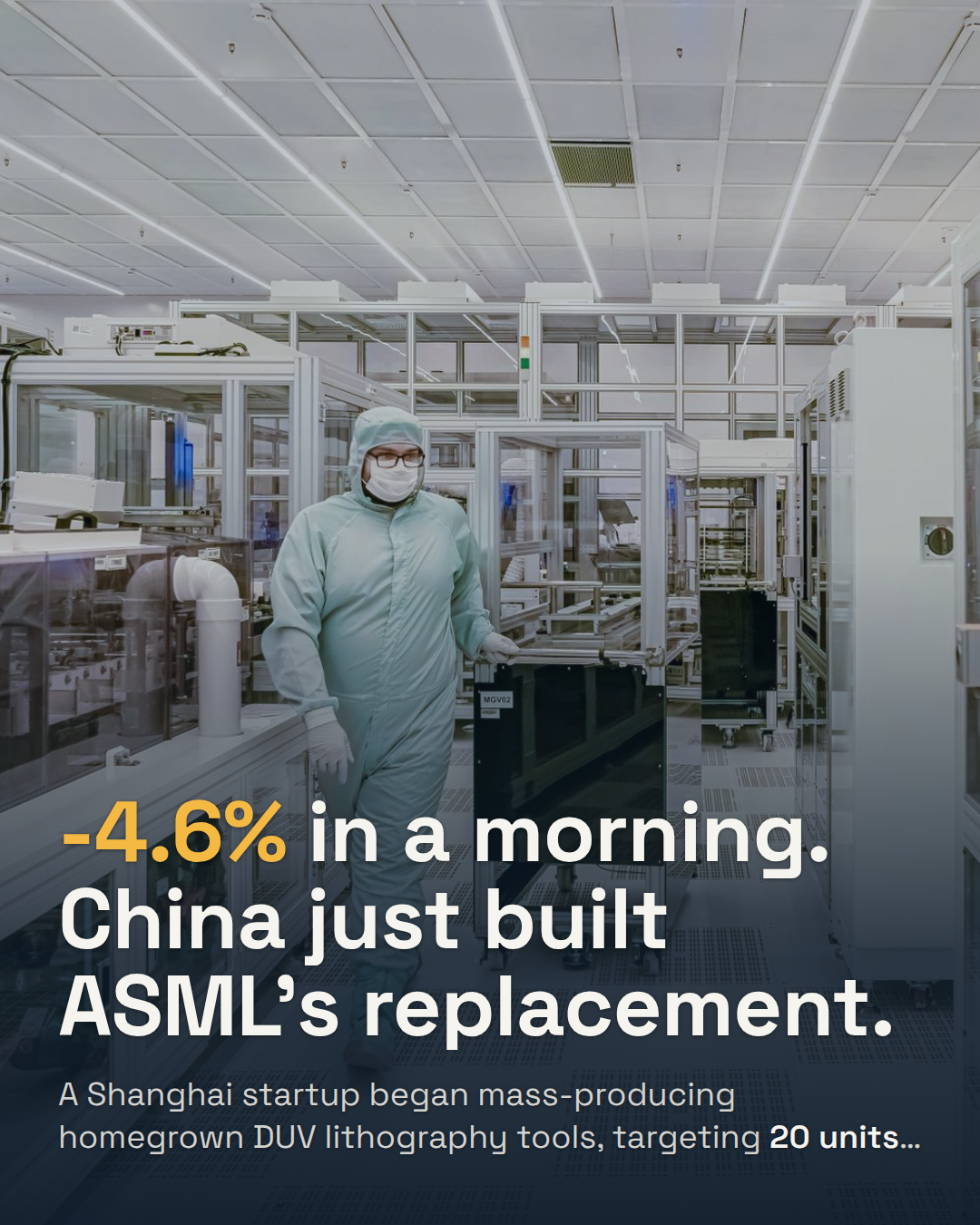
ASML shares fell as much as 4.6% in trading on July 27, sliding toward $1,677.71, their lowest level since early June, after The Information reported that a Shanghai-based chipmaking equipment startup has begun limited mass production of a domestically developed immersion deep ultraviolet (DUV) lithography machine. Follow-on reporting named the company as Shanghai Yuliangsheng Technology, a firm with ties to Huawei and to Huawei-linked equipment maker SiCarrier.
The plan, per multiple outlets citing the same report: roughly five machines built this year, scaling to about 20 in 2027, with first units earmarked for China's three biggest chipmakers, Semiconductor Manufacturing International Corp (SMIC), Hua Hong Semiconductor, and ChangXin Memory Technologies (CXMT, the DRAM maker that priced Asia's biggest IPO of the year just one day earlier). SMIC has reportedly been testing a Yuliangsheng-built immersion DUV tool since September 2025.
The stock drop is the least interesting part of this story. The real signal is what a working domestic DUV tool does to an assumption every semiconductor-equipment analyst has been pricing in for three years: that China cannot yet build its own advanced lithography machines, and that export controls are therefore a hard ceiling on how fast Chinese chipmakers can scale.
What actually shipped, and what it can't do yet
The Yuliangsheng tool is designed for 28-nanometer-class processes, roughly two chip generations behind ASML's newest immersion systems. Using multi-patterning, a technique that runs a wafer through the same machine multiple times to fake a finer resolution, reports say it could stretch toward 7nm, or even 5nm at reduced yields. That's not competitive with leading-edge AI logic, but it's more than enough for the memory, analog, and mid-tier chips that make up most global semiconductor demand, and that increasingly sit inside AI servers as memory and power-management components.
Why ASML sold off on someone else's factory
ASML doesn't lose a single order today. What moved the stock is exposure math. China accounted for 36% of ASML's net system sales in the fourth quarter of last year; that share had already fallen to 19% by the first quarter of 2026 as export restrictions tightened, and China still represents roughly a fifth of ASML's expected 2026 revenue. A credible domestic substitute, even a technologically inferior one, is the first real threat to that remaining base. Washington and The Hague have kept ASML's most advanced EUV machines out of China since 2023, and a proposed U.S. bill, the MATCH Act, would go further, banning DUV immersion exports outright and barring ASML from servicing machines China already owns. Every one of those restrictions was designed to slow Chinese chipmaking down. Today's report is the market pricing in the possibility that they instead accelerated a substitute.
The signal under the headline
This is the pattern founders should file away, because it shows up far beyond semiconductors: cut off a supplier and you don't just create scarcity, you create an incentive strong enough to fund a competitor into existence. China has poured state capital into lithography for years with little to show for it; a credible, if crude, domestic tool arriving now suggests the restriction itself became the forcing function. If your business depends on a single vendor, region, or regulatory regime for a critical input, the lesson isn't "hope the restriction holds." Restrictions on mature technology have a shelf life, and the moment a workaround clears a "good enough" bar, pricing power shifts fast.
What this changes for founders and operators
- Mid-tier chip supply is about to get less concentrated, not more. If your product depends on DRAM, analog, or power-management chips rather than bleeding-edge AI silicon, a second supply base entering production is a multi-year deflationary input, similar to what CXMT's own IPO signaled for memory this week.
- Export controls are a timing tool, not a moat. Don't build a multi-year strategy assuming a competitor stays blocked from a capability forever. Model what happens when the gap closes faster than the regulation anticipated.
- Geopolitical stock moves reach you even if you hold nothing. A 4.6% single-day move can still hit you through index funds, hardware pricing, or a portfolio company's cap table.
- "Good enough" beats "best" in commoditizing markets. A 28nm tool stretched to 7nm won't win the AI chip race, but it doesn't need to: it only needs to take share in the volume tiers that fund the next generation of R&D.
If you remember one thing
The headline number was ASML's stock falling 4.6% in a morning. The number that actually matters is 36% to 19%, the collapse of China's share of ASML's sales that made a crude, two-generations-behind lithography tool a market-moving story instead of a footnote. When a restriction meant to protect your position starts funding your replacement, the smart move is to price that in before the market forces you to.
We break down how supply-chain concentration and input pricing flow into a business model in FiscEdge's financial modeling course. If you're building on top of AI infrastructure and want to understand where the hardware costs actually come from, our AI for entrepreneurs track covers it. For the fundamentals of reading a move like this one, start with what unit economics really means, and see how it connects to yesterday's CXMT memory IPO breakdown. Browse the full blog for more. Follow @fiscedge for daily Business & AI analysis.
Topics & Categorization:
How interesting did you find this article?