Elon Musk Just Became the World's First Trillionaire. The Real Story Isn't the Trillion.
Elon Musk just became the world's first trillionaire as SpaceX IPO'd. The headline number is the least interesting part — the real lesson is how markets price the future, and why wealth comes from ownership, not salary.

FiscEdge Academy
Contributing Faculty & Practitioner
News Breakdown · FiscEdge Academy
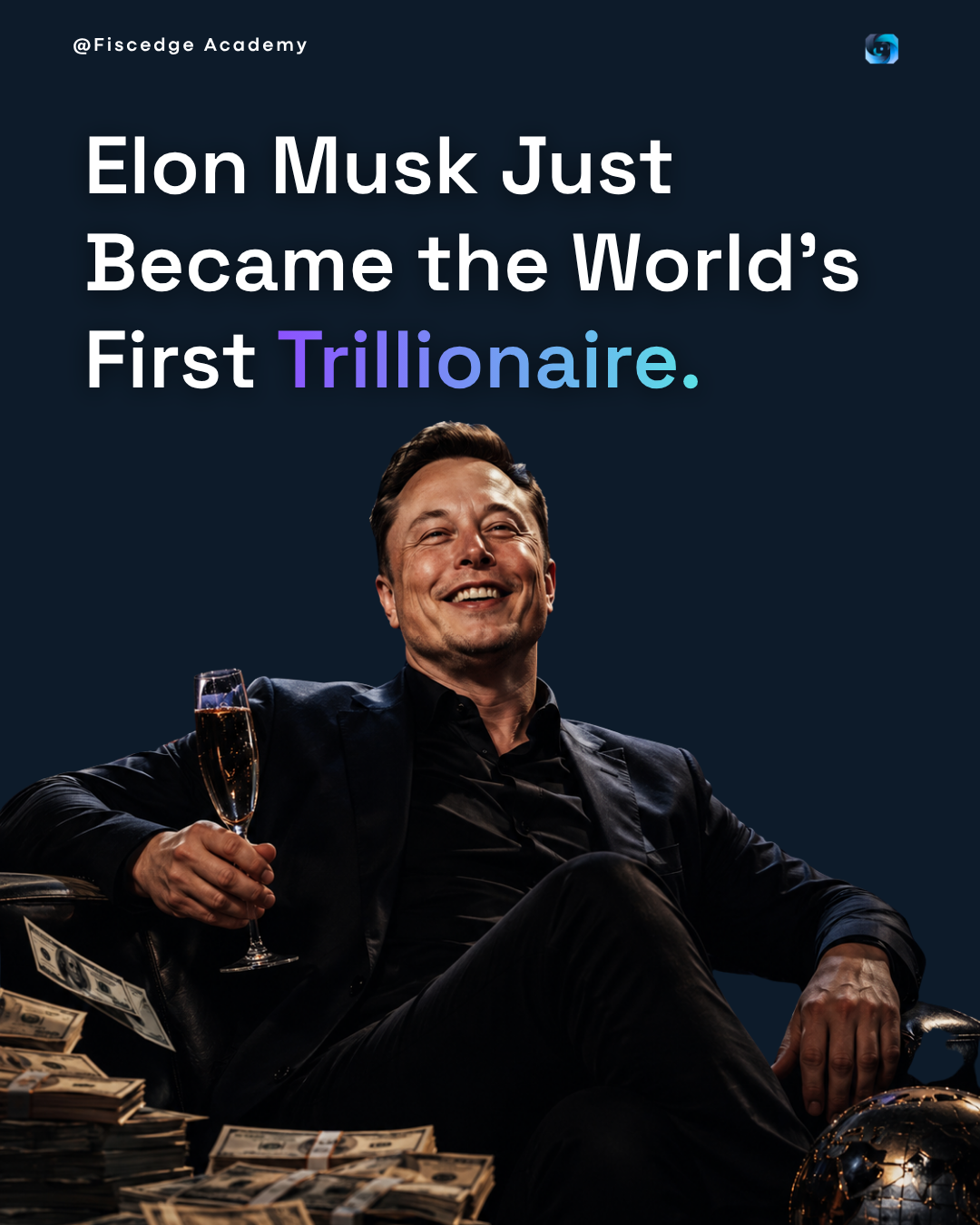
On June 12, 2026, a bell rang on the Nasdaq and Elon Musk became the first person in recorded history worth more than $1 trillion.
SpaceX went public under the ticker SPCX, opening at $150 a share. That single event pushed Musk's stake in the company past $766 billion. Add his Tesla holdings and his paper net worth landed somewhere between $1.05 and $1.26 trillion, depending on who's counting. He is now worth more than the next five richest people on earth — combined. His fortune is larger than the GDP of Taiwan, Ireland, or Sweden.
The number is staggering. It's also the least interesting part of this story.
If you're a founder or an operator, two facts buried under the headline matter far more than the trillion. Let's break them down.
Fact 1: A company that loses money is worth more than one that prints it
Here's the paradox the market just signed off on.
SpaceX IPO'd at roughly a $1.77 trillion valuation, on about $18.7 billion in revenue — and it's still reporting a net loss. Meta, by comparison, is valued around $1.44 trillion on $200+ billion in revenue, wildly profitable.
Read that again. SpaceX earns roughly 10x less than Meta. And the market values it higher.
By every conventional metric, that doesn't compute. The IPO was four times oversubscribed. Retail investors alone placed $100 billion in orders for a company still in the red.
So what were they actually buying?
Not revenue. Not profit. Conviction. A bet on Starlink's global network, on space-based infrastructure, on one person's track record of delivering on goals everyone called impossible. Analysts have a name for the gap between SpaceX's financials and its price tag: the "Elon premium."
The lesson for founders is uncomfortable but important: markets don't price what you earn. They price what they believe you'll become. Revenue is evidence. Narrative, defensibility, and a credible path to a massive future are what actually move valuation. If you've ever wondered why a profitable small business sells for 3x earnings while a money-losing startup raises at 50x, this is the whole answer.
That's not a license to ignore fundamentals — most companies don't get an "Elon premium," and most never will. Your unit economics still decide whether the business underneath the story works. It's a reminder that value lives in the future you can credibly point to, not just the spreadsheet you can show today.
Fact 2: He has almost no cash
Earlier this year, Musk said it plainly: less than 0.1% of his net worth is cash. Almost all of it is equity in companies he controls and co-founded. He earns no meaningful salary from any of them.
This is the part most people miss when they look at a trillionaire and think "salary."
You do not reach this kind of wealth by being paid. You reach it by owning. Salary is linear — you trade hours for dollars, and it caps out. Equity is exponential — you own a slice of something whose value can compound for decades while you sleep.
Every "world's richest person" of the last 30 years — Gates, Bezos, Arnault, now Musk — got there the same way: a concentrated ownership stake in something that grew enormous. None of them got there on a paycheck.
For an operator, the takeaway is direct. The highest-leverage financial decision you make usually isn't your salary negotiation. It's whether you own equity in the value you help create — your own company, equity in the startup you join, or assets that compound outside your job. Comfort comes from income. Wealth comes from ownership.
If you remember one thing
The trillion is the spectacle. The mechanism is the lesson.
Value is a bet on the future, not a receipt for the past — and the people who capture it own equity, they don't earn a wage. Build (or buy) ownership in something with a future worth believing in.
This is the kind of framework we teach across FiscEdge's startup strategy course and financial modeling for founders tracks. For another breakdown of where smart money is moving, read why Jeff Bezos raised $12B for a company with no product — or browse the full blog. Follow @fiscedge for daily Business & AI breakdowns.
Topics & Categorization:
How interesting did you find this article?